Looking for a tool that can help you assess potential autism spectrum disorder in children? Read our guide to learn more about the signs of child ASD to look out for, then use the Modified Checklist for Autism in Toddlers (M-CHAT) to make an assessment based on what the child's parents have been observing for a while.
## **The signs of ASD in children**
If you're handling a kid whose parents are suspecting them to have autism spectrum disorder, you can educate them about the common signs of ASD that they should keep an eye out for. These include the following (NHS, 2022):
- The child doesn't respond to their name when called
- The child avoids eye contact
- The child wiggles their fingers/makes unusual finger movements near their eyes
- The child doesn't smile back when you smile at them
- The child doesn't talk as much as other kids their age
- The child doesn't pretend play
- The child becomes upset (sometimes agitated) when exposed to certain smells, certain everyday noises/sounds, and tastes
These are just some of the many signs to look out for. If you are handling such kids, it would be best to have tools for assessing/observing ASD signs and symptoms. One such example is the Modified Checklist for Autism in Toddlers, or the M-CHAT for short.
## **What is the Modified Checklist for Autism in Toddlers (M-CHAT)?**
The M-CHAT is a nifty autism spectrum disorder (ASD) screening tool developed by Diana L. Robins, Deborah Fein, and Marianne Barton in 1999. It is meant to assess children between sixteen to thirty months of age to check if they have signs of ASD. Healthcare professionals such as family doctors, nurses, and pediatricians, especially those who focus on developmental and behavioral problems in kids, are the ones that usually include this in their roster of examination tools.
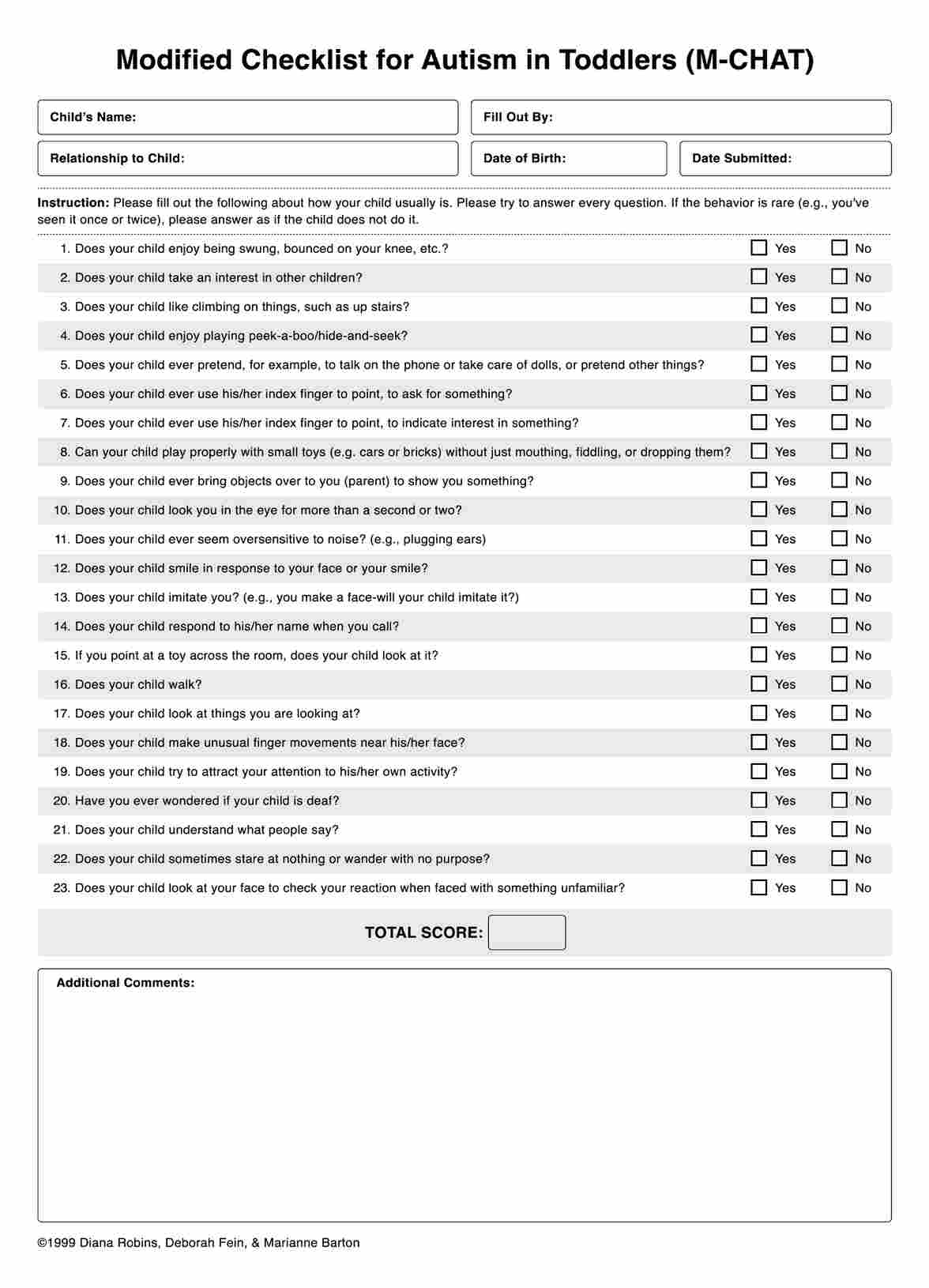
The checklist comes in the form of a questionnaire with twenty-three items revolving around a child's development and behavior. The questions mostly revolve around actions they might or might not be doing, like the following:
- Does the child point at things with his or her index finger?
- Does your child ever pretend, for example, to talk on the phone or take care of dolls, or pretend other things?
- Is the child interested in other children?
- Does the child watch or look at things you're watching/looking at?
- Is the child able to make and maintain contact with his or her eyes?
- Does the child play pretend?
- Does the child scream or plug their ears when they hear certain noises?
- Does the child walk or climb on things like playground equipment and furniture?
- Does your child pretend or make-believe (e.g., drink from an empty cup, pretend to feed a stuffed animal)?
- Does the child make unusual movements using his or her fingers?
- Does the child respond when you call out his or her name or when they hear a strange or funny noise?
- Does your child understand when you tell him or her to do something?
This questionnaire is meant to be answered by a toddler's parent(s) or guardian(s). The questions that they need to answer are simple Yes or No questions. Here are some of the questions they will see on the checklist:
- Does your child enjoy being swung, bounced on your knee, etc.?
- Does your child take an interest in other children?
- Does your child like climbing on things, such as upstairs?
- Does your child enjoy playing peek-a-boo/hide-and-seek?
- Does your child ever pretend, for example, to talk on the phone or take care of dolls, or pretend other things?
- Does your child ever use his/her index finger to point, to ask for something?
- Does your child ever use his/her index finger to point, to indicate interest in something?
- Can your child play properly with small toys (e.g. cars or bricks) without just mouthing, fiddling, or dropping them?
- Does your child ever bring objects over to you (parent) to show you something?
- Does your child look you in the eye for more than a second or two?
Depending on the question, a Yes or No could mean either Pass or Fail. For every answer equivalent to a Fail, the toddler will score a point. The total score will influence what should be done next for the toddler.
### **Things to note regarding this tool**
Please note that, while this is a popular tool to use, it would be good to note that it has limitations. Research has shown that it's possible for this tool to have false positives and even false negatives. Through testing, researchers have determined that the tool had a sensitivity rate of 52%, a specificity of 84%, a positive predictive value (PPV) of 20%, and a negative predictive value (NPV) of 96% (Kim et al., 2016).
Kim et al. discovered that both false positives and negatives were high for children confirmed to have hearing and vision impairments. Children aged 2 with lower socioeconomic status, those who have motor and cognitive impairments, and those with emotional/behavioral dysregulation had high false positive rates.
Given the complexity of autism spectrum disorder, it would be best for a child's healthcare provider/child's pediatrician to avoid relying on this tool as the only tool used to identify children with ASD. They're going to need further evaluation, so make sure to conduct other tests and use other tools to check if they have vision and hearing impairements, motor and cognitive issues, etc. Once you've ruled out other factors that may influence results, you can start focusing on using tools that just zoom into autism spectrum disorder signs and symptoms.
## **How to use the Modified Checklist for Autism in Toddlers (M-CHAT)**
The following are steps to take to make the most of this tool in your practice:
### **Step 1: Have a toddler's parent(s) or guardian(s) answer the questionnaire**
On the day of your appointment with the toddler's parent(s) or guardian(s), you should issue this to them at a certain point. Whether you want them to answer on the spot or have them take it home is up to you. If the parent or guardian is fully aware of what the toddler does and what they are like, then they be able to answer the questionnaire on the spot.
If you want to be more sure about things, have them take it home so they can observe their toddler and answer the questions accordingly. This might be the better choice since you will give them the time to properly observe the child. If you are opting to have them take the checklist home, make sure to agree as to when they should submit a fully completed checklist to you.
### **Step 2: Tally the scores and determine the next course of action**
Once you receive a fully completed parent-completed questionnaire/checklist, you need to tally the scores. Despite being a Yes or No questionnaire, the point designations are not set. While the majority of the Yes answers are equal to a Pass (which is worth 0 points), there are some Yes answers that are equal to a Fail (which is worth 1 point). To help you out so you don't have to guess, you just need to know these:
- For Questions 11, 18, 20, and 22, a Yes is equivalent to Fail, a No is equivalent to Pass
- For the rest of the questions, a Yes is equivalent to Pass, a No is equivalent to Fail
Once you have calculated the child's scores, check these score ranges and designations to help inform your decisions as to what should be the next step:
- **0 to 2 points** = Low risk. No follow-up interview is necessary because the child screened negative. The child can be rescreened after 3 months or after 24 months (if the child is younger than 2 years by then) if the parent or guardian wishes.
- **3 to 6 points** = Moderate risk. You need to schedule a follow-up interview with the parents to gather more information about the child. Their answers should help you determine if the toddler needs to go through a diagnostic evaluation as well as early intervention services.
- **7 points or mor**e = High risk. Skip the follow-up interview and have them referred for a diagnostic evaluation and early intervention services.
## **What is the M-CHAT R?**
In 2009, the authors of the M-CHAT created a new version of the tool to more accurately assess a child's behavior and development for signs of ASD, as they believed the original to have the risk of leading to false positives. This version of the M-CHAT is called the Modified Checklist for Autism in Toddlers (Revised) and it has a lower risk of false positives and can detect more ASD cases than the original.
It is more or less similar to the original M-CHAT, but this time, there are only 20 questions. The way they're answered is still the same: Yes or No. The only major difference is how the tools suggest risk via the scoring.
### **M-CHAT R scoring**
Here are the score ranges for the M-CHAT R:
- **Low risk**: 0-2. If the child is younger than 24 months, it's recommended to have them screened again a little after their second birthday. Besides that, no further action is required unless observations show signs or risk of ASD.
- **Medium risk**: 3-7. You must administer the M-CHAT R/F, which is the follow up interview for this. You can obtain a copy from the M-CHAT official website. If the M-CHAT R/F total score is 0-1, no further action is required but should be rescreened if parents or guardians still observe signs. If the score is 2 or higher, they are positive and should be referred for a diagnostic evaluation.
- **High risk**: 8+. The use of the M-CHAT R/F can be bypassed and have the child referred for a diagnostic evaluation.
### **Common ASD interventions for toddlers**
Once you've conducted a comprehensive examination of a child and have made an official ASD diagnosis, here are some common interventions you can provide for them:
- **Play therapy**: Through this form of therapy, you can encourage toddlers to engage in play with their parents and other children their age. Play therapy will allow them to learn how to interact with others through participation and collaboration, which can help them learn how to establish relationships down the line and express themselves better (Autism Therapy for Toddlers: What You Need to Know?, 2025).
- **Applied behavioral analysis (ABA)**: This method of intervention assesses the child's environment and determines what their behaviors are, how they work, and how they are shaped. This intervention's goal is to reduce behaviors that negatively impact the child's learning capabilities and ones that are just detrimental to their overall well-being, and to boost/promote positive behaviors that ultimately benefit the child, especially as they get older (Autism Speaks, 2021).
- **Speech therapy**: Through this form of therapy, a child with ASD learn how to effectively communicate with others, especially while maintaining eye contact. Beyond maintaining eye contact, they will learn how to continue maintaining communication, understand body language, facial expressions, and possibly sign languages and gestures (Autism Speaks, 2019).
## **References**
Autism Speaks. (2021). Applied Behavior Analysis (ABA). Autism Speaks. https://www.autismspeaks.org/applied-behavior-analysis
Autism Speaks. (2019). Speech Therapy | Autism Speaks. Autism Speaks. https://www.autismspeaks.org/speech-therapy
Autism Therapy for Toddlers: What You Need to Know? (2025). Magnetaba.com. https://www.magnetaba.com/blog/autism-therapy-for-toddlers-explained
Kim, S. H., Joseph, R. M., Frazier, J. A., O’Shea, T. M., Chawarska, K., Allred, E. N., Leviton, A., & Kuban, K. K. (2016). Predictive Validity of the Modified Checklist for Autism in Toddlers (M-CHAT) Born Very Preterm. The Journal of Pediatrics, 178, 101-107.e2. https://doi.org/10.1016/j.jpeds.2016.07.052
NHS. (2022, November 11). Signs of autism in children. NHS; NHS. https://www.nhs.uk/conditions/autism/signs/children/