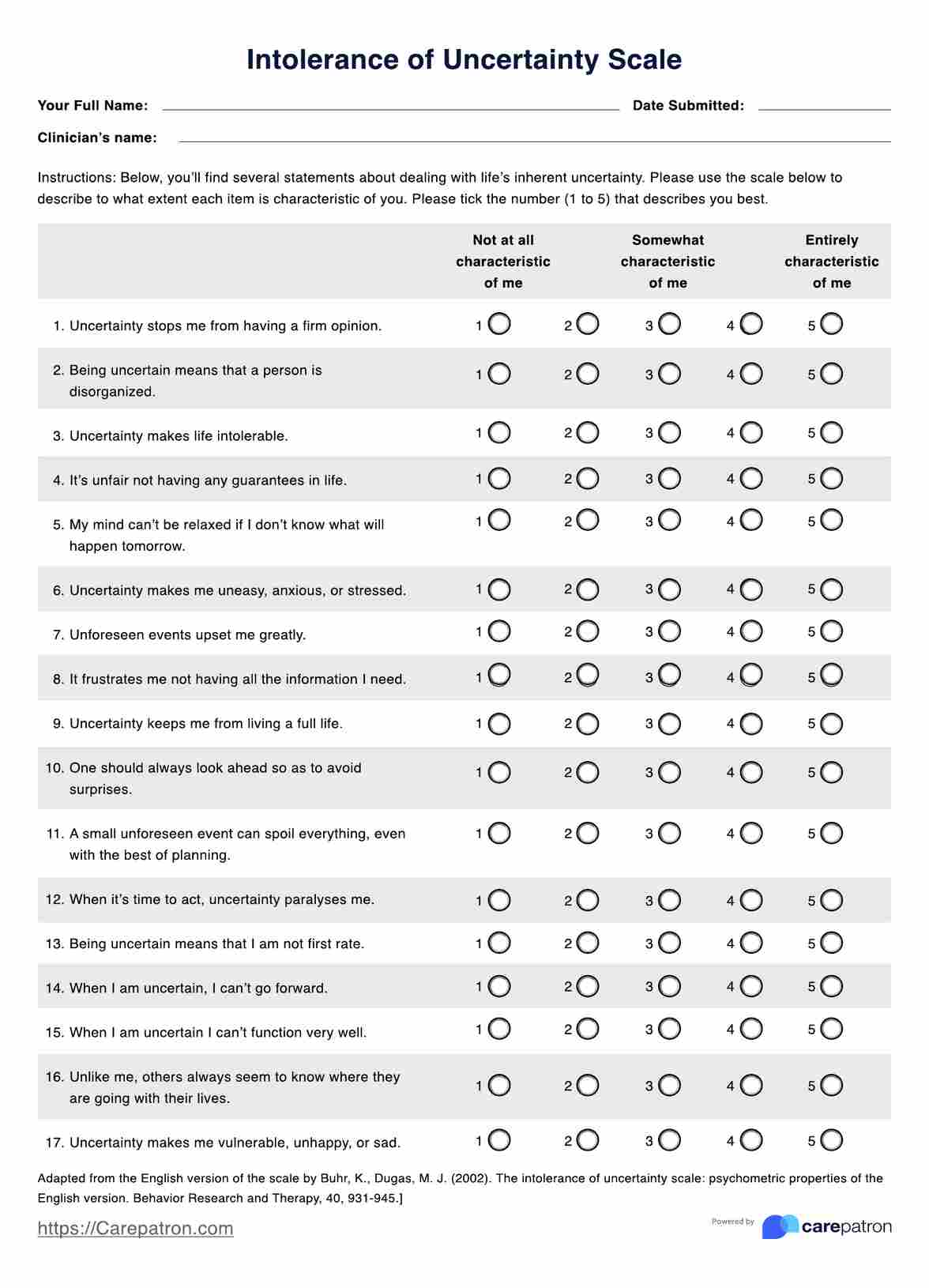
How to use the Intolerance of Uncertainty Scale:
The Intolerance of Uncertainty Scale is an invaluable tool issued to patients with an intolerance for uncertainty or anxiety. It can help gauge the symptoms related to their intolerance.
It can be used in two ways. It's up to you to decide how you want to go about it:
- You can use the scale and instruct your patients to answer when you read out each item. The answers are preset for the scale, so they must select from the options. This will be like an interview-style format.
- This will make accomplishing the Intolerance of Uncertainty Scale take longer, but the upside is that you can have them expound on their answers. You might gain valuable information to help you assess and treat your patient better.
- You can hand your patient the Intolerance of Uncertainty Scale and have them answer it independently. If they're taking the sheet home, agreeing on when you should receive a fully-accomplished copy is best.
Either way, your patient will do the same thing. Here are some of the items that they have to answer:
- Uncertainty stops me from having a firm opinion.
- My mind can't relax if I don't know what will happen tomorrow.
- Uncertainty makes me uneasy, anxious, or stressed.
- One should always look ahead to avoid surprises.
- When I am uncertain, I can't function very well.
- The smallest doubt can stop me from acting.
- The ambiguities in life stress me.
To answer these, they simply need to pick from the following answers:
- Not at all characteristic (1 point)
- A little characteristic (2 points)
- Somewhat characteristic (3 points)
- Very characteristic (4 points)
- Entirely characteristic (5 points)
There are twenty-seven items in total. Now, the scoring for this scale is based on two factors:
- Factor 1: Uncertainty has negative behavioral and self-referent implications
- Factor 2: Uncertainty is unfair and spoils everything
Factor 1 covers the following items: 1, 2, 3, 9, 12, 13, 14, 15, 16, 17, 20, 22, 23, 24, and 25.
Factor 2 covers the following items: 4, 5, 6, 7, 8, 10, 11, 18, 19, 21, 26, and 27.
There are no score ranges for this scale, but the higher the score for each factor, the higher the severity level of intolerance of uncertainty as well (for each factor).
What are the next steps after using the Intolerance of Uncertainty Scale?
Generally, Cognitive Behavioural Therapy treats problematic levels of intolerance of uncertainty. However, this will still depend on the patient's score and the severity of their symptoms.
Therapists can help provide clinical interventions and teach them skills and techniques to lessen the impact of anxiety symptoms, depression symptoms, and other mental disorders that contribute to the patient's intolerance of uncertainty. They can help them reconfigure the way they think so they don't consider change as a negative event and, instead, come up with a healthier way of thinking about change so they can navigate it.
Do note that the Intolerance of Uncertainty Scale shouldn't be used to diagnose a patient with anxiety disorders or other psychiatric disorders. It would be best to conduct a comprehensive examination of a patient to determine what specific mental health problems are. It's best to treat the Intolerance of Uncertainty Scale as an assessment that assesses an aspect of anxiety disorders.