





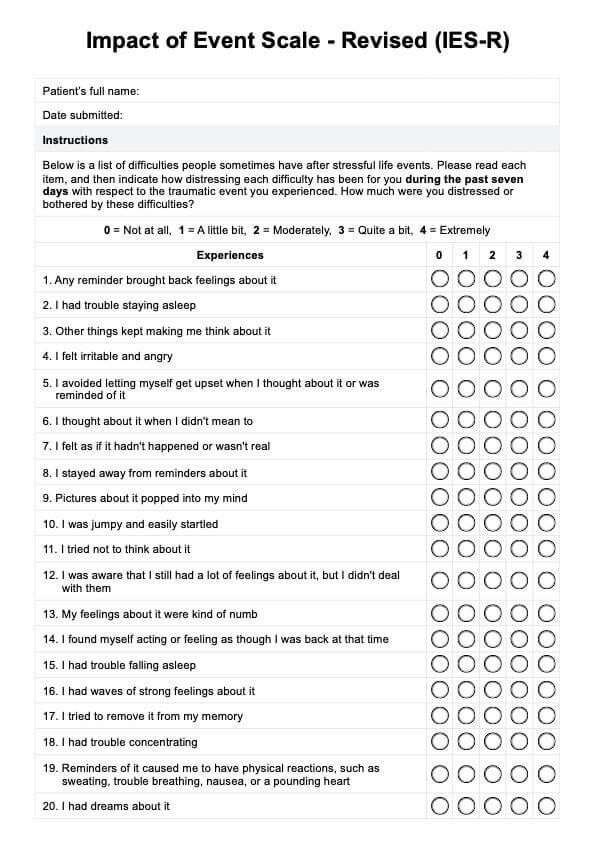




What is the Impact of Event Scale - Revised (IES-R)?
The Impact of Event Scale - Revised is a mental health assessment tool D.S. Weiss and C.R. Marmar created to revise the original Impact of Events Scale created by M. Horowitz, N. Wilner, and W. Alvarez. Weiss and Marmar added five questions to the original, boosting the total number of questions for assessing psychological trauma and posttraumatic stress disorder to 22.
It's a highly reliable assessment and has been widely regarded and validated in various journals, including the Journal of Nervous and Mental Disease, the American Journal of Psychiatry, and the Journal of Traumatic Stress.
How is it structured and answered?
The IES-R comes in the form of an itemized self-report questionnaire. Each item has statements related to traumatic events (no specific traumatic event is indicated), the psychological distress they've sustained, effects and intrusive feelings related to the trauma (e.g., difficulty concentrating), and stress response. Here are some examples of these statements:
- Other things kept making me think about it
- I had trouble concentrating
- I had dreams about it
- My feelings about it were kind of numb
- I was jumpy and easily startled
- I found myself acting or feeling as though I was back at that time
Respondents need to rate themselves using the following system:
- 0 = Not at all
- 1 = A little bit
- 2 = Moderately
- 3 = Quite a bit
- 4 = Extremely
They must answer each item based on the last seven days before being given a copy of the IES-R, and concerning whatever traumatic events they've experienced.
How is the IES-R scored?
The IES-R has hyperarousal, intrusion, and avoidance subscales.
Here are the items for each subscale:
- Intrusion subscale: Items 1, 2, 3, 6, 9, 14, 16, 20
- Avoidance subscale: Items 5, 7, 8, 11, 12, 13, 17, 22
- Hyperarousal subscale: Items 4, 10, 15, 18, 19, 21
To calculate each subscale's mean score, add the points based on each answer and divide it by the number of items per subscale.
For example, say we want to get the mean score for the intrusion subscale. The respondent answered 4 for each item, making the total score 32 for the subscale. Next, we divide 32 by eight since the subscale has eight items. The intrusive subscale mean score is 4.
To calculate the mean score of the entire assessment, add up the total score and divide it by 22.
How are the results interpreted?
To interpret the mean scores for the subscales and the entire measure, refer to the following:
- 0 = No symptoms
- 1 = Few symptoms
- 2 = Moderate symptoms
- 3 = A high level of symptoms
- 4 = An extremely high level of symptoms
The next step after conducting this assessment
After receiving accomplished copies of the IES-R, it's recommended that mental health professionals conduct other assessments related to post-traumatic stress disorder and then cross-check all the findings with the posttraumatic stress disorder (PTSD) criteria set by the latest edition of the Diagnostic and Statistical Manual of Mental Disorders.









