


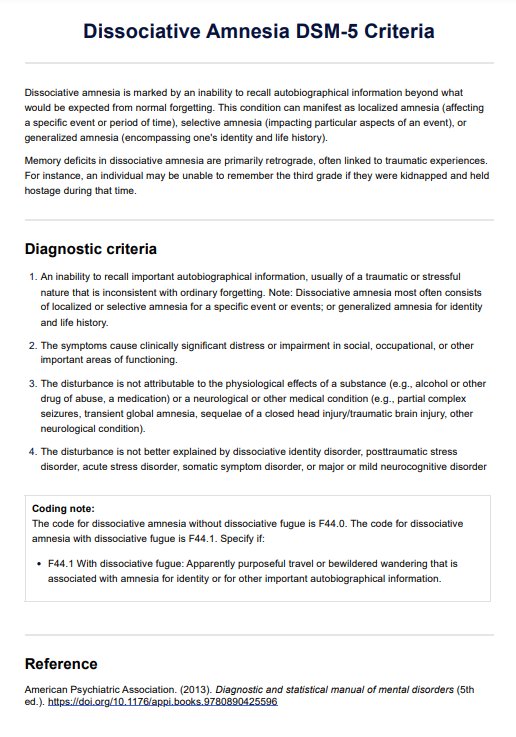




What is dissociative amnesia?
Dissociative amnesia is marked by the inability to recall autobiographical information, which goes beyond ordinary forgetfulness. This condition can manifest in various forms: localized amnesia (inability to remember a specific event or period), selective amnesia (inability to recall a particular aspect of an event), or generalized amnesia (loss of identity and life history).
According to Speigel (2022), this condition may also present as continuous amnesia, where patients forget each new event as it happens, or as systematized amnesia, where patients forget information within a specific category.
Another type of dissociative amnesia is dissociative fugue. The Diagnostic and Statistical Manual of Mental Disorders, 5th Edition (DSM-5) describes this as sudden, unexpected travel or wandering away from one's usual environment, along with an inability to remember one's past (American Psychiatric Association, 2013).
While some individuals with amnesia quickly recognize gaps or a sense of fragmentation in their long-term memory, most people with dissociative disorders are initially unaware of their memory loss. They may minimize or rationalize these deficits.
Awareness often emerges when they realize they cannot recall their personal identity or when situations highlight missing autobiographical information. This might occur, for instance, when they encounter evidence or are informed of past events they cannot remember. Generalized dissociative amnesia, involving the loss of a significant portion or all of one's life history and identity, is rare (American Psychiatric Association, 2013).









