Body Language TestAI Template IconToolbar IconShare Icon

Body Language Test

Take our Body Language Test to improve your understanding of non-verbal cues, enhance communication skills, and interpret emotions accurately.

Emma Hainsworth avatar

By Emma Hainsworth on Aug 2, 2025.

Fact Checked by Ericka Pingol.

Use Template

What is body language?

Body language refers to the non-verbal communication that occurs through the physical behaviors and movements of the body (Ponzio, 2006). It encompasses a wide range of expressions, such as facial expressions, gestures, posture, eye movements, and the use of space, distance, and touch. These physical cues can convey a person's feelings, attitudes, and intentions, often more powerfully than words alone. Understanding these nonverbal cues is crucial to accurately decoding body language.

While some body language is instinctual and universal, such as smiling or frowning, others can be culturally specific and learned. For example, the meaning of certain hand gestures—such as showing the middle finger—can vary significantly from one culture to another.

Why is interpreting body language important?

Body language is crucial in social interactions, as it can enhance or sometimes contradict what is said verbally. It is a critical component of effective communication, as it can indicate agreement, interest, or a person's emotional state, such as confidence, nervousness, or aggression. It also plays a significant role in relationship dynamics, professional interactions, negotiations, and everyday exchanges. For instance, breaking eye contact may suggest anxiety or discomfort, while maintaining gaze might convey interest or enthusiasm.

Understanding body language can lead to more effective communication, allowing individuals to read unspoken cues and respond appropriately. It can be beneficial when someone tries to control or hide their verbal expression, as their body language may reveal more about their true thoughts and feelings, such as sadness, anger, or fear.

How does our Body Language Test work?

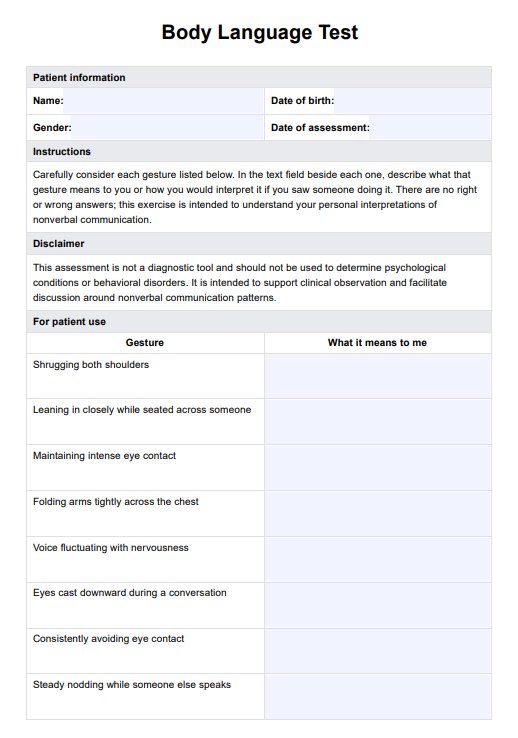
The Body Language Test from Carepatron offers healthcare professionals a streamlined and intuitive format for evaluating nonverbal communication. Our test is not a diagnostic tool, but rather a supplementary resource that encourages patient self-reflection and supports clinical observation and decision-making. By inviting patients to share their personal interpretations of common gestures, the test fosters greater awareness of individual and cultural differences in body language. It can be especially useful in therapeutic, psychiatric, or behavioral health settings, where understanding nonverbal cues is essential for effective care planning.

Step 1: Access the template

Click the “Use template” button on this page to open the Body Language Test within the Carepatron platform. If you haven’t installed the app yet, you’ll be prompted to do so. Once opened, the template allows you to document and manage assessments in a secure, centralized workspace.

Step 2: Use the template in assessment sessions

The form provides a standardized format to capture key nonverbal cues, such as eye contact, gestures, voice tone, and body posture. This consistency helps ensure that no critical observations are missed, whether during a therapy session, an interview, or a clinical evaluation.

Step 3: Conduct the test during interactions

Use the template to record observations in real time or after a session. The tool is flexible and supports various settings, allowing you to note behaviors like nervous fidgeting, prolonged eye contact, or shifts in body language that may reflect underlying emotions.

Step 4: Review and interpret the results

Review completed entries to identify nonverbal behavior patterns or contradictions between what the patient says and how they act. This can be especially helpful in detecting emotions such as anxiety, frustration, or sadness that aren’t explicitly stated. Previous assessments can also be compared to track progress or shifts in behavior over time.

Step 5: Guide care and patient awareness

Use the insights to inform your next steps—whether it’s further evaluation, psychoeducation, or therapeutic intervention. This test can also help patients gain a deeper understanding of their nonverbal habits, improving communication and emotional awareness within and beyond the clinical setting.


The benefits of a Body Language Test

Learning to read body language effectively enhances communication skills and emotional intelligence. This ability to interpret non-verbal cues, such as expansive hand gestures, tone of voice, and even the subtlety of a genuine smile or a microexpression, leads to a more precise understanding and reduced misunderstandings. Recognizing these cues can reveal underlying emotions, answer unspoken questions in various interactions, and enable clinicians to sense a person's mental state better.

In professional settings, reading body language gives a strategic advantage. For instance, observing how someone sits, stands, or rests their arms can provide insight into their comfort level or confidence. This is particularly useful in interviews and negotiations, where understanding the subtle nuances of body language can guide the course of conversation. A shift in leg placement, or breaking eye contact, may signal unease or suggest disagreement—even when the verbal message implies otherwise.

Personal growth is also a key benefit. Developing an awareness of one's body language, such as the use of expansive hand gestures or the authenticity of a smile, boosts self-confidence and aids in self-expression. It also enhances one's ability to perceive and align non-verbal cues with speech to influence others effectively. Whether it's in daily conversation or high-stakes communication, being able to identify and control your own nonverbal signals helps you communicate more clearly and convincingly.

However, interpreting body language requires intuition and a cautious approach. Considering the context is essential, as body language can be misinterpreted if viewed in isolation. The tone of voice, facial expressions, and body postures should be read with the overall situation and cultural norms to provide accurate answers and create meaningful understanding. For example, noticing a person’s head tilt, arm crossing, or the position of their mouth in response to a topic can all suggest whether they're feeling happy, angry, anxious, or disinterested.

Reference

Ponzio, A. (2006). Body language. In Elsevier eBooks (pp. 78–85). https://doi.org/10.1016/b0-08-044854-2/01397-3

Commonly asked questions

A facial expression test can reveal nuanced emotions by analyzing micro-expressions and other subtle facial movements. For example, genuine smiles involve the mouth and eyes, often characterized by crow's feet or raised eyebrows. Such tests can help identify emotions like happiness, sadness, anger, fear, surprise, contempt, and disgust, which are critical for understanding non-verbal communication.

Leaders use expansive body movements and hand gestures to emphasize points and engage with their audience. These gestures can convey confidence and help articulate complex ideas. By incorporating such movements into your speech, you can enhance the clarity of your message and make a more impactful connection with your listeners.

Micro-expressions are brief, involuntary facial expressions that reveal genuine emotions, often before a person can hide them. They are crucial in reading body language because they can provide insights into someone's genuine feelings, which might be concealed by controlled facial expressions or speech. These fleeting signs can indicate emotions like anger, fear, sadness, happiness, surprise, contempt, and disgust.

EHR and practice management software

Get started for free

*No credit card required

Free

$0/usd

Unlimited clients

Telehealth

1GB of storage

Client portal text

Automated billing and online payments