Everyone has a story to tell, and here we share and celebrate those who chose care as their life's work.
These are their words, their work and we're grateful to share them.
Elizabeth and Dennis handed their billing to Carepatron and grew My Therapeutic Concepts from five clients to seventy in two months, without losing their evenings.
Looking to add more tools to assess patients for autism spectrum disorder? Read our guide to learn more about the common signs of childhood ASD and use the Childhood Autism Spectrum Test to examine your patients to help gather enough information to make an official diagnosis.
## **What is autism spectrum disorder (ASD)?**
Autism spectrum disorder (ASD) is a complex developmental condition that profoundly impacts communication and interaction (American Psychiatric Association, n.d.). Individuals with ASD struggle to understand social cues, establish connections, and engage in typical activities. Repetitive behaviors, odd or unusual phrases, and intense interests are common traits that reflect the disorder's spectrum of symptoms and severity.
Interventions tailored to individual needs are pivotal in managing ASD. Applied behavior analysis (ABA) focuses on behavior modification, cultivating skills, and reducing issues (Du et. al., 2024). Speech therapy enhances communication proficiency, while occupational therapy refines motor skills and daily tasks. Social skills training also equips individuals for more effective interactions.
ASD persists throughout a person's life, but early intervention can significantly foster progress. Its prevalence is estimated at 1 in 6 (17%) children aged 3–17 years who were diagnosed with a developmental disability, as reported by parents, during a study period of 2009–2017 (Centers for Disease Control and Prevention, 2025). The disorder is believed to result from a combination of genetic and environmental factors. While ASD cannot be cured, various interventions enable individuals to lead fulfilling lives.
Early diagnosis and intervention are crucial for better outcomes. By embracing tailored strategies and fostering a supportive environment, individuals with ASD can navigate life's challenges and contribute positively to society.
## **What is the Childhood Autism Spectrum Test?**
One of the autism screening tools you can use to identify children who potentially have ASD is the Childhood Autism Spectrum Test (CAST), which is formerly known as the Childhood Asperger Syndrome Test. It's a valuable tool to have when you're conducting comprehensive examinations to make autism diagnoses.
### **What to expect from this test**
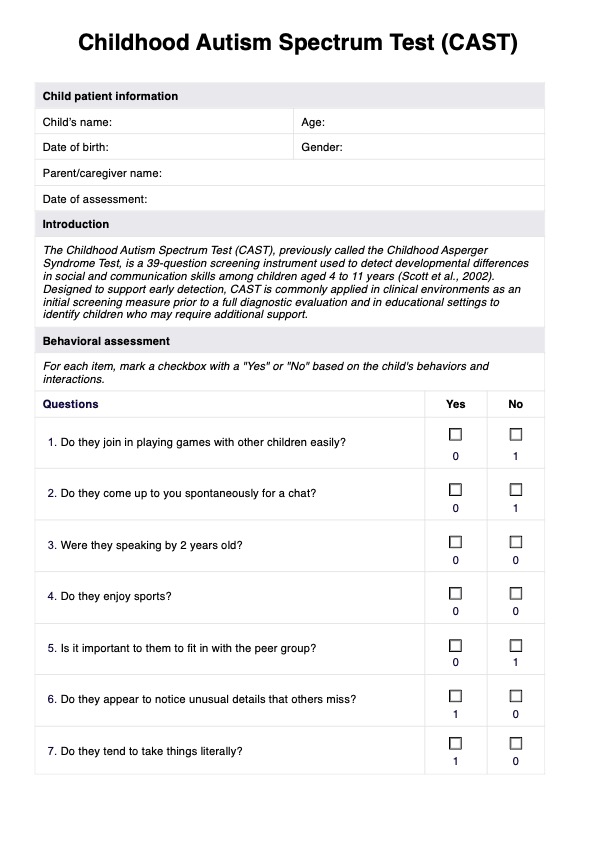
The test is designed for early screening. It has 39 items, 37 of which are scored. Healthcare professionals or observers assessing a child only need to tick Yes or No based on what they notice/know about the child suspected of having ASD. These items cover autistic traits. Here are examples of such items:
- Do they join in playing games with other children easily?
- Do they appear to notice unusual details that others miss?
- Do they tend to take things literally?
- Can they keep a two-way conversation going?
- Do they have an interest which takes up so much time that they do little else?
- Do they have difficulty understanding the rules for polite behavior?
- Do they appear to have an unusual memory for details?
The last two items are for finding out if the child's teachers or health visitors expressed any concerns about the child's development, and if they've been diagnosed with language delays, ADHD, hearing or visual difficulties, ASD, a physical disability, or other developmental disorders.
### **Why should I use this test?**
The CAST serves as a bridge for effective communication between parents, caregivers, educators, and healthcare professionals. Its results facilitate discussions about a child's development, enabling a collaborative approach to assessment and intervention. It also gives parents and professionals insights into potential ASD traits. The results can help inform decisions regarding further evaluations and necessary interventions.
The test has also been assessed by professionals and researchers. Numerous assessments resulted in the following:
- The CAST as a screening tool demonstrated good reliability and validity when it comes to assessing primary school-aged children (Scott et al., 2002)
- The tool has good internal consistency (Cronbach’s alpha = .71 to .81), depending on who is doing the rating (teacher or parent) and the child's age (Holmboe et al., 2014)
- If reused over a two-week interval, it has a test-retest reliability of 83% (Williams et al., 2006)
- Setting the cut-off score to 15 allows the CAST to accurately discriminate between neurotypical children and children with autism with 100% sensitivity, 97% specificity, and a positive predictive value of 50% (Williams et al., 2005)
If you're a specialist who diagnoses autism in children, make sure to have this test along with any other tools you might have (e.g., Autism Spectrum Quotient, parent-completed questionnaires, teacher-completed questionnaires, etc) so you can cover as much ground as possible before cross-checking everything with the current edition of the Diagnostic and Statistical Manual of Mental Disorders (DSM).
## **How to use the Childhood Autism Spectrum Test:**
The Childhood Autism Spectrum Test (CAST) is a widely used screening tool designed to help identify potential signs of autism spectrum disorder (ASD) in children between the ages of 4 and 11. To use the Childhood Autism Spectrum Test (CAST), follow these steps:
### **Step 1: Access the test**
Click the “Use template” button on this page to begin. You’ll be directed to the Carepatron platform. This gives you instant access to a ready-to-use, customizable form built for clinical environments and designed for early screening. You can also click "Download" to instantly get a PDF copy of the file.
### **Step 2: Explain how it works**
If you're handing this test to a parent, legal guardian, caregiver, or teacher, please make sure to explain that they have 39 items to answer, and that all they need to do is to tick Yes or No based on their observations of the child's behaviors.
Please tell the observer to elaborate on Item 38 via the Additional Notes section of the template.
### **Step 3: Scoring**
Each "Yes" response is assigned one point, except for Items 38 and 39. After completing the questions, tally the total score. Higher scores indicate a higher likelihood of ASD-related traits. Set the cut-off score to 15, because, as mentioned earlier, doing so will make this tool more accurate when discriminating between neurotypical children and children with autism.
### **Step 4: Interpretation**
After completing the assessment, manually tally the total score from the 39 contributing items. Use the provided scoring guide to categorize results as typical, moderate, or significant developmental differences. This hands-on approach supports clinical judgment and encourages closer engagement with each child’s behavioral presentation.
## **Other autism-related tools you can use**
Besides the CAST, we have other tools you can use to help you assess autism traits in children and adults. Here are three examples:
- **[Modified Checklist for Autism in Toddlers (M-CHAT)](https://www.carepatron.com/templates/modified-checklist-for-autism-in-toddlers-m-chat#app-chapter-one)**: The M-CHAT is a parent-completed questionnaire and it's similar to the CAST because all the answer options are just Yes or No. Parents must observe their child and answer based on what they've noticed/what they're aware of concerning their child.
- **[High-Functioning Autism in Adults Checklist](https://www.carepatron.com/templates/high-functioning-autism-in-adults-checklist)**: Some adults might have autism, but they might be unaware of it because they're still functioning normally or at a level where you wouldn't think they have autism. Use the High-Functioning Autism in Adults Checklist to help adults reflect on their behavior and difficulties that may be signs of autism. They just need to rate themselves 1 to 5 based on how often each item applies to them.
- **[DSM-5 Autism Criteria Checklist](https://www.carepatron.com/templates/dsm-5-autism-criteria-checklist)**: We mentioned that you must cross-check information with the ASD criteria set by the current edition of the DSM. The current edition is DSM-5, so you can use this checklist to see if all the information you've gathered about a child or adult satisfies the criteria for making an ASD diagnosis or not.
## **References**
American Psychiatric Association. (2024, January). What Is Autism Spectrum Disorder? Psychiatry.org; American Psychiatric Association. https://www.psychiatry.org/patients-families/autism/what-is-autism-spectrum-disorder
Centers for Disease Control and Prevention. (2025, April 15). Data and statistics on autism spectrum disorder. https://www.cdc.gov/autism/data-research/index.html
Du, G., Guo, Y., & Xu, W. (2024). The effectiveness of applied behavior analysis program training on enhancing autistic children’s emotional-social skills. BMC Psychology, 12(1). https://doi.org/10.1186/s40359-024-02045-5
Holmboe, K., Rijsdijk, F. V., Hallett, V., Happé, F., Plomin, R., & Ronald, A. (2014). Strong genetic influences on the stability of autistic traits in childhood. Journal of the American Academy of Child and Adolescent Psychiatry, 53(2), 221-230. https://doi.org/10.1016/j.jaac.2013.11.001
Scott, F. J., Baron-Cohen, S., Bolton, P., & Brayne, C. (2002). The CAST (Childhood Asperger Syndrome Test): Preliminary development of a UK screen for mainstream primary-school-age children. Autism, 6(1), 9-31. https://doi.org/10.1177/1362361302006001003
Williams, J., Scott, F., Stott, C., Allison, C., Bolton, P., Baron-Cohen, S., & Brayne, C. (2005). The CAST (Childhood Asperger Syndrome Test): Test accuracy. Autism, 9(1), 45-68. https://doi.org/10.1177/1362361305049029
Williams, J., Allison, C., Scott, F., Stott, C., Bolton, P., Baron-Cohen, S., & Brayne, C. (2006). The Childhood Asperger Syndrome Test (CAST): Test-retest reliability. Autism, 10(4), 415-427. https://doi.org/10.1177/1362361306066612
Commonly asked questions
The CAST entails a questionnaire of 39 items, commonly filled out by a parent or caregiver of a child aged 4 to 18 years. Typically, it takes around 20 to 30 minutes to finish, assuming they know what to tick for all items.
The CAST score helps identify potential autism traits. Scores of 15 or above suggest significant developmental differences, prompting referral for further evaluation. It’s a screening tool—not a diagnostic assessment.
The Childhood Autism Spectrum Test can be used by healthcare professionals, educators, and caregivers to screen children aged 4–11 for autism traits, with interpretation ideally handled by trained clinicians.
The Childhood Autism Spectrum Test can be used by healthcare professionals, educators, and caregivers to screen children aged 4–11 for autism traits, with interpretation ideally handled by trained clinicians.