









What is an enmeshed parent-child relationship?
An enmeshed parent-child relationship refers to an overly close and intertwined dynamic where emotional boundaries between the parent and child are blurred. In such relationships, the parent often becomes excessively involved in the child’s life, making it difficult for the child to establish independence. This lack of separation can stifle the child’s development and prevent them from becoming their own person with their own life, thoughts, and emotions. Enmeshed relationships are commonly seen in psychological research, particularly within family systems theory, which studies how family members interact and influence one another. In this context, enmeshment can lead to a toxic relationship where individual autonomy is compromised.
Historically, enmeshment has been linked to attachment theory, which explores how emotional bonds formed in early life impact later relationships. In an enmeshed relationship, emotional boundaries are weak, leading to codependence. The child often feels responsible for the parent’s emotional well-being, unable to separate their own identity from their parent's. As a result, enmeshment hinders the development of a healthy sense of self, leaving individuals struggling to assert their own life choices.
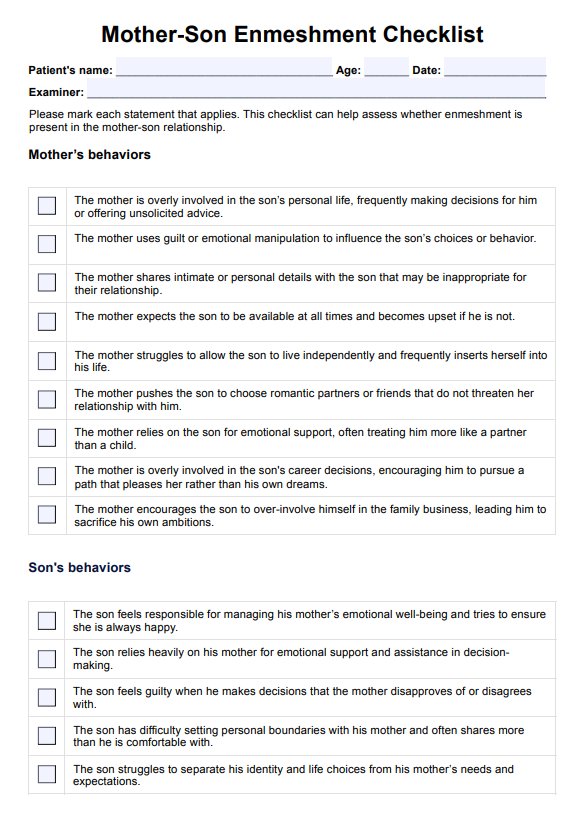
Signs of an enmeshed mother-son relationship
Here are some common signs of an enmeshed mother-son relationship:
- Over-involvement: The mother is overly involved in her son's personal and romantic relationships, often inserting herself into decisions and influencing outcomes.
- Guilt trips: The mother uses guilt or emotional manipulation to control the son’s behavior or choices, making him feel responsible for her emotional well-being.
- Difficulty with forming a healthy romantic relationship: The son struggles to keep healthy relationships with romantic partners, often feeling torn between his mother’s needs and those of his partner.
- Inability to set personal boundaries: The son may find it difficult to establish boundaries with his mother, leading to a lack of separation between his own life and his mother’s.
- Prioritizing the mother's emotional needs: The son often prioritizes his mother’s emotional state over his own, making it hard for him to fulfill his own needs in other relationships.
- The mother is the center of the son's life: The mother expects constant availability from the son and becomes upset when he tries









