








What is an MCL injury?
The medial collateral ligament (MCL) is a band of connective tissue on the inner side of the knee, bridging the femur (thigh bone) and tibia (shin bone). A common knee ligament injury, MCL damage is often the result of forceful twisting of the knee joint or direct trauma to the outer knee, as well as repeated stress and pressure over time from overuse. MCL injuries can be highly debilitating to the functioning of the knee joint. Athletes who play high-impact sports are at an elevated risk for MCL injuries.
Types of MCL injuries
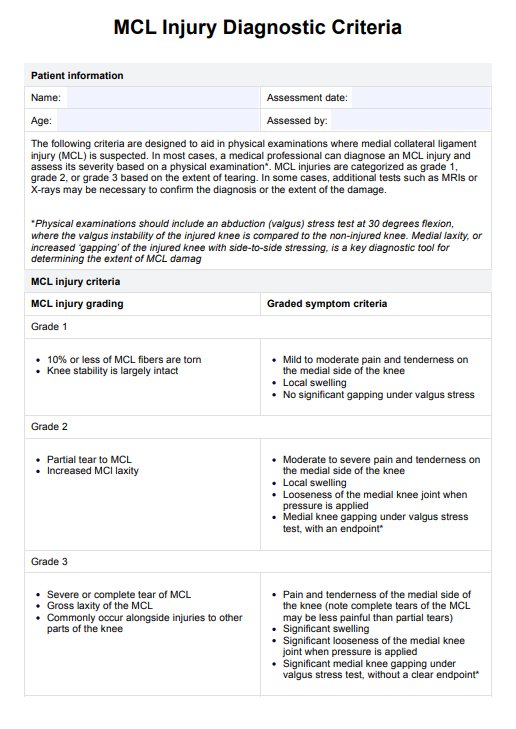
MCL injuries range in severity from light sprains to a partial or complete tear of the knee ligament, with implications for recovery time and success. Typically, medical professionals classify MCL tears as Grade 1, Grade 2, or Grade 3 to indicate their severity (Reider, 1996):
- Grade 1 MCL injuries are those in which 10% or less of the fibers that make up the ligament are torn. This type of mild tear is associated with some pain but little impact on knee stability. Grade 1 MCL injuries could heal on their own within a few weeks.
- Grade 2 indicates a partial tear of the MCL has occurred. The severity of this kind of MCL tear depends on how many medial collateral ligament fibers are still intact.
- Grade 3 refers to MCL injuries in which a complete MCL tear has occurred. Patients with a torn MCL of this severity display significantly increase medial laxity of the knee joint as very few connective MCL fibers are intact.









