


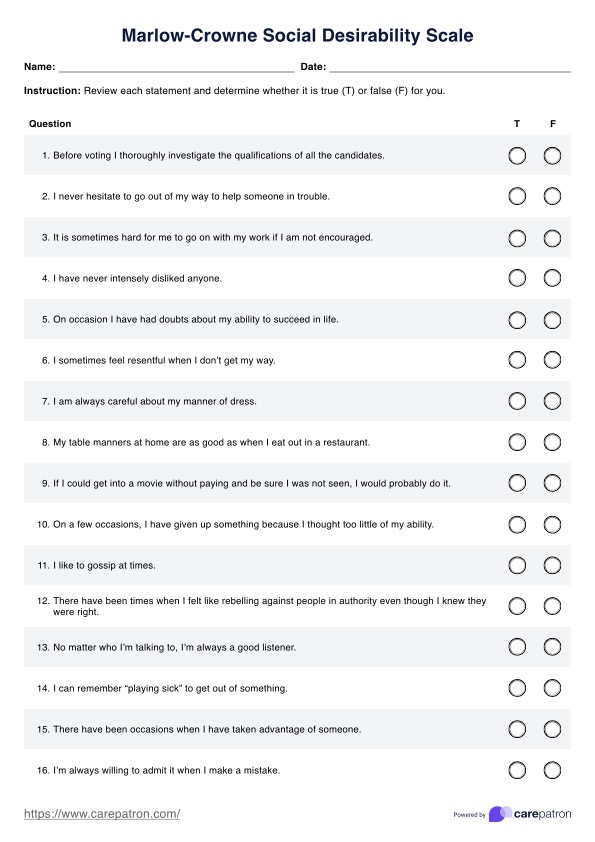




What is the Marlowe-Crowne Social Desirability Scale?
The Marlowe-Crowne Social Desirability Scale (MCSDS) is a widely used social desirability measure designed to assess socially desirable responses, where individuals modify their answers to self-report assessments to align with socially approved norms rather than their actual behaviors or attitudes. This bias can introduce significant differences in self-reported data (Adams, 2005), affecting the validity of psychological research and clinical practice, particularly in areas reliant on subjective reporting, such as mental health, behavioral assessments, and health-related behaviors.
Developed by Douglas P. Crowne and David Marlowe in 1960, the MCSDS consists of 33 true-false items that evaluate whether respondents provide socially desirable responses by emphasizing traits viewed as favorable while minimizing undesirable characteristics. The scale was created to be social desirability independent of intelligence and other personality traits, allowing researchers to distinguish between genuine self-reports and responses influenced by the need for social approval.
In healthcare and clinical survey research, the MCSDS is particularly valuable for identifying biases in self-reported health behaviors, such as medication adherence, substance use, or mental health symptoms, where patients may underreport or overreport based on perceived social expectations. Its application helps researchers and clinicians adjust for socially desirable responding, improving the accuracy of assessments and interventions.
As part of scale development, shorter versions of the MCSDS, such as the 12-, 13-, and 11-item versions, have been introduced to maintain reliability while reducing respondent burden (Ballard, 1992). However, despite its widespread use in different fields like clinical psychology, variations in social desirability measures across different populations and cultural contexts should be considered when interpreting results.









