10 examples of LCL injury exercises
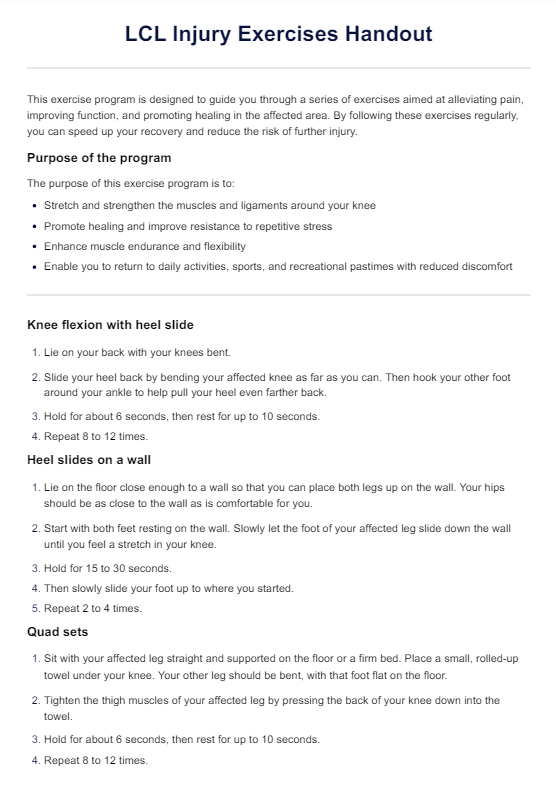
Healthcare professionals can use the following LCL sprain exercises to help patients rehabilitate from LCL injuries. Each exercise is designed to strengthen the muscles surrounding the knee, improve flexibility, and enhance overall stability.
1. Knee flexion with heel slide
Lie on the patient’s back with knees bent and feet flat on the floor. Instruct the patient to slide their heel back by bending the affected knee as far as possible, then hook the other foot around the ankle to pull the heel farther back. Hold for about 6 seconds, then rest for up to 10 seconds. Repeat 8 to 12 times.
2. Heel slides on a wall
Have the patient lie on the floor close enough to a wall to place both legs on it. Start with both feet resting on the wall, then slowly let the foot of the affected leg slide down the wall until a stretch is felt in the knee. Hold for 15 to 30 seconds, then slide the foot back up. Repeat 2 to 4 times.
3. Quad sets
Sit with the patient’s affected leg straight and supported on the floor or a firm bed, placing a small, rolled-up towel under the knee. Instruct the patient to tighten the quadriceps muscles of the affected leg by pressing the back of the knee down into the towel. Emphasize the contraction and relaxation of the quadriceps muscles. Hold for about 6 seconds, then rest for up to 10 seconds. Repeat 8 to 12 times.
4. Short-arc quad
Have the patient lie on their back with knees bent over a foam roll or a sizeable rolled-up towel. Instruct them to lift the lower part of the affected leg and straighten the knee by tightening the thigh muscle, keeping the bottom of the knee on the foam roll or towel. Hold for about 6 seconds, then slowly bend the knee and lower the leg. Repeat 8 to 12 times.
5. Straight-leg raises to the front
Have the patient lie on their back with the good knee bent so that the foot rests flat on the floor. Tighten the quadriceps muscles in the affected leg by pressing the back of the knee flat down, then lift the leg so that the heel is about 30 centimeters off the floor. Hold for about 6 seconds, then lower slowly, relaxing the quadriceps muscles. Repeat 8 to 12 times.
6. Hamstring set (heel dig)
Sit with the patient’s affected leg bent and the good leg straight and supported on the floor. Instruct the patient to tighten the hamstring muscles by pressing the heel into the floor. This will activate the inner and outer hamstring muscles. Hold for about 6 seconds, then rest for up to 10 seconds. Repeat 8 to 12 times.
7. Hip adduction
Sit on the floor with the patient's knees bent and place a pillow between them. Instruct the patient to squeeze the pillow by tightening the thigh muscles. Hold for 6 seconds, then rest for up to 10 seconds. Repeat 8 to 12 times.
8. Hip abduction
Sit on the floor with the patient's affected knee close to a wall. Bend the affected knee while keeping the other leg straight in front. Place a pillow between the outside of the knee and the wall, and instruct the patient to push the outside of the knee against the pillow and the wall. Hold for 6 seconds, then rest for up to 10 seconds. Repeat 8 to 12 times.
9. Lateral step-up
Stand the patient sideways on the bottom of a staircase with the injured leg on the step and the other foot on the floor. Instruct the patient to use the injured leg to raise themselves, bringing the other foot level with the stair step. Ensure they keep their hips level and the knee moving in a straight line with the middle toe, then slowly lower the foot back down. Repeat 8 to 12 times.
10. Wall squat with ball
Stand with the patient’s back facing a wall and place an exercise ball between the middle back and the wall. Instruct the patient to move their feet about a foot in front of their hips, tighten their belly muscles, and slowly squat down as if sitting in a chair, rolling the back over the ball. Ensure the knees do not go in front of the toes as they squat, hold for about 6 seconds, then slowly rise to a standing position. Repeat 8 to 12 times.