


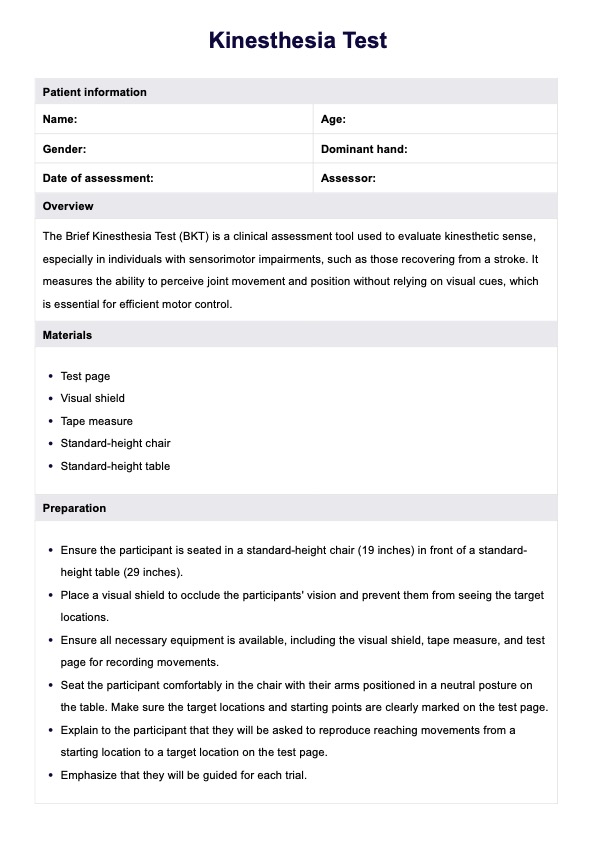




What is a Kinesthesia Test?
A Kinesthesia Test, or the Brief Kinesthesia Test (BKT), is a clinical assessment designed to evaluate an individual's kinesthetic sense—specifically, their ability to perceive joint movement and position without visual cues. This test is particularly useful in patients with sensorimotor impairments, such as those recovering from a stroke, where proprioceptive feedback may be compromised.
During the test, the healthcare professional guides the participant’s hand through a series of reaching movements to designated target points. These movements are performed without visual assistance, which helps assess the participant's proprioceptive abilities and awareness of joint positioning. The patient is asked to replicate the reaching movement from a starting position to a target, with the examiner gently guiding the hand as necessary. The test is designed to evaluate both fine motor control and spatial awareness of joint movement.
The procedure involves performing three trials for each hand—two longer reaches and one shorter reach (Borstad & Nichols-Larsen, 2016). This allows for a thorough assessment of both accuracy and consistency in kinesthetic perception. The examiner should ensure that the patient is seated comfortably and that all equipment, such as the visual shield and tape measure, is in place to facilitate accurate testing.
By administering this test, clinicians can gain valuable insights into the participant's proprioceptive abilities and identify areas where sensorimotor recovery may need further attention.









