





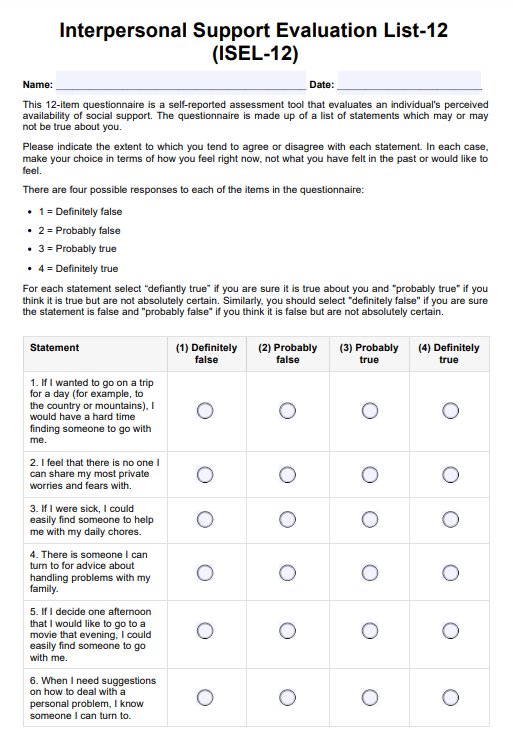



What is the Interpersonal Support Evaluation List-12?
The Interpersonal Support Evaluation List (ISEL) is a broadly employed self-reported assessment tool that evaluates an individual's perceived availability of social support (Merz et al., 2014). Rather than measuring actual support received, the ISEL focuses on the level of support someone believes is accessible to them. The ISEL-12 is a shorter version of the original ISEL, consisting of a 12-item measure of three sub-scales, each with a different dimension of perceived social support (Baltes et al., 2024).
The three sub-scales and measures of functional support are as follows (Baltes et al., 2024):
- Appraisal social support: Perceived availability to ask for guidance and or advice.
- Belonging social support: Perceived availability of connectedness, empathy, and concern within social networks.
The Latinos Sociocultural Ancillary Study demonstrated the reliability, structural, and convergent validity of ISEL-12 scores compared to other data, demonstrating ISEL-12 psychometric properties (Merz et al., 2014). In this study, participants completed measures in either English or Spanish, identifying their ancestry as Dominican, Central American, Cuban, Mexican, Puerto Rican, or South American.
The ISEL-12 demonstrates adequate internal consistency; confirmatory factor analyses revealed that both the one-factor and three-factor models fit the data equally well, demonstrating the flexibility and adequacy of the ISEL-12 model.
Results from multigroup confirmatory factor analyses further supported a similar one-factor structure providing equivalent variances and response patterns across different language groups and ancestry groups (Merz et al., 2014). This means that people from diverse backgrounds responded to the items in a similar way, with equivalent response patterns.
Convergent validity analyses were conducted to assess how well the ISEL-12 related to other psychological and social concepts. The convergent validity analyses suggested that the total social support score was associated with several related measures in ways that matched expectations, supporting internal consistency reliability (Merz et al., 2014).
For instance, higher social support scores were associated with greater social network integration and higher levels of life engagement. At the same time, these scores were inversely linked to perceived stress and the negative affect, anxiety, and depression, with total scores representing their expected directions (Merz et al., 2014).









