





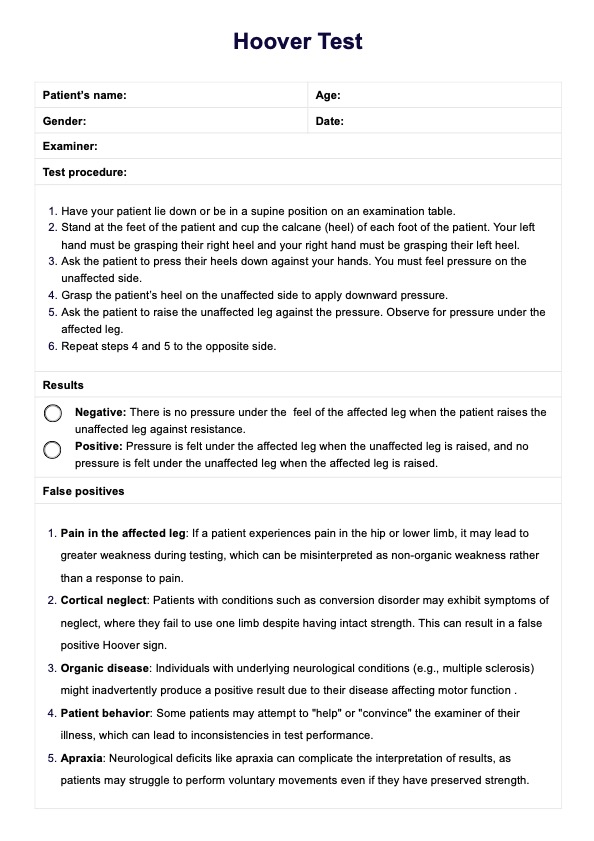




What is a Hoover sign?
Hoover's sign is a clinical tool used to distinguish between organic and functional weakness in the lower limbs. First described by Charles Franklin Hoover in the early 20th century, this test is essential for identifying functional neurological disorders, such as conversion disorder, and detecting potential malingering. It is also useful in assessing conditions like suspected stroke and other neurological impairments.
The test evaluates the interplay of hip extension and the involuntary extension reflex in the opposite limb. Specifically, it works on the principle that when a patient exerts effort to lift one leg, the leg occurs with a compensatory downward pressure in the contralateral heel, as a result of normal motor mechanisms (Fuller & Manford, 2010). This sign relies on the natural coordination between the limbs during movement. By observing these responses, the test helps differentiate between functional disorders and structural or neurological issues.
Healthcare professionals—including neurologists, physiatrists, and physical therapists—regularly use Hoover's sign to evaluate patients experiencing voluntary hip extension weakness. With a sensitivity of 63% and a specificity of 100% (Mehndiratta et al., 2014), the test is highly effective in diagnosing functional neurological disorders and ensuring the appropriate management of patients.









