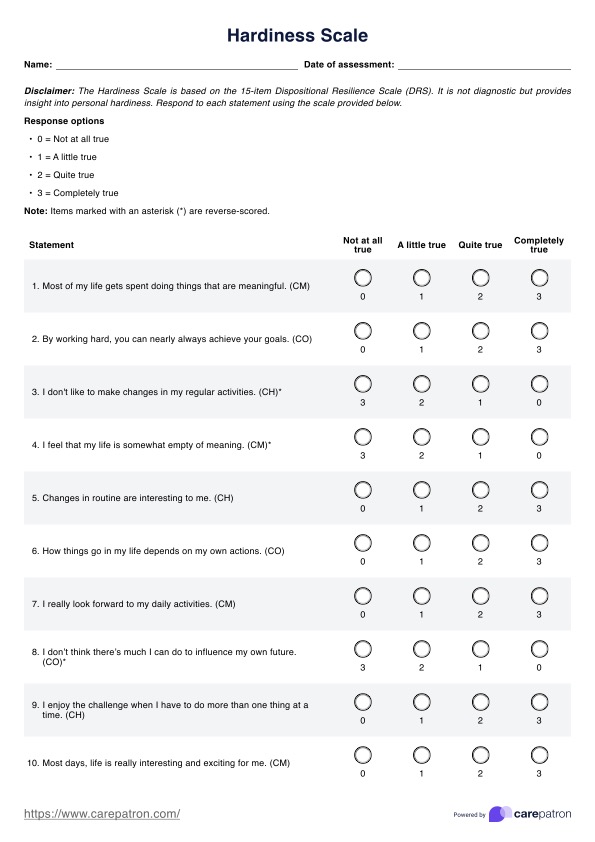
What is the Hardiness Scale?
The Hardiness Scale, formally known as the "Dispositional Resilience (Hardiness) Scale (HARDY)" or DRS-15 is a psychological tool used to assess a person's psychological hardiness, or resilience, across three key dimensions: Commitment (CM), Control (CO), and Challenge (CH). These factors collectively represent a broad hardiness factor, which helps in understanding how individuals cope with stress and change.
The scale was developed based on the Hardiness Scale originally developed by Kobasa (1979), a widely recognized measure of personality hardiness that identifies individuals who tend to remain healthy and perform well under stress. The DRS-15 is shorter and more reliable construct valid hardiness measure. The current DRS-15 scale traces its origins from a 53-item version used in the 1980s with Illinois Bell executives. Over time, this scale evolved through refinements, including a 50-item version (Bartone, 1989) for city bus drivers, followed by a 45-item version and later a 30-item scale (Bartone, 1991).
Various tools have been developed to measure hardiness, with the short hardiness measure like the Dispositional Resilience Scale (DRS-15) by Paul Bartone (2013) being among the most widely used. However, limitations in its reliability and construct validity prompted the development of a new hardiness scale, such as the Hardiness Resilience Gauge (HRG).
High scores on the hardiness test correlate with active problem-solving, reduced anxiety and PTSD symptoms, and greater well-being. Furthermore, the scale examines distinct hardiness facets, providing a detailed view of how commitment, control, and challenge contribute to overall resilience.
Despite multiple methods of measuring hardiness, the Hardiness Scale is based on the DRS-15, which is the most widely used method. It involves assessing a patient's psychological resilience across three dimensions: Commitment, Control, and Challenge. This process helps healthcare practitioners understand a patient's ability to cope with stress and adapt to challenges, aiding in personalized care and intervention strategies. Below are the steps for using the scale effectively.
Further psychometric improvements with military samples resulted in a scale (Bartone, 2013) with 15 items selected based on item distribution characteristics, item response theory plots, scale reliabilities, item-total correlations, and confirmatory factor analysis. This version demonstrates moderate to strong psychometric properties and validity, with a Cronbach's alpha of 0.69 (Madrigal et al., 2016) and test-retest reliability of 0.78 over 3 weeks (Bartone, 2007). This 15-item version includes both positively and negatively keyed items across the three hardiness dimensions: commitment, control, and challenge. In a study of 700 Army reservists, the scale showed good reliability with a Cronbach's alpha of .83 for the total measure and varying alphas for the individual theoretically relevant outcome measures.
Respondents with higher scores on the Hardiness Scale are less likely to use negative coping strategies compared. As such, they tend to show fewer symptoms of stress-related disorders, such as PTSD, highlighting the hardiness resilience gauge as an effective tool for identifying protective traits. The hardiness challenge dimension reveals a person’s openness to change, which is vital for managing stress effectively.