









What is the Foot Posture Index (FPI-6)?
The Foot Posture Index (FPI-6) is a novel rating system tool for evaluating standing foot posture in clinical and research settings. It assesses both the rear and forefoot, comprehensively evaluating overall foot position and alignment.
Unlike traditional measures, which often require specialized equipment, the FPI-6 offers a simple, reliable method for scoring standing foot posture using visual and manual assessments. Morrison and Ferrari (2009) also found it a reliable method for assessing the foot in children and adolescents.
The evaluation is conducted while the patient stands comfortably, with both feet supporting their weight evenly. Patients are instructed to stand still, keep their arms at their sides, and look straight ahead to ensure an accurate assessment. This dynamic but structured evaluation helps identify foot type and determine potential risk factors associated with abnormal foot mechanics.
FPI-6 criteria for assessment
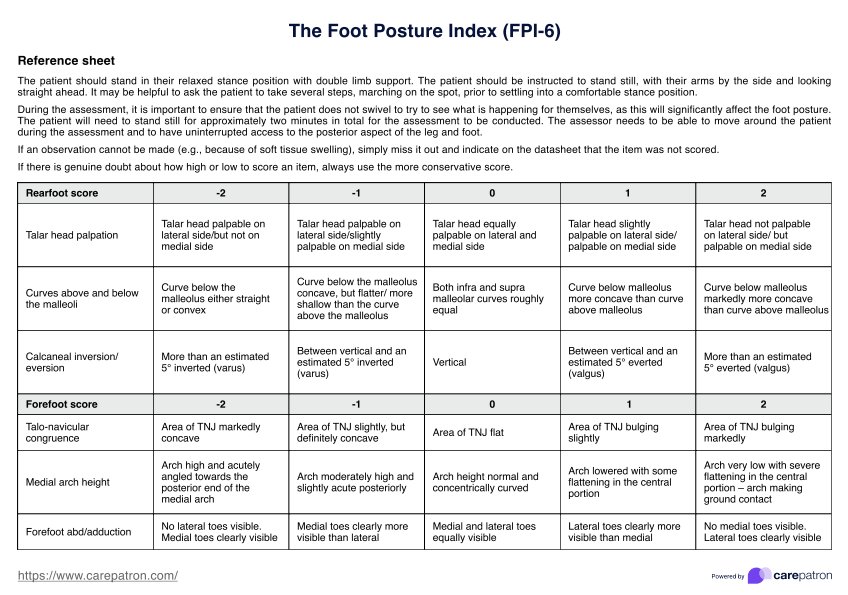
The FPI-6 consists of six observational criteria, each scored on a scale from -2 to +2, where negative values indicate a supinated foot posture, positive values indicate a pronated foot posture, and scores closer to zero represent a neutral alignment (Redmond et al., 2006):
- Talar head palpation: Assesses the prominence of the talar head. If the talar head is more palpable on the lateral side, it suggests a supinated foot posture, whereas prominence on the medial side indicates a pronated foot posture.
- Curvature above and below the malleoli: Examines the concavity of the curves above and below the lateral malleolus. A more pronounced concavity below the malleolus is associated with a pronated foot, while a straighter or convex shape suggests supination.
- Calcaneal inversion/eversion: Evaluates the alignment of the heel bone (calcaneus) relative to a vertical position. An inverted heel (tilted inward) indicates supination, while an everted (tilted outward) heel suggests pronation.
- Talo-navicular joint (TNJ) congruence: Observes the shape and contour of the TNJ area. A more concave TNJ suggests supination, whereas a bulging TNJ indicates pronation.
- Medial longitudinal arch height: Measures the height and shape of the foot’s arch. A high, sharply angled arch suggests supination, while a low, flattened arch is characteristic of pronation.
- Forefoot abduction/adduction: Assesses the visibility of the toes from a posterior view. If the medial toes (big toe side) are more visible, the foot is adducted, indicating supination. If the lateral toes (little toe side) are more prominent, the foot is abducted, indicating pronation.
As mentioned, the FPI-6 helps practitioners assess static foot posture, determine risk factors, and guide interventions for patients with gait abnormalities or lower limb discomfort.
However, modifications to the cutoff values may be necessary when screening for supinated feet, as the FPI-6 has limitations in identifying high-arched individuals (Teyhen et al., 2011). It is important for clinicians to consider this when diagnosing foot-related issues and planning treatment strategies.









