Exception to rules
In Oregon, while emotional support animals are generally granted accommodations under the Fair Housing Act and Air Carrier Access Act, there are exceptions where specific rules may not apply. These exceptions ensure that accommodations do not compromise safety or impose unreasonable burdens.
Health and safety concerns
Housing providers or airlines may deny accommodation to emotional support animals that pose a direct threat to the health or safety of others. For instance, if the ESA has a history of aggression or is at risk of spreading disease, the accommodation request may be refused. This applies to any emotional support animal in Oregon, where public safety remains a priority under federal law.
Undue administrative burden
Granting accommodation for an ESA should not impose an undue administrative or financial burden on housing providers or airlines. However, if allowing an ESA significantly disrupts operations or alters their nature, accommodation can be denied. These entities are required to document and justify their decision and attempt to provide alternative solutions where possible.
Fraudulent documentation
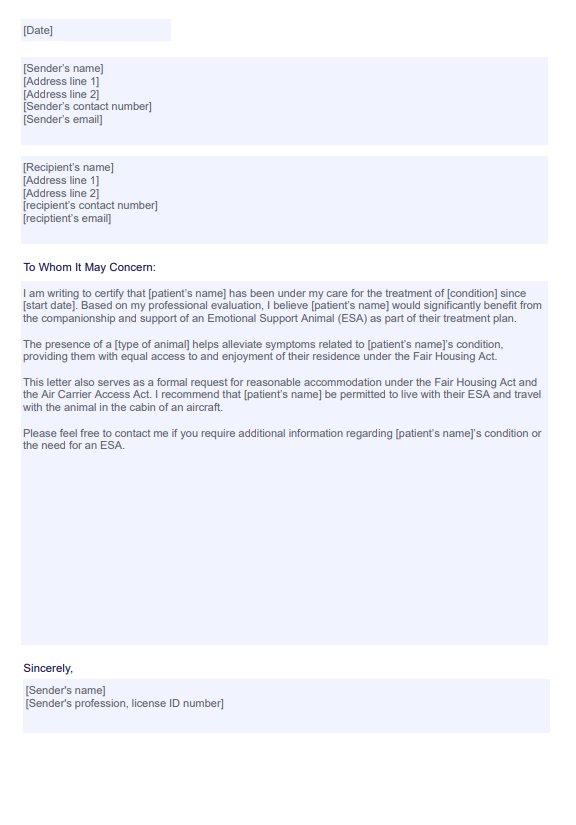
Using fraudulent or non-legitimate documentation for an ESA, such as a fake emotional support animal letter Oregon, is grounds for denial. Individuals must obtain a valid ESA letter from a licensed mental health professional to ensure validity.
Fraudulent documents, including unverified sources for a free emotional support animal letter PDF or printable free emotional support animal letter PDFs, are not recognized by federal and state laws.
Non-compliance with policies
Individuals are required to comply with all housing provider or airline policies regarding ESAs, such as providing proper documentation and adhering to specific pet policies. Failure to follow these regulations, even with a valid ESA letter, can result in a denial of accommodation. Clear communication and policy adherence are crucial for ensuring the ESA owner is granted appropriate accommodations.
Case-by-Case basis
Each request for accommodation is considered on a case-by-case basis, assessing the individual's needs and the capabilities of the housing provider or airline. Flexibility is often applied to ensure that decisions are fair and align with both the individual's needs and operational policies. This ensures that each support animal in Oregon is treated fairly under the Fair Housing Act and other relevant legislation.
While emotional support animals have protections under federal regulations, these exceptions help maintain a balance between individual needs and practical considerations for housing providers and airlines. To reach a fair resolution, both parties must engage in open dialogue and consider all aspects of the situation.