How to use our Cervical Joint Position Error Test template
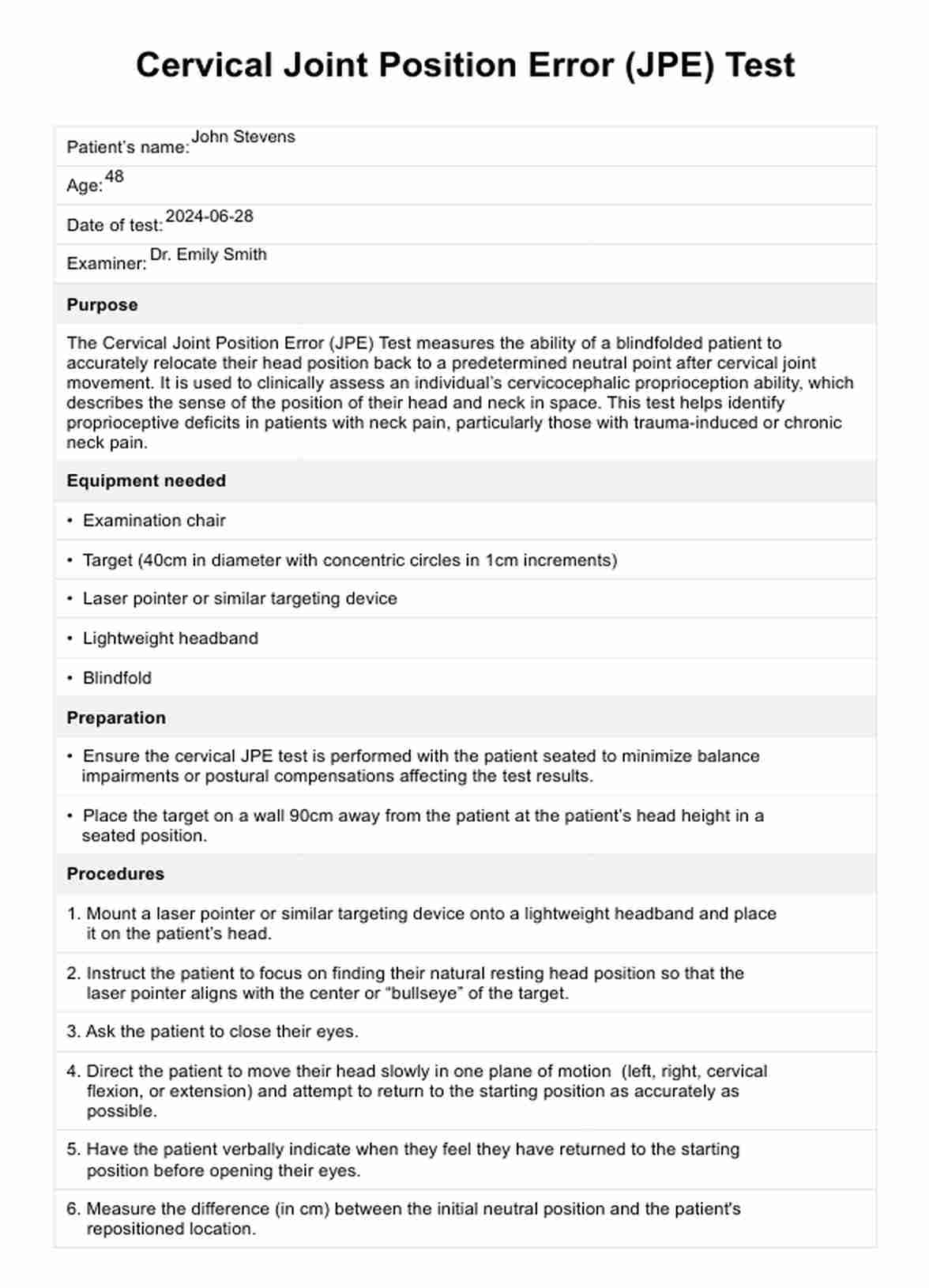
Carepatron's free printable Cervical Joint Position Error Test template allows you to conduct the test and document results in minutes. Follow these steps to get started:
Step 1: Download and prepare the template
Download a copy of our Cervical Joint Position Error Test template. This template will guide you through recording patient information, conducting the test, and noting the results. Ensure all necessary equipment is ready, including an examination chair, target, laser pointer, headband, and blindfold.
Step 2: Prepare the patient
Instruct the patient to sit comfortably in the examination chair. Place a target on the wall 90 cm away from the patient at their head height. Secure the laser pointer onto the headband and place it on the patient’s head. Explain the procedure to the patient, ensuring they understand the purpose and steps of the test. Allow the patient to find their natural resting head position, aligning the laser with the center of the target.
Step 3: Conduct the head movements
With the patient blindfolded, ask them to move their head in one plane of motion (left, right, cervical flexion, extension, etc.). After the movement, instruct the patient to return to the starting position as accurately as possible. The patient should verbally indicate when they believe they have returned to the starting position before removing the blindfold.
Step 4: Measure and record the displacement
Measure the difference between the laser beam's position on the target at the test's start and end. Record the displacement in centimeters. Repeat the test at least three times for each direction of motion assessed. Ensure the patient re-centers their starting position and rest before each trial.
Step 5: Analyze the results
Convert the displacement measurements into degrees using the formula provided in the template. Then calculate the average from both the measures in centimeters and degrees to get the overall result. If the directional error is over 4.5 degrees or more than 7 cm from the bullseye, the patient is considered to have a proprioceptive deficit.