









What is the Bragard Test?
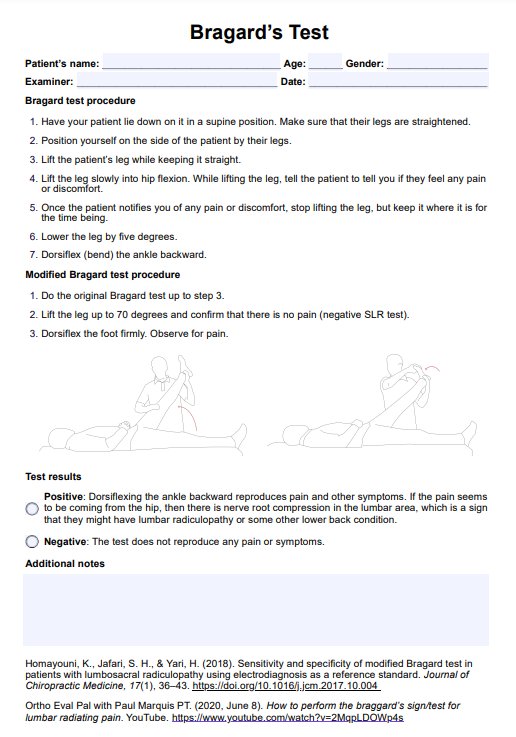
The Bragard Test (also known as Bragard's Test, Bragards Test, or Bragard's sign) is a clinical provocative test used to assess lower back pain and determine whether it stems from nerve root compression, such as lumbar radiculopathy. This test helps differentiate a genuine Lasegue sign from a false positive, providing clarity in evaluating sciatic nerve irritation.
It is closely related to the Straight Leg Raise Test, as both involve lifting the patient’s leg to provoke symptoms. However, the Bragard Test adds ankle dorsiflexion, a step designed to assess nerve irritation further. This additional maneuver makes it particularly useful for patients presenting with radicular symptoms. The Bragard Test is an essential part of clinical examination and aids in narrowing down the cause of lower back pain before considering more advanced diagnostic options.
The Modified Bragard Test, compared to the original, has slightly different steps: the leg is raised to 70 degrees, and dorsiflexion is performed only after confirming a negative Straight Leg Raise Test result. The modified version has acceptable test performance and diagnostic accuracy with a sensitivity of 69.3% and a specificity of 67.42%, making it better than other clinical provocative tests. The positive predictive value is 73.15%, and the negative predictive value is 63.16%, with a diagnostic odds ratio of 4.63 (Homayouni et al., 2018). Both the original and modified versions are valuable in identifying positive clinical findings and guiding further investigation.









