Everyone has a story to tell, and here we share and celebrate those who chose care as their life's work.
These are their words, their work and we're grateful to share them.
Elizabeth and Dennis handed their billing to Carepatron and grew My Therapeutic Concepts from five clients to seventy in two months, without losing their evenings.
## **What is a BPD Favorite Person Test?**
In the context of borderline personality disorder (BPD), a "favorite person" refers to an individual whom someone with BPD becomes emotionally reliant on or intensely attached to (Jeong et. al., 2022). This attachment can be characterized by idealization, intense emotional connection, and a strong desire for validation and emotional support from the favorite person.
Individuals with BPD often experience intense emotions and struggle with maintaining stable and healthier interpersonal relationships (Chapman et al., 2024). The concept of a favorite person can arise as a coping mechanism to alleviate feelings of chronic emptiness, loneliness, or insecurity (Miller et al., 2021). The favorite person BPD relationship may serve as a primary source of support and validation for the individual with BPD.
It's important to note that the designation of someone's favorite person can be both positive and challenging for individuals with BPD and their chosen confidant. While the intense emotional reactions may initially feel rewarding and fulfilling, it can also place significant pressure on the favorite person to meet the individual's emotional needs and expectations. This dynamic can strain the healthy relationship and lead to the need for healthy boundaries.
## **Signs that the patient has a favorite person**
In individuals with BPD, having a “favorite person” can significantly affect their emotional and relational patterns. Signs of this include an intense emotional bond that goes beyond typical friendship, often involving deep admiration and idealization. The favorite person may be seen as flawless, leading to emotional dependency and a strong need for their validation and reassurance.
Patients may exhibit clingy or possessive behaviors due to a heightened fear of abandonment, particularly with this person. Mood swings are common—extreme highs occur during closeness, and deep lows when separated. The individual may neglect other relationships, focusing entirely on the BPD favorite person, and experience emotional turmoil marked by jealousy, insecurity, and anxiety disorders. Recognizing these behaviors can offer critical insight into the patient’s relational struggles and help guide more targeted therapeutic support, especially when working with a licensed mental health professional.
## **How does our BPD Favorite Person Test work?**
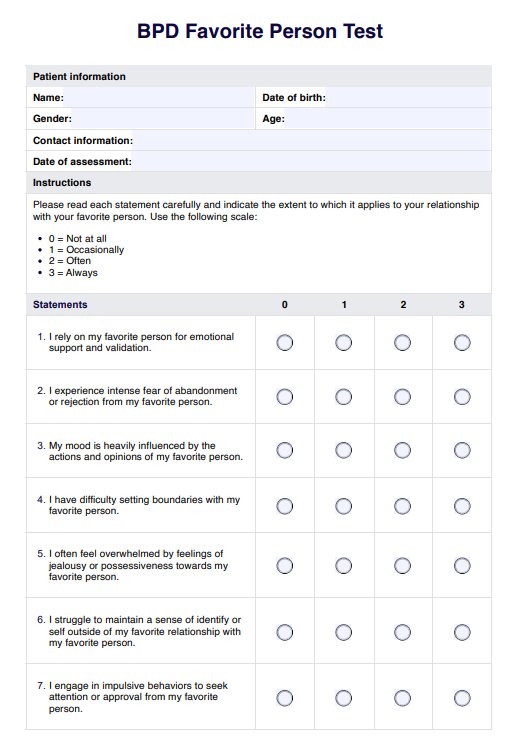
Carepatron’s BPD Favorite Person Test makes it easier for healthcare providers to assess emotional dependency patterns in patients with borderline personality disorder. Note that this test is not a diagnostic tool. Instead, it functions as a structured self-report measure that highlights how a patient’s thoughts, emotions, and behaviors shift in relation to their “favorite person.”
### **Step 1: Access the test template**
Click the “Use template” button to open the BPD Favorite Person Test directly within the Carepatron platform. If you're new to Carepatron, this action will guide you through downloading the app and setting up your workspace. Once installed, you can immediately begin using the digital Borderline Personality Disorder test template in your practice.
### **Step 2: Use the template in patient assessment**
Incorporate the template during clinical interviews or psychological evaluations. It provides structured prompts that help identify signs of emotional instability, idealization, and fear of abandonment—key indicators in BPD patients who may have a BPD favorite person relationship or struggle to maintain a healthy favorite person relationship.
### **Step 3: Conduct the test**
Work through each section of the test with your patient, ensuring a supportive and non-judgmental environment. The template is designed for flexibility, allowing clinicians to adapt questions or probe deeper into specific BPD symptoms as needed to collect accurate, meaningful data that helps diagnose BPD or rule out other mental health conditions such as bipolar disorder, eating disorders, or binge eating.
### **Step 4: Gather and interpret results**
After the assessment, review responses to identify behavioral patterns and emotional triggers associated with the favorite person relationship dynamic. The template’s format supports organized note-taking, enabling quick recognition of trends and guiding clinical judgment for accurate diagnosis, further evaluation, or treatment planning based on the American Psychiatric Association's Diagnostic guidelines.
### **Step 5: Provide patient support and next steps**
Use the insights gathered to develop a tailored care plan that may include therapy referrals, emotion regulation strategies, or education on healthy boundaries and coping strategies.
## **Results and next steps**
Once the patient completes the BPD Favorite Person Test, their total score will help indicate the degree of emotional reliance they may have on a specific individual. This score provides valuable clinical insight into the intensity of their attachment behaviors and the potential impact on their mental health, personality disorder, and interpersonal relationships.
- **0–10 (Mild reliance)**: Suggests minimal emotional dependency. While some signs of attachment exist, they are unlikely to cause significant disruption. Clinicians may monitor but generally won’t need to intervene unless symptoms escalate.
- **11–20 (Moderate reliance)**: Indicates growing emotional reliance that may influence behavior and mood regulation. This level may benefit from early intervention strategies, including psychoeducation and supportive therapy.
- **21–30 (Severe reliance)**: Reflects intense emotional dependency, often accompanied by distress, instability, or maladaptive coping behaviors. At this level, clinicians should consider a comprehensive treatment plan involving dialectical behavior therapy (DBT), emotional regulation techniques, and structured support systems.
Below are the recommended next steps to take:
### **Interpretation of results**
Review the test results carefully, considering the patient's responses and any patterns or themes that emerge. Assess the intensity and dynamics of the patient's relationship with their favorite person, including their level of emotional dependency, fear of abandonment, and idealization.
### **Psychoeducation**
Provide psychoeducation to the patient about the significance of favorite person relationships in BPD. Help the patient understand how their attachment to a favorite person may contribute to emotional instability, difficulties in interpersonal relationships, and challenges in maintaining healthy boundaries.
### **Therapy referral**
Refer the patient to individual therapy, ideally with a therapist experienced in treating BPD using evidence-based approaches such as dialectical behavior therapy (DBT). Therapy can help the patient develop coping strategies, regulate emotions, and build healthier relationships, including setting and maintaining boundaries with their favorite person.
### **Family involvement**
If appropriate, involve family members or loved ones in the treatment process, particularly if they play a significant role in the patient's favorite person relationship. Educate family members about BPD and guide how to support the patient in building healthier relationships and improving self-esteem.
### **Setting boundaries**
Collaborate with the patient to establish and maintain healthy boundaries within their relationship with their favorite person. Help patients recognize and communicate their needs and limits effectively, fostering autonomy and self-advocacy.
### **Developing self-esteem**
Work with the patient to address underlying issues contributing to low self-esteem and reliance on external validation. Encourage the patient to engage in activities and practices that promote self-care, self-compassion, and self-empowerment.
### **References**
Chapman, J., Jamil, R. T., & Fleisher, C. (2024). Borderline personality disorder. StatPearls Publishing. https://www.ncbi.nlm.nih.gov/books/NBK430883/
Jeong, H., Jin, M. J., & Hyun, M. H. (2022). Understanding a mutually destructive relationship between individuals with borderline personality disorder and their favorite person. Psychiatry Investigation, 19(12), 1069–1077. https://doi.org/10.30773/pi.2022.0079
Miller, C. E., Townsend, M. L., & Grenyer, B. F. S. (2021). Understanding chronic feelings of emptiness in borderline personality disorder: A qualitative study. Borderline Personality Disorder and Emotion Dysregulation, 8(1), Article 27. https://doi.org/10.1186/s40479-021-00164-8
Commonly asked questions
Losing their favorite person can trigger intense emotional distress, including feelings of abandonment, emptiness, and despair. They may experience heightened mood swings, impulsivity, and a sense of identity disturbance.
BPD symptoms typically peak in early adulthood, with most individuals experiencing the highest intensity of symptoms in their late teens to early twenties.
The notion of a life expectancy of 27 for individuals with BPD is a myth. While BPD can impact the quality of life and increase risk factors for certain health conditions, there is no specific life expectancy associated with the disorder.