Everyone has a story to tell, and here we share and celebrate those who chose care as their life's work.
These are their words, their work and we're grateful to share them.
Elizabeth and Dennis handed their billing to Carepatron and grew My Therapeutic Concepts from five clients to seventy in two months, without losing their evenings.
## **What is the Apathy Test?**
The Apathy Test is a tool designed to assess a person's level of apathy, which is just a lack of interest, enthusiasm, emotion, or concern in various aspects of life. This test is particularly useful for mental health professionals to evaluate how apathy affects an individual's emotions, behavior, and overall motivation. It is often used to distinguish apathy from a particular symptom, such as depression and lack of empathy, and to understand how it can affect a person's daily functioning and relationships, including with friends and family.
The Apathy Test typically involves a series of questions that explore a person's feelings and affect. It helps to identify whether a lack of interest or enthusiasm in events is due to an underlying mental health condition like a psychiatric disorder, a brain disorder like Alzheimer's disease, or a response to specific situations. This can come as an illness or changes in life circumstances. For example, the test can be useful for doctors when evaluating how a patient's apathy might influence or affect their usual behavior or coping mechanisms.
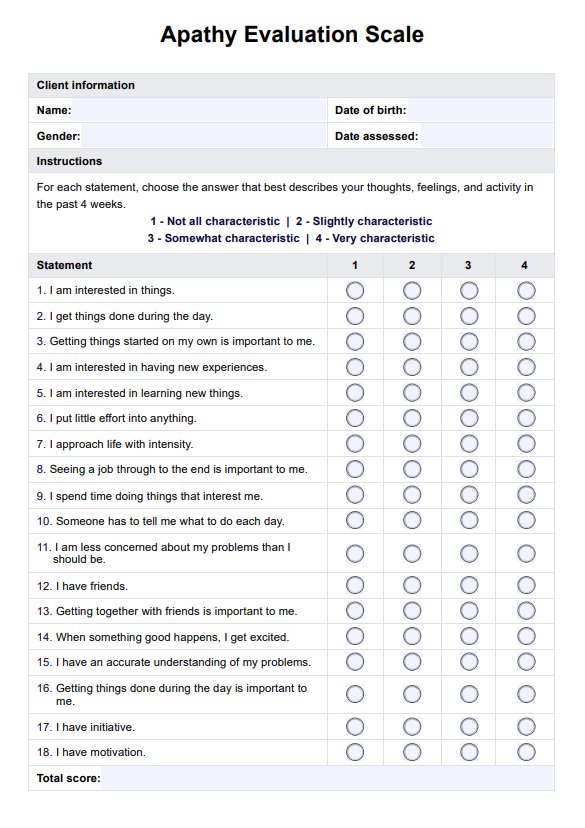
Conducting the Apathy Test is straightforward and allows the doctor to assess a patient's or child's level of apathy efficiently. For this guide, we are using Marin and colleagues' (1991) Apathy Evaluation Scale (AES) in a self-administered version. The AES assesses goal-directed behavior associated with apathy by examining behavioral, cognitive, and emotional indicators, using 18 items and taking approximately 10–20 minutes to administer.
## **How to conduct the Apathy Test?**
Following these steps below, practitioners can effectively use this Apathy Test to gather valuable insights into a patient or child's emotional state and behavior.
### **Step 1: Access and use the template**
The first step is to access the test template provided within this guide. This ready-to-use template simplifies the testing process, ensuring that all necessary questions and prompts are included for a comprehensive assessment.
### **Step 2: Review the test content**
Before administering the test, carefully review the content to familiarize yourself with the questions and their intent. This step ensures that you understand how each question relates to evaluating the patient's apathy, behavior, and positive emotions.
### **Step 3: Conduct the test**
When conducting the Apathy Test (Apathy Evaluation Scale in this case), create a comfortable environment for the patient. Observe the patient's reactions and answers. Encourage honesty and reflection to gain accurate insights into the patient's feelings, emotions, and behavior.
### **Step 4: Gather and interpret results**
After completing the test, gather and analyze the results to identify positive emotion, apathy, or indifference patterns. Compare these findings with the patient's usual behavior and overall life situation to make informed conclusions about their emotional health.
### **Step 5: Provide education and next steps**
Once the results are interpreted, educate the patient on their levels of apathy. Discuss potential underlying causes and suggest next steps, including further cognitive assessments or intervention options, to help the patient improve their motivation and emotional well-being.
Please note that this test doesn't cover every nuance and type of apathy. These are general questions about having an interest in things, having the motivation to do certain things like everyday tasks, and emotional reactions (or the lack thereof).
If you and your patient believe the patient has apathy worse than your regular apathy syndrome, like bystander apathy or just plain indifference towards certain things, it would be best to conduct other tests (including physical exams that can detect problems like vascular dementia).
## **Scoring and interpretation**
The Apathy Evaluation Scale has 18 items rated on a 4-point Likert scale. The total score ranges from 18 to 72, with higher scores indicating greater apathy. To accurately assess the results, it's important to note that all except three items (#6, #10, #11) are reverse-scored. This means that lower scores in all except these three items mean higher apathy.
After calculating the total score, healthcare professionals can interpret the results to determine the extent and direction of the patient's apathy, which can then guide further evaluation (like checking for underlying medical causes) and treatment planning (Lee et al., 2020).
## **Next steps after the test**
After conducting the Apathy Test and interpreting the results, the next steps involve discussing the findings with the patient. If the test indicates significant levels of apathy, it's essential to explore potential underlying causes, such as depression, medical conditions, or life stressors. As mentioned earlier, it would be best to use other similar assessments that cover various types of apathy so that their emotional responses or even potential medical causes can be covered.
A mental health professional should consider referring the patient to a mental health specialist for a more comprehensive evaluation. Additionally, creating a personalized treatment plan that may include therapy, lifestyle changes, or medication can be crucial in addressing the patient's apathy.
Regular follow-ups are recommended to monitor progress and adjust the treatment plan as needed. This proactive approach ensures that the patient receives the necessary support to improve their emotional well-being and quality of life.
### **References**
Lee, B., Gleason, C., & Umucu, E. (2020). Clinical utility and psychometric properties of the Apathy Evaluation Scale. Rehabilitation Psychology, 65(3), 311–312. https://doi.org/10.1037/rep0000356
Marin, R. S., Biedrzycki, R. C., & Firinciogullari, S. (1991). Reliability and validity of the Apathy Evaluation Scale. Psychiatry Research, 38(2), 143–162. https://doi.org/10.1016/0165-1781(91)90040-v
Commonly asked questions
Healthcare professionals typically use tools like the Apathy Quiz, Apathy Test or validated scales like the Apathy Evaluation Scale to test for apathy. They usually involve answering a series of questions that assess interest, enthusiasm for interest, and emotional and cognitive engagement. The results help identify the level of apathy and guide further evaluation.
A person may notice that they have apathy if they experience a consistent lack of interest, enthusiasm, or concern for the things, events, activities, or people they once cared about. If these feelings persist, they should consider consulting with a doctor or mental health professional for assessment is important.
Apathy is not uncommon and can occur in various contexts, especially in relation to mental health conditions like depression, neurological disorders, or a disease or dementia. It is often underreported, as people may not recognize or acknowledge their symptoms.