





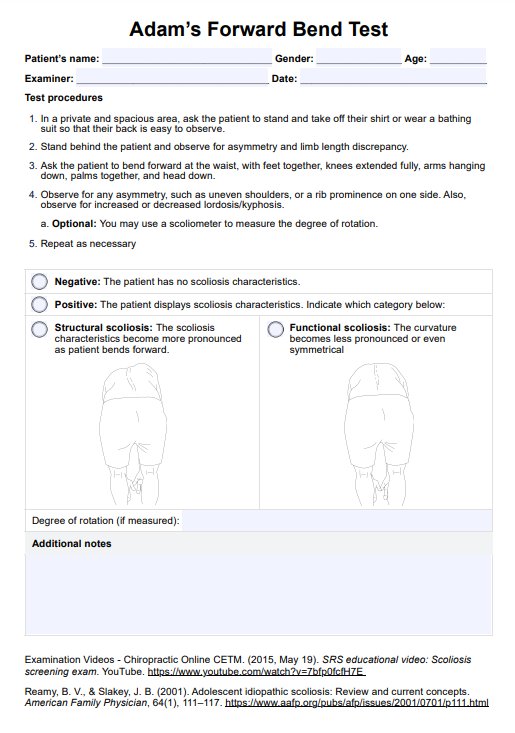




What is the Adam's Forward Bend Test?
The Adam's Forward Bend Test, also known as the Adam's Forward Bending Test or just the Adam's Test, is a physical examination developed to help healthcare professionals screen patients with scoliosis and determine whether they have functional or structural scoliosis.
Scoliosis is a spinal condition in which the spine has an abnormal lateral curvature, and the degree of the curvature varies depending on the person. If left unchecked, scoliosis can impact a person's quality of life and functional capabilities. Small curves indicating mild scoliosis are normally fine and do not cause any major problems except mild discomfort. However, extreme curves can adversely affect a person's body. Large curves can cause lung problems, can make ribs rub against the pelvis (which is something that definitely should not happen), and can even develop arthritis that damages the spinal joints, which can cause bone spurs to appear.
Scoliosis can be categorized into two main groups:
- Functional scoliosis: A temporary curve caused by factors like muscle spasms or leg length discrepancies. It becomes less visible or disappears when the patient bends forward.
- Structural scoliosis: A permanent spinal curve that remains present whether the patient is standing or bending forward.
While the Adam's Test is best used for differentiating between the two categories of scoliosis, it can also be done on individuals with no prior signs of scoliosis to screen them. In fact, it is a common part of school assessments and routine checks for adolescent idiopathic scoliosis, often done after a visual inspection to confirm suspected scoliosis. And since the test is extremely simple, it does not take a scoliosis specialist to do the test—school nurses, physical therapists, and family doctors routinely use it. It is best used with other tests for diagnosing scoliosis.









