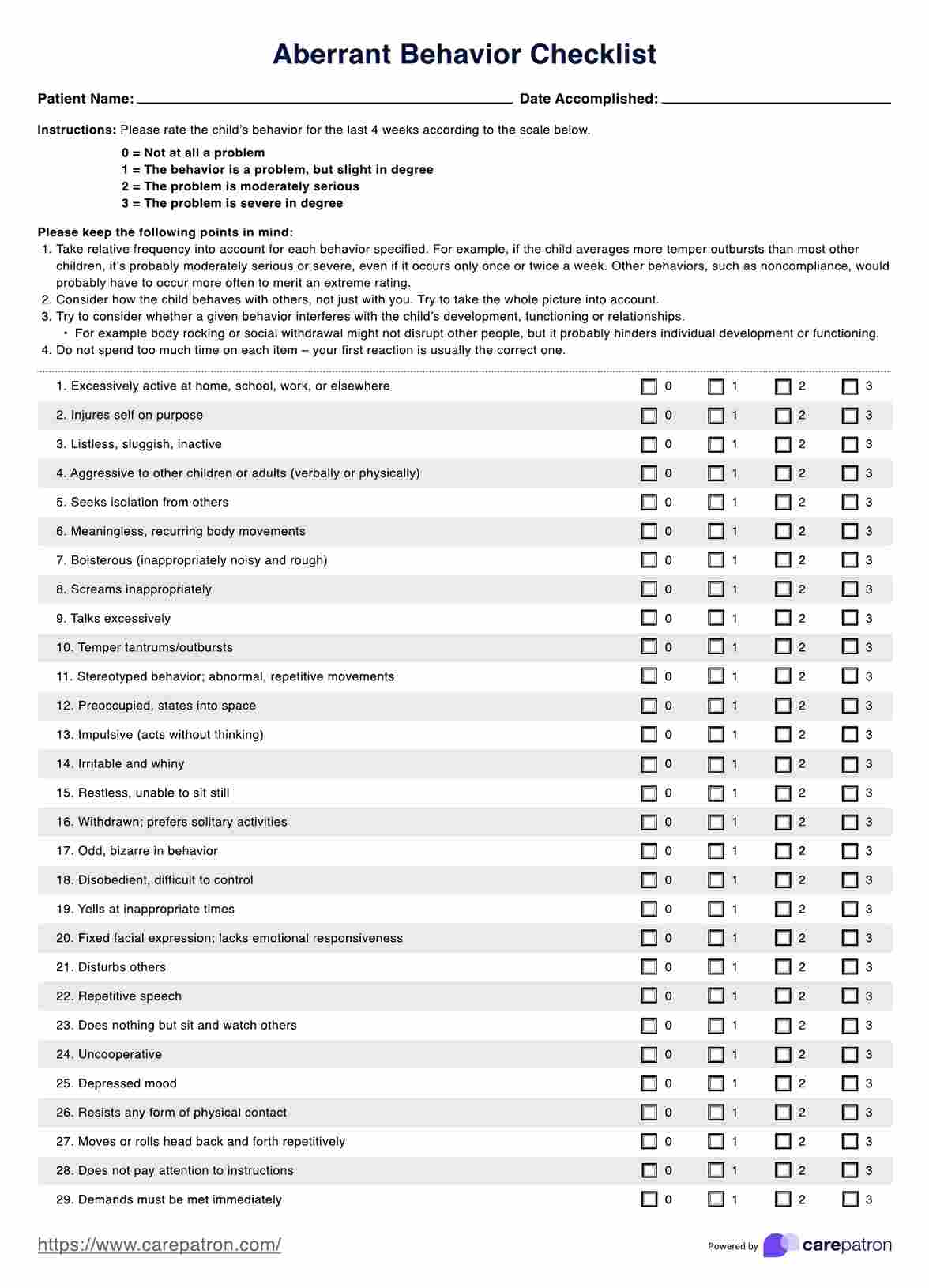
Looking for a tool to help you track a child's behavior so you can see if it's viable to determine if they exhibit aberrant behavior or not? Read our guide to learn more about aberrant behaviors, then use the Aberrant Behavior Checklist so that you or the parents/guardians of the child you need to assess can tick off specific behaviors and severity levels concerning the child. This will help collate information necessary before diagnosing a child for specific behavioral disorders/developmental issues.
## **What is aberrant behavior?**
When we label something as "aberrant behavior," what people essentially refer to are behaviors and corresponding actions that do not follow societal expectations and norms. While norms vary from country to country, community to community, anything that doesn't follow such norms is often deemed unacceptable, offensive, potentially dangerous, something that needs to be corrected, and "criminal" by legal systems (US Legal Forms, 2025).
From the mental health side of things, aberrant behaviors (challenging behaviours) might stem from intellectual and developmental disabilities, mental deficiency, as well as behavioral disorders such as oppositional defiant disorder, substance use disorder, and more.
Common traits of those who are suspected or confirmed to exhibit aberrant/challenging behaviors often include:
- The use of inappropriate speech
- Tendency for social withdrawal
- Tendency to be lethargic
- Hyperactivity
- Heightened irritability
- Addictive tendencies
- Impulsivity
- They tend to perform repetitive actions (stereotyped behavior)
- They don't follow rules (non-compliance)
- They engage in thievery
- They are unusually aggressive
- They are dishonest and do dishonest things (cheating, tampering)
Mental health professionals whose work focuses on correcting these behaviors and reducing the severity of specific disorders, intellectual disabilities, and other problems that cultivate aberrant behavior, will often use tools such as behavior rating scales and mental retardation-specific instruments/standardized measures as part of comprensive mental health assessments and mental health research, such as the Behavioral Problems Inventory (sometimes called Behavior Problems Inventory), [General Behavior Inventory](https://www.carepatron.com/nl/templates/general-behavior-inventory-gbi), and the Aberrant Behavior Checklist. They will use these to assess patients and clinical samples to determine how behaviors occurred, what factors have contributed to the emergence of these behaviors, how severe these behaviors have affected those being assessed, etc.
## **What is the Aberrant Behavior Checklist?**
The tool we will be discussing is the Aberrant Behavior Checklist (ABC). This is a nifty screening tool used to assess a child for the severity of their behavioral problems and any developmental disabilities they might have, especially if they have Autism Spectrum Disorder.
The checklist comes with fifty-eight items for an observer to rate, and they are all divided into five different behavioral categories:
- Irritability
- Hyperactivity
- Lethargy
- Stereotypic behavior
- Speech
This checklist can be used when a child (whether they have ASD or not) exhibits behavioral problems and developmental disabilities. The earlier it is used, the better because you'll be able to determine how to curb these problems and developmental disabilities the child may have before they worsen.
It can also be used to monitor the child every now and then, post-care plan implementation.
## **Psychometric properties of the Aberrant Behavior Checklist**
The Aberrant Behavior Checklist has undergone several validation studies that assessed its psychometric characteristics. Various American Journals have used this well-established assessment tool to assess various samples of various age groups.
Through the paper Factor Structure of the Aberrant Behavior Checklist in Individuals with Fragile X Syndrome: Clarifications and Future Guidance, Aman et al assessed the ABC's factor structure (with both exploratory and confirmatory analyses) in 797 people with Fragile X Syndrome, which is a type of genetic developmental disorder characterized by developmental delays, intellectual disabilities, learning disabilities, and it's also an indicator of potential autism spectrum disorder and ADHD (Cleveland Clinic, 2024).
Through their study, they found that, in confirmatory factor analyses, using a Fragile X Syndrome-specific algorithm produced the most consistent factor structure for the 797 participants they assessed. They've also concluded that the original ABC algorithm for scoring the behavior of those diagnosed with Fragile X Syndrome is the most reliable (Aman et al., 2020).
Aman, through another paper entitled Factor validity and norms for the aberrant behavior checklist in a community sample of children with mental retardation, assessed teacher ratings of 666 students who attended special classes; these students had autism characteristics. The analysis found four main groups of behaviors (factors) in the ABC, which were similar to those found in the original version of the checklist. Age and classroom placement affected behavior ratings, but gender did not have an impact. The findings suggest that the original scoring method for the ABC can be applied to community samples, though Aman indicated that further research/future research is needed for a better and more comprehensive understanding (Marshburn & Aman, 1992).
For the paper The Aberrant Behavior Checklist in a Clinical Sample of Autistic Individuals with Intellectual Disabilities and Co-Occurring Mental Health Problems: Psychometric Properties, Factor Structure, and Longitudinal Measurement Invariance, data were collected from 200 autistic individuals during a mental health assessment, focusing on their ABC scores at three different times: at intake, after intervention, and during follow-up. These times were used to explore longitudinal measurement invariance and internal consistency over time.
The study found that the original five-factor structure of the ABC had a reasonable fit, similar to or slightly better than previous research. Some ABC subscales were positively related to autism traits and negatively related to communication skills. Four out of five subscale scores maintained consistency over time; however, the hyperactivity/noncompliance subscale did not (Kildahl et al., 2025).
The findings confirm that the ABC is a valid tool for use with autistic individuals with intellectual disabilities but the authors suggest that careful consideration is needed when comparing results from the hyperactivity/noncompliance subscale over time (Kildahl et al., 2025).
### **Why should I use this?**
Using the Aberrant Behavior Checklist to assess children (especially those confirmed to have an autistic disorder) is practical because it's straightforward to use. Since purchasing it also comes with scoring components, you can calculate and interpret them easily.
Given that you are assessing a child's behavioral problems and developmental disabilities, the best way to be effective is to consider them from multiple perspectives. The Aberrant Behavior Checklist helps you do that since it seeks to assess the child in terms of Irritability, Hyperactivity, Lethargy, Stereotypic Behavior, and Speech.
Your assessment of the child will become more informed if you use this alongside other types of behavioral assessments or worksheets. This will make your care plan well-informed and comprehensive as well, allowing you to cover more ground when correcting problem behaviors.
Also, given that it has a scoring system and assesses a child based on several behavioral categories, this is a good thing to reissue occasionally after implementing your treatment plan to see if the treatment effects are helpful/effective. Doing so will help you track any changes in the patient and determine whether your treatment plan should be maintained or tweaked to see if any changes you make will improve things.
## **How to use the Aberrant Behavior Checklist**
If you ever decide to use the Aberrant Behavior Checklist, here's our mini-Aberrant Behavior Checklist manual to help you use it:
### **Step 1: Download a copy of the PDF file**
You can obtain a copy of the PDF file by clicking "Use Template" or "Download." It's up to you if you want to print copies or use it on your electronic device (it's an interactive template!).
### **Step 2: Rate the child based on the fifty-eight items**
Using the Aberrant Behavior Checklist is straightforward! The observer must rate the 58 items on a scale of 0 to 3 based on the past 4 weeks before engaging with the checklist!
Here are the score designations:
- 0 = Not at all a problem
- 1 = The behavior is a problem, but slight in degree
- 2 = The problem is moderately serious
- 3 = The problem is severe in degree
You also have to keep the following points in mind:
- The frequency of the problem: if, for example, your child throws temper tantrums more than most children, then they should probably be rated with a 2 or 3, even if it only occurs once or twice a week
- Think about how the child behaves when they are with others, not just you
- Is the behavior interfering with the child's development, functioning, and their relationships with others?
Lastly, as much as possible, don't spend too long on each item. Your first reaction is normally the correct answer, so rate accordingly.
We also recommend getting parent ratings, if possible. This is so you have another perspective to compare to when making an overall assessment, to see if there are minimal or significant differences between observations and ratings.
### **Step 3: Calculate and interpret the scores**
Once you have fully accomplished the checklist, it's time for you to calculate the scores as well as interpret them. To do that, purchasing a kit from the [Stoelting Co. official website](https://stoeltingco.com/Psychological-Testing/Aberrant-Behavior-Checklist-Second-Edition-ABC-2~10402) would be best to get all the necessary materials for accurate calculations and scoring, especially when assessing the irritability subscale, hyperactivity subscale, and other ABC subscale scores.
### **Step 4: Develop a care plan based on the results of using the checklist kit**
Suppose you have purchased an official kit and used it to calculate and interpret the scores based on the five behavior categories. In that case, you can use those calculations and interpretations to help you determine what goes into your [care plan](https://www.carepatron.com/templates/care-plan).
## **Common interventions for correcting aberrant behavior**
- **Social skills training**: Social skills training will help those with aberrant behaviors learn which specific behaviors they have, and actions they do are deemed to be unacceptable and what consequences can happen if they don't stop or make amends (if they've caused offense).
- **Positive and negative reinforcement**: Taking away or avoiding factors that cause children to exhibit aberrant behaviors is important (negative reinforcement) because it prevents them from exhibiting bad/maladaptive behaviors, and by rewarding good behavior (positive reinforcement), the likelihood of them exhibiting good behaviors increases.
- **Cognitive behavioral therapy**: This therapy is all about reconfiguring cognitive distortions. If it's confirmed that a person's aberrant behaviors are the result of cognitive distortions, then having them undergo CBT programs to help adjust their thought patterns and emotional responses to healthier ones to prevent them from exhibiting such behaviors.
## **References**
Aman, M. G., Norris, M., Kaat, A. J., Andrews, H., Choo, T.-H., Chen, C., Wheeler, A., Bann, C., & Erickson, C. (2020). Factor structure of the Aberrant Behavior Checklist in individuals with fragile X syndrome: Clarifications and future guidance. Journal of Child and Adolescent Psychopharmacology, 30(8), 512–521. https://doi.org/10.1089/cap.2019.0177
Cleveland Clinic. (2024, February 7). Fragile X Syndrome: Diagnosis, Symptoms & Treatment. Cleveland Clinic; Cleveland Clinic. https://my.clevelandclinic.org/health/diseases/5476-fragile-x-syndrome
Kildahl, A. N., Hellerud, J. M. A., Halvorsen, M. B., & Helverschou, S. B. (2025). The Aberrant Behavior Checklist in a clinical sample of autistic individuals with intellectual disabilities and co-occurring mental health problems: Psychometric properties, factor structure, and longitudinal measurement invariance. Journal of Autism and Developmental Disorders. https://doi.org/10.1007/s10803-024-06697-5
Marshburn, E. C., & Aman, M. G. (1992). Factor validity and norms for the Aberrant Behavior Checklist in a community sample of children with mental retardation. Journal of Autism and Developmental Disorders (J Autism Dev Disord), 22(3), 357–373. https://doi.org/10.1007/bf01048240
US Legal Forms. (2025). Aberrant behavior: Understanding its legal definition. https://legal-resources.uslegalforms.com/a/aberrant-behavior