How Does it Work?
Step 1: Sample Collection
A healthcare provider will prepare for the CRP test by selecting an appropriate vein, usually in the arm, and cleaning the area with an antiseptic. They will then insert a needle into the vein and collect a small amount of blood into a special tube or vial.
Step 2: Laboratory Analysis
The collected blood sample is sent to a laboratory for analysis. In the lab, a technician will centrifuge the sample to separate the liquid (serum or plasma) from the blood cells.
Step 3: CRP Measurement
The separated serum or plasma is then tested using immunoturbidimetry or a high-sensitivity CRP (hs-CRP) assay. In immunoturbidimetry, a specific antibody reacts with CRP in the sample, causing it to clump together and change the sample's turbidity. The degree of turbidity is proportional to the CRP concentration. The hs-CRP assay uses more sensitive techniques to measure lower levels of CRP, which is particularly useful for assessing cardiovascular risk.
Step 4: Reporting Results
The laboratory provides a report indicating the blood's CRP level in milligrams per liter (mg/L) or milligrams per deciliter (mg/dL). This result is typically sent to the healthcare provider who ordered the test.
Step 5: Interpretation
The healthcare provider interprets the CRP level in the context of the patient's medical history and symptoms. Elevated CRP levels may suggest inflammation in the body, but the specific cause and severity of the inflammation require further evaluation.
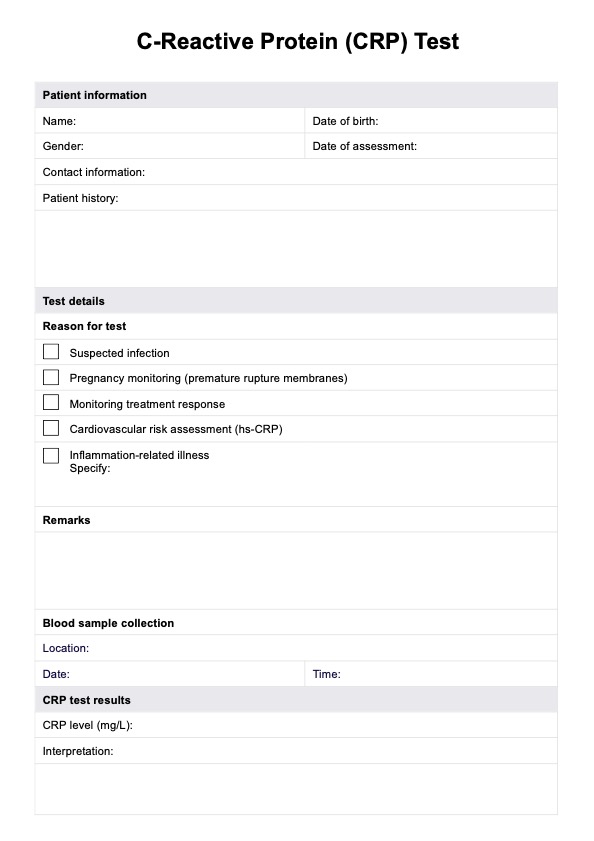
The CRP test is not a definitive diagnosis tool but plays a vital role in understanding inflammation's underlying cause. You can get the test request form from your healthcare provider or laboratory, but it's essential to consult your doctor before taking the test. They will provide you with the necessary forms and instructions for sample collection.







%2520Test.png)