


Lachman TestAI Template IconToolbar IconShare Icon

Lachman Test

Bernard Ramírez avatar

By Bernard Ramírez on Aug 18, 2025.

What is a Lachman Test?

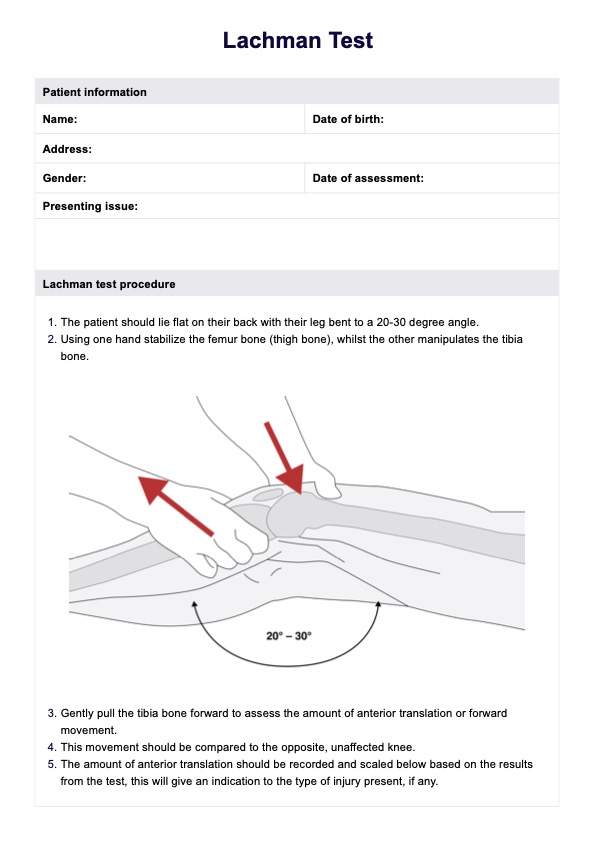
The Lachman Test is a diagnostic tool used to evaluate the anterior cruciate ligament's (ACL) stability in the knee joint. During the test, the examiner stabilizes the femur bone with one hand while pulling the tibia forward with the other. The amount of forward movement is then compared to the opposite, unaffected knee. If the ACL is intact, the tibia should have minimal forward movement. If an ACL tear is present, there will be abnormal movement, indicating damage.

Research has shown that the Lachman Test is one of the most reliable and accurate tests for diagnosing anterior cruciate ligament injuries, with a reported sensitivity of 77.7-100% and specificity of 85-98% (Katz & Fingeroth, 1986). However, the accuracy of the test can be affected by factors such as the skill and experience of the examiner, the patient's knee pain, muscle relaxation, and joint position, along with the severity of the injury.

In addition to the traditional manual Lachman Test, some variations use devices like arthrometers to measure anterior translation. These tools can provide objective and precise measurements but may not be as widely available. Other tests, like the pivot shift test, are often performed alongside it for comprehensive assessment.

Overall, the Lachman Test remains an essential tool for evaluating ACL injuries and is often used in conjunction with other clinical tests and imaging studies to guide treatment decisions for both acute and chronic knee injuries.

How does this printable Lachmans Test work?

The printable Lachman Test is a tool that healthcare professionals can use to assess the integrity and stability of the knee joint's anterior cruciate ligament. The test involves the manipulation of the tibia bone whilst the knee is flexed at a 20-30 degree angle. It is used to help establish if a patient has an anterior cruciate ligament tear (ACL tear) and is considered one of the most reliable tests for detecting a torn ACL.

Here are the steps involved in using/filling the template:

Step 1: Print out the Lachman Test template

Access the Lachman Test template by clicking "Use a template," allowing you to edit the resource via the Carepatron app. For a PDF copy, choose "Download."

Step 2: Physical examination

The patient should lie flat on their back with their injured leg bent to a 20-30 degree angle. Using one hand stabilize the femur bone (thigh bone), whilst the other manipulates the tibia bone. The examiner should gently pull the tibia bone forward to assess the amount of anterior translation or forward movement. This movement should be compared to the opposite, unaffected knee.

Step 3: Interpret the results

The results of the Lachman Test can indicate the presence of an ACL injury, with abnormal anterior translation suggesting a tear or damage to the ligament. Use the Additional notes section in the template to write down your findings.

Results and interpretation

The Lachman test evaluates anterior tibial translation to assess the condition of the ACL. Tibial movement of 5 mm or more beyond the normal limb's range typically indicates an ACL rupture. Additionally, more than 2 mm of anterior tibial translation in the affected knee compared to the unaffected knee is considered a positive test, suggesting an ACL injury.

Grading of ACL laxity is categorized into three levels based on the extent of anterior tibial translation compared to the uninjured side (Coffey & Bordoni, 2020).

  • Grade I (Mild): 0 to 5 mm of anterior tibial translation, indicating a minor injury with some preservation of ACL function.
  • Grade II (Moderate): 6 to 10 mm of anterior tibial translation, suggesting significant ACL damage but partial continuity of the ligament.
  • Grade III (Severe): 11 to 15 mm of anterior tibial translation, indicating a complete ACL rupture.

If anterior tibial translation exceeds 11 mm, the examiner should also evaluate for concomitant injuries, such as medial collateral ligament (MCL) tears or meniscal damage, which may contribute to joint instability. This grading system provides a comprehensive understanding of the ACL injury severity and informs treatment decisions.

When to use the Lachman Test and other ACL Tests?

ACL tests, including the Lachman Test, are typically used when there is suspicion of an ACL injury. The tests help evaluate knee joint stability and determine the severity and extent of ACL injuries. It can also be used to help rule out injuries to other structures, such as the posterior cruciate ligament.

Here are some situations where ACL tests may be appropriate:

Following a knee injury

ACL injuries often occur during high-impact sports or activities involving sudden direction changes or jumping. If a person experiences a knee injury during one of these activities, ACL tests may be used to determine if there is damage to the ligament.

Pre-operative assessment

Before undergoing ACL surgery, patients may experience a series of tests to evaluate the extent and severity of the injury. ACL tests can help guide surgical decision-making and provide valuable information for the surgical team.

Follow-up evaluation

After undergoing treatment for an ACL injury, patients may undergo follow-up evaluations to assess their progress and determine if additional treatment is necessary. ACL tests can evaluate knee joint stability and determine whether the ligament has healed adequately.

Athletic clearance

Athletes who have suffered an ACL injury may need to undergo testing to determine if they are ready to return to their sport. ACL tests can evaluate knee joint stability and determine if the athlete is ready to resume activity.

Who is this Lachman Test PDF for?

The Lachman Test PDF is a valuable resource for healthcare professionals who evaluate and manage knee injuries, particularly those involving the anterior cruciate ligament (ACL). Here are some practitioners who may find this helpful template:

Orthopedic surgeons:

Orthopedic surgeons diagnose and treat musculoskeletal injuries and conditions, including ACL injuries. The Lachman Test PDF can be a helpful tool for assessing ACL injuries and guiding treatment decisions, including surgical intervention.

Sports medicine physicians:

Sports medicine physicians focus on preventing, diagnosing, and treating sports-related injuries. ACL injuries are common in athletes, and sports medicine physicians may use the Lachman Test PDF to evaluate knee joint stability and determine the extent of the injury.

Physical therapists:

Physical therapists are healthcare professionals who specialize in rehabilitating musculoskeletal injuries and conditions. Physical therapists can use the Lachman Test PDF to assess knee joint stability and guide the development of a rehabilitation plan.

Athletic trainers:

Athletic trainers are healthcare professionals who work with athletes to prevent, diagnose, and treat sports-related injuries. The Lachman Test PDF can be useful for athletic trainers to assess knee joint stability and determine if an athlete is ready to return to play.

Physical Therapy Software Feedback

Commonly asked questions

A Lachman Test's accuracy depends on the examiner's skill and experience. Still, research suggests it can be reliable for diagnosing ACL tears and injuries when performed correctly.

No significant risks are associated with a Lachman Test, although patients with knee injuries or instability may experience some discomfort during the test.

A Lachman Test typically takes less than 5 minutes to perform. Still, the overall evaluation process may take longer depending on the injury's complexity and the examination's extent.

EHR and practice management software

Get started for free

*No credit card required

Free

$0/usd

Unlimited clients

Telehealth

1GB of storage

Client portal text

Automated billing and online payments