7 things you need to know before taking your healthcare remote 👊
Choose the right telehealth monitoring software
Choosing the right telehealth monitoring software could very well be the make or break of your healthcare practice. Clients will struggle to contact you without it, and you'll encounter more administration work, making your practice and day-to-day life arguably more difficult. Here are some things you'll want to ensure your software can do;
- HIPAA Compliance - As a mental healthcare practitioner, compliance should be at the top of your list… make sure your software provider does the same.
- Telehealth - Remote healthcare isn't possible without it. Why pay extra for an external provider?
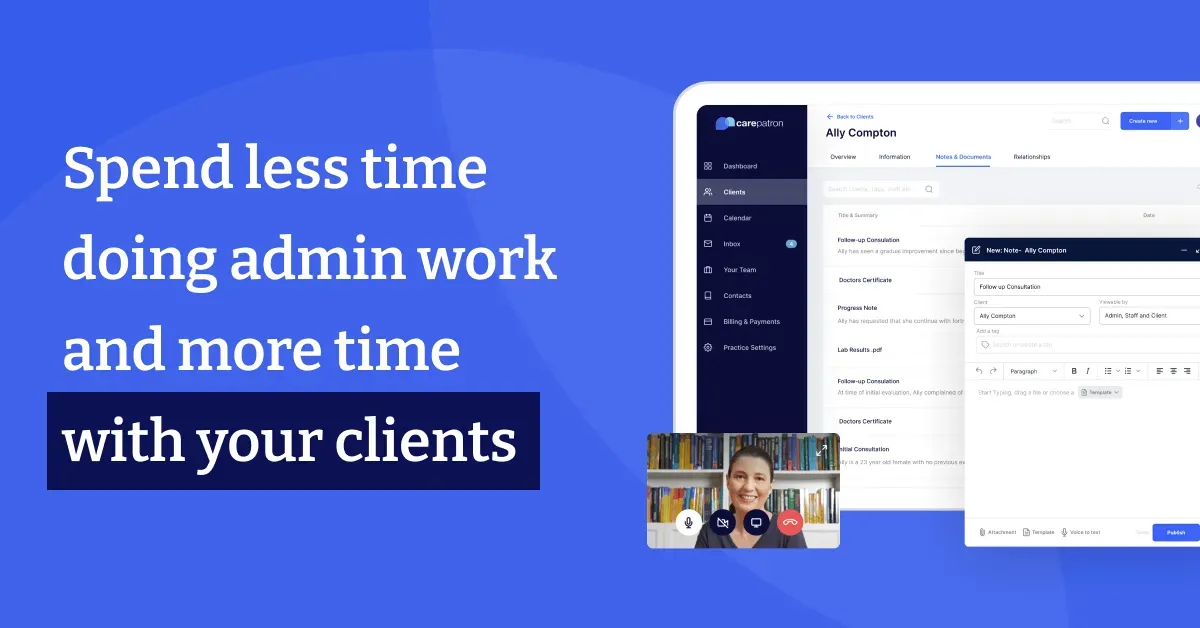
- AI Medical Transcription - Don't type when you can talk. Make sure your software has this capability, trust me. You'll thank me later.
- Collaborate – Working remotely. Bring your client and their care team together in one digital workspace. That means sharing information in an encrypted, HIPAA-certified environment.
- Mobile Healthcare – Remote healthcare requires access to your practice management app from any device, anytime.
- Autosave your work - One of my personal favorites, market leaders Carepatron, syncs work and notes every 0.002 microseconds. No. Losing. Work. Ever!
Measure patient data meaningfully
Remote patient monitoring arguably requires more attention to data. Making sure your clients are up to date with appointments, assessments, and medications they need. Seeing clients in person may enable a more thorough evaluation; staying up to date with how clients are progressing. Demographics are a significant one here, as if a client has moved or changed their phone number or email, you will likely have great difficulty getting in contact with them. In addition to this, ensuring that safety plans are up to date is vital as an acute client may struggle without meetings in person.
Choose user-friendly devices
Choosing devices that are user-friendly for yourself and your client are also crucial. There is nothing worse than talking to someone over a phone that doesn't work or a computer with the internet too slow to enable video calls. This can have a detrimental impact on the rapport built with clients if they cannot access you for appointments or are acute. This means not only having a user-friendly device but also that the software you're using is user-friendly. The last thing you want is for the software to create any barrier for the client to seek help.
Understand the technical aspects
Every software you use will have its technical processes and capabilities. Some will be a lot more straightforward than others, and some will be far more complex. Before selecting a mental health software platform, you'll want to consider what kind of practice you are working in, what discipline you practice, what your limitations are in terms of resources, and finally, what kind of requirements you'll have for your software platform. One software platform that we think is suitable for a broad scope of healthcare practitioners is Carepatron. The best part is that they have a free option, meaning you can try before you sign your life away!
Know the CPT codes for remote patient monitoring
Don't be afraid of CPT codes, and let them put you off remote patient monitoring! They are just simple codes used to denote physiological data gathered by the practitioner. Similar to DSM codes, RPM "service codes" — 99453 and 99454 enable the practitioner to develop and manage a treatment plan specific to the acute or chronic health condition currently being experienced by the client. This article by Foley has some great information if you want to read up some more… But in short, it's essential to know what the CPT codes are for remote patient monitoring, don't worry- no one expects you to learn them off by heart! But make sure you have access to a list of the codes to use in your assessment, formulations, and treatment plans.
Getting paid for remote healthcare monitoring
As we know, working from home can mean doing more hours, with the same output… Or, in other words, being unproductive. As a mental health practitioner, it is imperative, even if working remotely, to divide up your time and have a healthy schedule to avoid burnout and fatigue. Even though working remotely means you're nearly always available to your client's it doesn't mean you should be. Your mental health is important too! One bonus of keeping your work schedule rigid, even when working remotely, is that you'll ensure you get paid for the work you do. Significant for your business and mental health 🙌
Overall stay connected with your patients effectively even when remote
Taking long, unscheduled phone calls from clients at all hours of the day is not billable, and it's not healthy for you or your business, and while it may seem kind at the time, it could mean your clients lose you altogether. Just don't do it! While staying in contact with clients online is more straightforward and means you can meet with them for shorter periods more frequently. It doesn't mean that an unscheduled 10 minute call here and there is a good idea as it will result in your resources becoming even more scarce. To make remote healthcare viable, you need to ensure it's beneficial for you too! Remote monitoring healthcare is here to stay, so make sure you do it right the first time!