





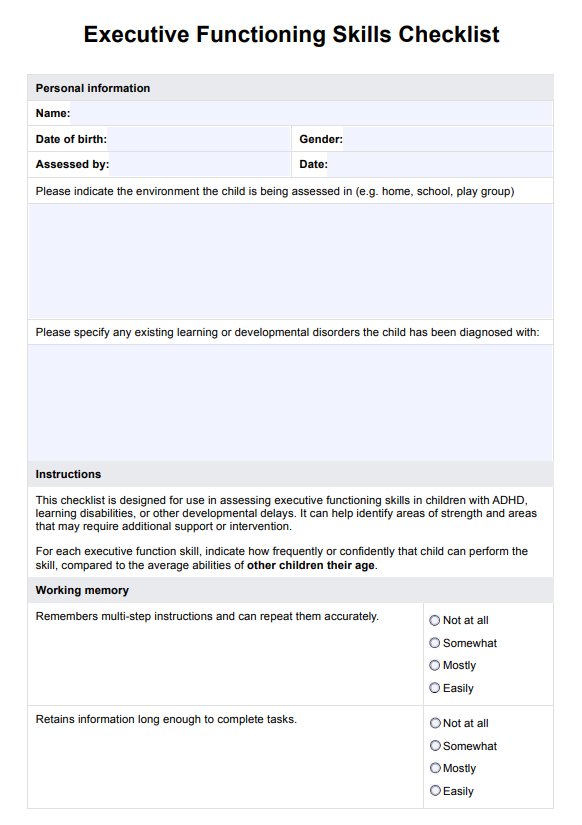




What are executive functioning skills?
Executive functioning skills are a set of high-order cognitive processes that enable individuals to plan, organize, and complete daily tasks effectively. These skills involve expending mental energy and are essential for professional or academic success and managing daily life. EFs are the cognitive abilities that facilitate goal setting, decision making, and adaptability.
Working memory
Working memory is crucial for holding, recalling and manipulating information over short periods. It allows people to remember multi step directions, organize thoughts, and apply learned concepts to new situations.
The efficiency of working memory increases rapidly during middle and late childhood as processing speed and inhibition skills increase. This is why, for example, average middle school students can solve much more complicated problems then children just a few years younger.
Emotion regulation
Emotion regulation involves managing emotions and stress levels, and is vital for maintaining appropriate social behavior, navigating social interactions, and coping with setbacks or frustration.
Time management
Time management entails planning, forethought, and allocating time effectively to various tasks. It helps with task completion, meeting deadlines and balancing activities.
Inhibitory control
Inhibitory control refers to the ability to resist impulses and distractions. Response inhibition is essential for maintaining focus and following rules.
Prioritization and decision-making
This skill involves determining the importance of tasks and making informed choices that align with goals. This includes the ability to break down a project into manageable parts and approach it systematically. The ability to prioritize tasks is critical for task completion.
Self-monitoring and task-monitoring
These skills involve tracking one's performance and progress on tasks. Children who self-monitor can recognize when they are off-task and adjust to stay focused. For example, students might check their work for errors and strive to improve based on feedback.
Task initiation
Task initiation is the ability to start tasks without undue procrastination or constant reminders. Good executive functioning helps students organize the steps of a task and then initiate action on each.
Attention and focus
Concentrating and avoiding distractions is crucial for learning and completing activities. Attention helps people stay engaged with their work.
Mental flexibility and adaptable thinking
Also known as cognitive flexibility, this skill involves switching between tasks, adapting to new situations, and considering different perspectives. Mental flexibility promotes creative problem solving.
Self-regulation
Self-regulation is a broad skill encompassing regulation of behavior, thoughts, and attention. It includes impulse control, remaining focused under pressure, and adjusting behavior based on the situation or feedback from others.
This skill is particularly difficult for children with developmental disorders such as attention deficit hyperactivity disorder (ADHD). In severe cases of executive dysfunction, children may be unable initiate action or stay focused on a specific goal or task independently.









