Everyone has a story to tell, and here we share and celebrate those who chose care as their life's work.
These are their words, their work and we're grateful to share them.
Elizabeth and Dennis handed their billing to Carepatron and grew My Therapeutic Concepts from five clients to seventy in two months, without losing their evenings.
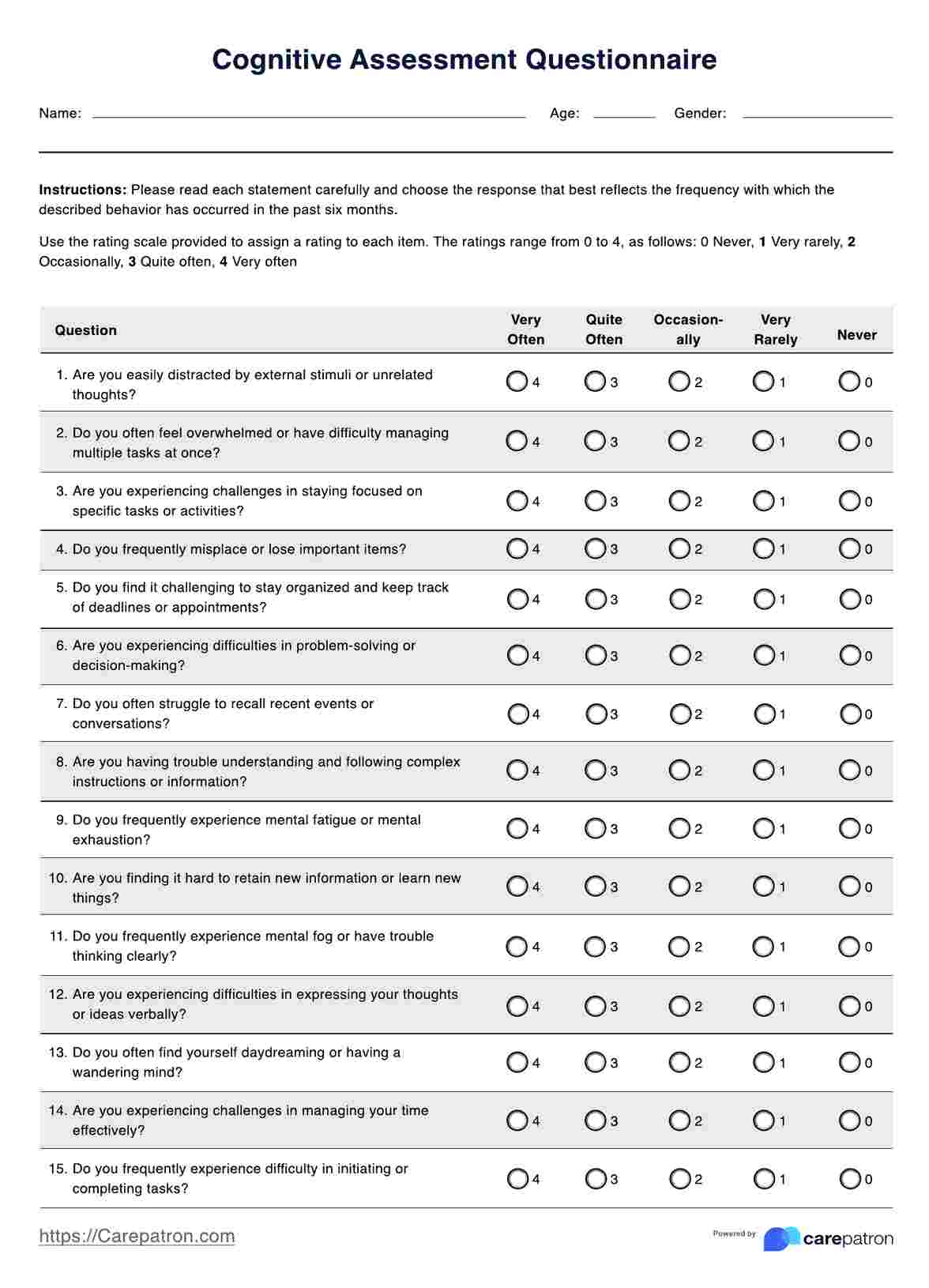
Looking for an assessment that you can use when conducting a comprehensive assessment of a patient with cognitive impairment? Read our guide to learn more about what to look for regarding cognitive impairment. Then, use the Cognitive Assessment Questionnaire to check if your patient potentially has cognitive issues.
## **Overview of cognitive impairment**
Cognitive impairment refers to a noticeable decline in a person's ability to think, learn, remember, use judgment, and make decisions, which goes beyond what is considered normal for their age (National Cancer Institute, 2025). Symptoms often include difficulties with memory, such as forgetting things often or missing appointments; trouble with language or following conversations; challenges with planning, organizing, or solving problems; and issues with concentration or understanding instructions (Mayo Clinic, 2025b).
While not an illness in itself, cognitive impairment is a symptom that can be mild to severe and can stem from various underlying causes, including medication side effects, depression, injury (e.g., traumatic brain injury), or conditions like delirium or dementia (Healthdirect Australia, 2025).
In many cases, cognitive impairment, particularly if it is mild cognitive impairment (MCI), is a risk factor or an early sign of dementia, which is a progressive condition that severely impairs daily life and can ultimately lead to an inability to perform self-care tasks, and in late stages, complications like infections or death (Anand & Schoo, 2024). Therefore, identifying the cause is crucial, as some forms of cognitive impairment are reversible with appropriate treatment.
## **What is a Cognitive Assessment Questionnaire?**
Cognitive testing plays a crucial role in evaluating and identifying cognitive impairment by assessing various aspects of cognition.
A Cognitive Assessment Questionnaire can help uncover a person's cognitive skills, strengths, and weaknesses. It is a set of organized questions meant to test different parts of the brain, like memory, attention, language skills, problem-solving, and executive functions.
Most of the time, the questionnaire is given as a self-report or informant-report measure. This means that the person or someone who knows them well, like a family member or carer, fills it out based on what they have seen and how they think the person is doing. The questions are carefully made to find out about specific cognitive domains, but they can also be used to find out about a wide range of cognitive skills.
A Cognitive Assessment Questionnaire aims to get a complete picture of how a person thinks and works. It helps doctors, researchers, or teachers find out about a person's cognitive strengths and weaknesses, look for signs of possible cognitive impairments, keep track of changes over time, and make choices about interventions or treatments based on accurate information.
The questionnaire may have questions about things like remembering meetings, following directions, and managing money. It may also ask if the person needs help paying attention, focusing, understanding words, or solving problems. It may also consider the person's or the informant's subjective experiences, such as memory problems or cognitive skill changes.
The Cognitive Assessment Questionnaire template can be utilized in a variety of clinical settings (e.g., primary care settings) by various healthcare practitioners. Examples include:
- **Diagnostic exams**: The questionnaire is especially helpful during diagnostic examinations for assessing cognitive functioning and identifying cognitive impairments or illnesses such as Alzheimer's disease or dementia.
- **Treatment planning**: The questionnaire aids in treatment planning by establishing baseline cognitive capacities, allowing healthcare providers to adjust treatments and treatment plans to specific strengths and deficiencies.
- **Progress monitoring**: When it comes to progress monitoring, having cognitive assessment tests is invaluable. It allows for regular assessments of cognitive capacities over time to evaluate the effectiveness of programs and make appropriate adjustments.
- **Research**: Researchers in psychology, neuroscience, and cognitive science can also utilize it to collect data for studies on cognitive processes and the impact of interventions.
- **Geriatric care**: The questionnaire is an important tool for routine cognitive examinations in older persons, assisting in diagnosing age-related cognitive decline and identifying relevant risk factors.
## **How does this Cognitive Assessment Questionnaire work?**
Cognitive Assessment Questionnaires help clients identify strengths and areas for improvement. Carepatron developed this questionnaire as a clinical tool to support your practice. However, it has not undergone formal validity or reliability testing. It should not be used as a diagnostic instrument or substitute for standardized cognitive assessments.
While this questionnaire isn't a validated assessment, it serves valuable purposes in clinical practice as an initial screening tool or as a way to start clinical discussion. Here are step-by-step instructions on how to use the template effectively during an appointment:
### **Step 1: Download the cognitive assessment questionnaire**
Make sure you have a full copy of the printable Cognitive Assessment Questionnaire. You can use the link on this page to download the PDF version.
### **Step 2: Give time for comprehension**
Provide plenty of time for your client to read the goal and instructions of the chosen cognitive assessment test. This aims to test things like memory, attention, problem-solving, and language skills.
### **Step 3: Set up the right environment**
Find a quiet and comfortable place where the individual can answer the cognitive assessment test without being interrupted. Give them enough time to fill out the form without hurrying.
### **Step 4: Give thought-out answers**
Make sure they know how important it is to answer each question honestly by selecting the right response that reflects the frequency of the behavior in the past six months. Not trying to guess or second-guess the answers is an important step for accurately evaluating cognitive skills.
### **Step 5: Review and calculate the results**
Take the time to look over the answers and calculate thoroughly. Should you need instructions on how to calculate the score, instructions are provided on our template.
Do remember that the results of these tests are only a sign of how well the brain is working, not a diagnosis. Detecting cognitive impairment may require further evaluation, additional cognitive ability tests, and other cognitive screening tools. Examples of assessments or tests for cognitive evaluation include the Mini-Mental State Examination (MMSE) and Montreal Cognitive Assessment (MOCA Test), which includes the clock drawing test, naming test, and attention test, etc.
## **Common strategies to prevent cognitive impairment**
Strategies to prevent or delay cognitive decline focus on modifying key lifestyle and vascular risk factors across the lifespan, as recommended by leading health organizations (Krueger et al., 2025). These include:
- Adopting a Mediterranean or MIND-style diet rich in fruits, vegetables, whole grains, nuts, and fish, while limiting processed foods, red meat, and sweets (Hara, 2022).
- Engaging in regular physical exercise, aiming for at least 150 minutes of moderate-intensity aerobic activity per week, is crucial (Centers for Disease Control and Prevention, 2024).
- Maintaining an active mind through lifelong learning, reading, and mentally stimulating hobbies like puzzles or strategy games.
- Furthermore, it is essential to remain socially active, get adequate, high-quality sleep, and aggressively manage cardiovascular risk factors like high blood pressure, high cholesterol, and diabetes, since what is good for the heart is generally good for the brain; finally, avoiding smoking and excessive alcohol consumption is strongly advised (Mayo Clinic, 2025a).
## **References**
Anand, S., & Schoo, C. (2024, January 11). Mild cognitive impairment. StatPearls Publishing. https://www.ncbi.nlm.nih.gov/books/NBK599514/#:~:text=It%20can%20represent%20an%20early,prompt%20conversations%20about%20future%20planning.
Centers for Disease Control and Prevention. (2024, October 25). Reducing risk for dementia. Alzheimer’s Disease and Dementia. https://www.cdc.gov/alzheimers-dementia/prevention/index.html
Hara, Y. (2022). Six strategies recommended by experts on how to reduce risk of cognitive decline. Cognitive Vitality. https://www.alzdiscovery.org/cognitive-vitality/blog/six-strategies-recommended-by-experts-on-how-to-reduce-risk-of-cognitive-decline#:~:text=Tips%20by%20the%20workgroup%20include,5.
Healthdirect Australia. (2025, October 7). Cognitive impairment. https://www.healthdirect.gov.au/cognitive-impairment#:~:text=impairment%20be%20prevented%3F-,What%20is%20cognitive%20impairment%3F,go%20from%20mild%20to%20severe.
Krueger, K. R., Mathieu Hainselin, Ayse Kuspinar, Breno, & Celeste. (2025). Editorial: Lifestyle and healthy aging to prevent cognitive decline and dementia. Frontiers in Dementia, 4, 1694494–1694494. https://doi.org/10.3389/frdem.2025.1694494
Mayo Clinic. (2025a). Dementia - Symptoms and causes. https://www.mayoclinic.org/diseases-conditions/dementia/symptoms-causes/syc-20352013
Mayo Clinic. (2025b). Mild cognitive impairment - Symptoms and causes. https://www.mayoclinic.org/diseases-conditions/mild-cognitive-impairment/symptoms-causes/syc-20354578
National Cancer Institute. (2025). NCI dictionary of cancer terms. https://www.cancer.gov/publications/dictionaries/cancer-terms/def/cognitive-impairment
Commonly asked questions
Questions in a cognitive assessment are designed to evaluate various mental abilities, not knowledge recall (like a history test). They typically include tasks that test verbal reasoning (e.g., understanding analogies or complex instructions), numerical reasoning (e.g., solving sequences or basic math problems), abstract reasoning (e.g., identifying patterns and relationships in non-verbal figures), spatial reasoning (e.g., mentally rotating shapes or understanding visual layouts), and working memory and attention (e.g., repeating sequences or focusing on specific stimuli).
A cognitive assessment, often called a cognitive test or intelligence test, is a standardized evaluation tool used to measure an individual's cognitive functions and potential, rather than learned skills or specific knowledge. It is composed of a series of subtests, each targeting a different domain of mental ability, such as executive functions, memory, attention, processing speed, reasoning, and problem-solving skills.
While there isn't one universal, definitive list of "5 cognitive tests," a comprehensive cognitive assessment often focuses on five core domains of cognitive ability such as memory, executive function, attention, language, and visuospatial skills. The specific tests used vary, but common and standardized batteries like the Mini-Mental State Exam (MMSE) or the Montreal Cognitive Assessment (MoCA) are often used for quick screening of these key areas.