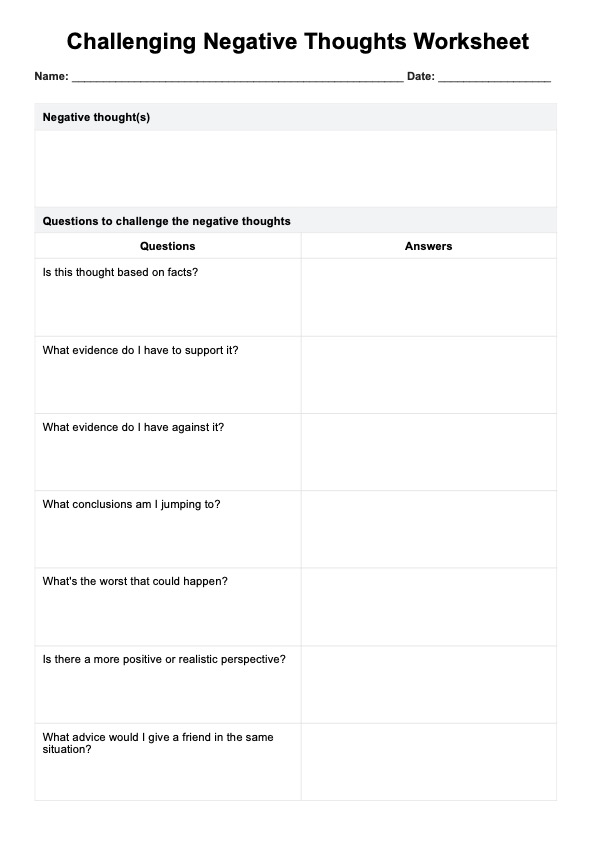
If your clients frequently experience negative thinking or self-critical inner dialogue, a Challenging Negative Thoughts Worksheet can help make cognitive restructuring more practical and effective. This tool guides you through evidence-based CBT strategies to help clients identify, question, and reframe distorted thoughts that impact their mental health and well-being.
## **How do negative intrusive thoughts emerge?**
Negative intrusive thoughts often appear without warning, but their roots are far from random. They stem from the way the brain processes emotion, memory, and stress—and how individuals interpret those internal experiences. These unwanted thoughts can range from fleeting worries to vivid, distressing images that seem to come “out of nowhere.” In reality, they’re linked to identifiable cognitive and neural mechanisms.
Intrusive thoughts often arise when the brain’s natural filtering system momentarily fails. Under typical circumstances, the prefrontal cortex works with regions like the anterior cingulate cortex (ACC) to regulate or suppress unhelpful mental content. However, when stress, fatigue, or anxiety are high, this top-down control weakens, allowing unwanted thoughts to surface and persist (Kalivas et al., 2023; Neuroscience News, 2022). These disruptions are especially tied to overactivity in the amygdala—the brain’s fear center, which triggers emotional responses before the rational brain can intervene.
Neurochemical factors also play a role. Low levels of gamma-aminobutyric acid (GABA), a neurotransmitter responsible for inhibiting unnecessary neural activity, can make it harder to “shut off” intrusive thoughts. Research from the University of Cambridge found that when GABA signaling in the hippocampus is reduced, individuals are less able to suppress unwanted memories or mental images, leading to repetitive, intrusive thought patterns (Schmitz et al., 2017).
Environmental and psychological stressors further intensify this process. Intrusive thoughts are more likely to occur during times of high emotional distress, trauma, or sleep deprivation. For example, individuals with anxiety disorders, obsessive-compulsive disorder (OCD), or post-traumatic stress disorder (PTSD) often experience intrusive thoughts as a symptom of the brain’s heightened threat sensitivity. The more a person tries to avoid or suppress these thoughts, the more attention they receive, creating a feedback loop where suppression paradoxically increases their recurrence (Rachman, 1978; Noroian, 2006)
Ultimately, negative intrusive thoughts emerge from a combination of neurobiology, cognition, and environment. They are not a sign of weakness or moral failing but rather a reflection of how the human brain manages fear, uncertainty, and control.
## **What is a Challenging Negative Thoughts Worksheet?**
A Challenging Negative Thoughts Worksheet is a structured cognitive behavioral therapy (CBT) tool that helps individuals identify and reframe automatic negative thoughts. These unhelpful thinking patterns often emerge in response to stressful or emotional situations and can reinforce anxiety, depression, and self-doubt. Grounded in cognitive restructuring, the worksheet guides users to question whether their thoughts are factual, explore evidence for and against them, and develop more balanced, realistic perspectives.
By walking through these prompts, individuals build greater self-awareness and learn how to manage distressing emotions more effectively. The worksheet promotes emotional regulation, resilience, and clearer thinking—supporting both personal growth and improved therapy outcomes. However, it works best when used consistently and under professional guidance. Some individuals may struggle to challenge deep-seated beliefs on their own, so combining the worksheet with therapeutic support or complementary techniques (such as mindfulness or behavioral activation) can enhance its effectiveness and sustainability.
## **How to use our Challenging Negative Thoughts Worksheet template**
Our Challenging Negative Thoughts Worksheet template provides healthcare professionals with a structured format for helping clients identify, analyze, and reframe negative thoughts. The template includes fields for recording responses and guiding patients or clients through key CBT-based questions. Follow these steps to use the template effectively:
### **Step 1: Access the template**
Start by downloading or accessing the worksheet. Click the “Use template” button to open it in the Carepatron app or select “Download” for a printable or fillable PDF version. This flexibility allows you to integrate it seamlessly into your workflow, whether in digital or physical form.
### **Step 2: Administer the worksheet**
You can administer the worksheet as part of a structured therapy session or provide it for independent reflection. Explain the purpose of the worksheet to the client, emphasizing how it will help them address negative thought patterns. For in-session use, guide them through the questions as an interactive dialogue and fill in the space provided for each question. Alternatively, you can allow the client time to respond independently.
### **Step 3: Review and discuss responses**
After completing the worksheet, review the client's answers together. Use the insights from their responses to identify recurring patterns in their thinking. Facilitate a discussion to help clients uncover a healthier, more realistic perspective and understand how their automatic thoughts influence their emotions and behaviors.
### **Step 4: Encourage continued use**
Encourage clients to use the worksheet whenever they encounter distressing thoughts. Provide them with a clean copy for homework or independent use. Highlight that consistent practice will lead to greater self-awareness and improved emotional regulation.
## **Other strategies to help the client fight negative thoughts**
Alongside CBT worksheets like the Challenging Negative Thoughts Worksheet, you can use other evidence-based techniques to help your clients recognize and manage unhelpful thought patterns. These approaches strengthen their ability to challenge negativity, improve mental health, and build long-term well-being.
### **Help your clients practice thought awareness and labeling**
Begin by helping your clients become more aware of their inner dialogue. Encourage them to identify and label negative thoughts as they arise, without judgment. For instance, they can note, “I’m having the thought that I’m not good enough,” rather than accepting it as fact. This awareness helps them create distance between themselves and the thought, reducing its emotional impact.
### **Use cognitive restructuring exercises**
Introduce [cognitive restructuring exercises](https://www.carepatron.com/guides/cognitive-restructuring/) to help clients evaluate whether their thoughts are accurate and balanced. Studies show that cognitive restructuring, one of the core techniques of CBT, reduces anxiety and depression by replacing irrational beliefs with more positive and realistic interpretations (Hofmann et al., 2012). You can prompt your clients with questions such as, “What evidence supports or contradicts this thought?” or “How might you view this situation if you were calmer or talking to a friend?” These structured yet straightforward reflections help shift thinking toward healthier perspectives.
### **Integrate mindfulness and acceptance-based strategies**
Mindfulness-based techniques complement CBT well. Encourage your clients to view their thoughts as fleeting mental events rather than as defining truths. Regular mindfulness practice has been shown to improve emotional regulation and well-being while reducing reactivity to distressing thoughts (Keng, Smoski, & Robins, 2011). Combining mindfulness with CBT worksheets can help clients observe their mental patterns, accept difficult emotions, and reduce the power of negativity over their daily lives.
### **Encourage positive behavioral activation**
You can also use [behavioral activation exercises](https://www.carepatron.com/guides/behavioral-activation-therapy/) to help clients counter withdrawal and isolation. Encourage them to engage in small, positive activities that promote enjoyment or a sense of accomplishment, such as spending time outdoors, journaling, or reconnecting with friends. Behavioral activation has strong evidence for improving mood and motivation, especially when used alongside CBT interventions (Dimidjian et al., 2006).
## **References**
Dimidjian, S., Hollon, S. D., Dobson, K. S., Schmaling, K. B., Kohlenberg, R. J., Addis, M. E., Gallop, R., McGlinchey, J. B., Markley, D. K., Gollan, J. K., Atkins, D. C., Dunner, D. L., & Jacobson, N. S. (2006). Randomized trial of behavioral activation, cognitive therapy, and antidepressant medication in the acute treatment of adults with major depression. Journal of Consulting and Clinical Psychology, 74(4), 658–670. https://doi.org/10.1037/0022-006X.74.4.658
Hofmann, S. G., Asnaani, A., Vonk, I. J. J., Sawyer, A. T., & Fang, A. (2012). The efficacy of cognitive behavioral therapy: A review of meta-analyses. Cognitive Therapy and Research, 36(5), 427–440. https://doi.org/10.1007/s10608-012-9476-1
Kalivas, P. W., Gourley, S. L., & Paulus, M. P. (2023). Intrusive thinking: Circuit and synaptic mechanisms of a transdiagnostic psychiatric symptom. Neuroscience and Biobehavioral Reviews, 150, 105196. https://doi.org/10.1016/j.neubiorev.2023.105196
Keng, S. L., Smoski, M. J., & Robins, C. J. (2011). Effects of mindfulness on psychological health: A review of empirical studies. Clinical Psychology Review, 31(6), 1041–1056. https://doi.org/10.1016/j.cpr.2011.04.006
Neuroscience News. (2022, April 18). The brain employs an alarm system to suppress intrusive thoughts - neuroscience news. https://neurosciencenews.com/acc-intrusive-thoughts-20393/
Noroian, P. (2006). Intrusive Thoughts in Clinical Disorders: Theory, Research, and Treatmentedited by David Clark, Ph.D.; New York, Guilford Press, 2005, 255 pages, $35. Psychiatric Services, 57(9), 1345–1345. https://doi.org/10.1176/ps.2006.57.9.1345
Rachman, S. (1978). Human fears: A conditioning theory and the treatment of fear. Behaviour Research and Therapy, 16(3), 237–249.
Schmitz, T. W., Correia, M. M., Ferreira, C. S., Prescot, A. P., & Anderson, M. C. (2017). Hippocampal GABA enables inhibitory control over unwanted thoughts. Nature Communications, 8(1), 1–12. https://doi.org/10.1038/s41467-017-00956-z