









What is the Ambivalent Sexism Inventory (ASI)?
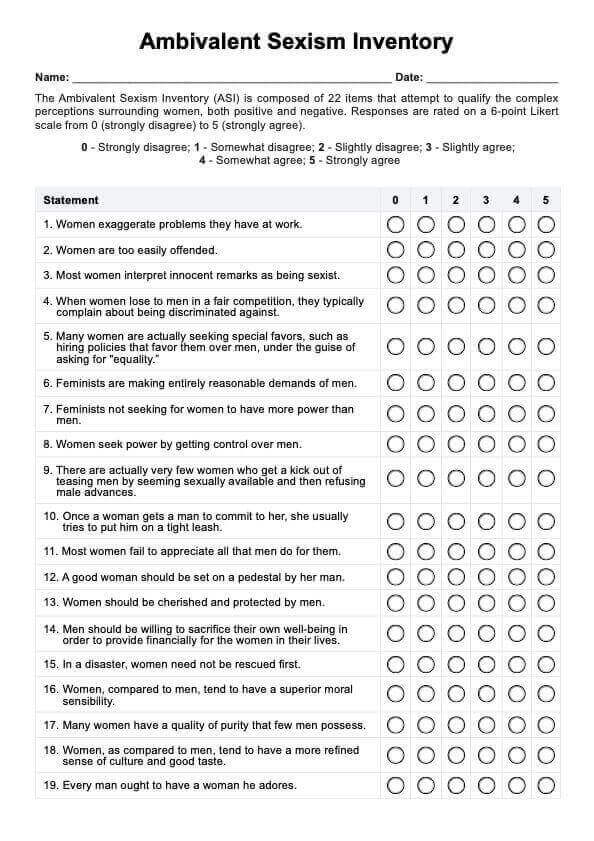
The Ambivalent Sexism Inventory (ASI) is a psychological assessment tool developed by Peter Glick and Susan Fiske in 1996. It was created to measure two distinct but related forms of sexism: hostile and benevolent sexism.
Hostile sexism encompasses overtly hostile attitudes and stereotypes about women. One example is viewing most women as manipulative, that women seek to gain power or control over men. Another is the belief that women lose to men in a fair competition because they are inferior, or that many women fail in certain activities because they don't have the same capabilities as men.
In contrast, benevolent sexism includes seemingly positive but patronizing beliefs that suggest women should be protected, cherished, or placed on a pedestal. These are subjectively positive perceptions in that the men holding these beliefs think that these are good things, even when they are not. These also include acceptance of the gender difference while still making women out to be better.
The ASI's purpose is to capture the dual nature of sexism for both men and women, differentiating hostile and benevolent sexism, and recognizing that both hostile and benevolent attitudes can perpetuate gender inequality.
The inventory has demonstrated high validity and reliability across diverse populations, with Cronbach's alpha coefficients typically ranging from 0.80 to 0.92 for the overall scale, and 0.70 to 0.92 for the subscales. This strong internal consistency makes the ASI a trusted tool for assessing sexist ambivalence and gender attitudes in both research and clinical settings.









