


Illinois Agility TestAI Template IconToolbar IconShare Icon

Illinois Agility Test

Learn how to conduct the Illinois Agility Test. Download a free PDF template for easy clinical documentation.

Use Template

What is the Illinois Agility Test?

The Illinois Agility Test, also known as the Illinois agility run test, is a widely recognized assessment used to evaluate an individual’s agility and speed, particularly in terms of rapid changes in direction. The test involves navigating through 11 turning points, requiring deceleration, acceleration, and quick directional changes of 90-180 degrees over a 60-meter course. The goal is to complete the test in the shortest time possible, showcasing an athlete’s ability to maneuver with speed and control.

While it primarily measures agility, the test is also an effective tool for assessing change-of-direction speed and maneuverability, key components in team sports like basketball, soccer, and football. The course is set up with cones placed at equal distances, ensuring a consistent challenge for athletes to demonstrate their agility. By incorporating this test into agility training programs, athletes can track their progress and improve their ability to navigate complex movements, which are essential in team sports.

How to conduct the Illinois Agility Test

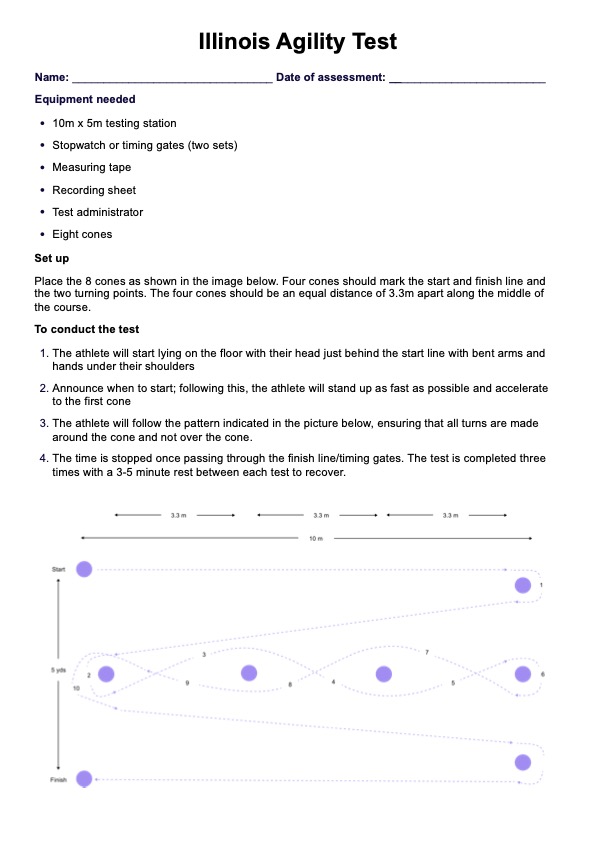
The Illinois Agility Test requires specific equipment, including a 10m x 5m testing area, a stopwatch or timing gates (two sets), a measuring tape, a recording sheet, a test administrator, and eight cones.

To set up the test, arrange the eight cones as shown in the diagram (not included). Four cones should mark the start and finish lines and the two turning points. The remaining four cones should be spaced equally, 3.3 meters apart, along the center of the course.

The athlete begins the test lying on the floor with their head just behind the start line. Their arms should be bent, with hands placed under their shoulders. When the test administrator gives the signal to start, the athlete quickly stands and accelerates toward the first cone.

The athlete must follow the specified pattern around the cones, ensuring each turn is made around them rather than over them. The time is recorded when the athlete crosses the finish line. The test is completed three times, with a rest period of 3–5 minutes between attempts to allow for recovery.

Illinois Agility Test Template

Download PDF Template

How to use our free Illinois agility run test template

Our free Illinois Agility Test template is free and easy to use. Follow these steps to get started:

Step 1: Download the template

Click the "Use template" button to access the test template via the Carepatron app. This lets you modify the form to cater to your needs. For a PDF copy, click "Download."

Step 2: Customize the template

Once you’ve accessed the template, tailor it to fit your requirements. You can edit the sections to match the specifics of your test, such as participant details, timing methods, or additional observations. This ensures the form aligns perfectly with your testing protocol.

Step 3: Conduct the test

Use the template to record the athlete’s performance. Note the time taken for each attempt and any observations or comments during the test. The form provides a structured way to track results efficiently.

Step 4: Review and analyze

After completing the test, review the recorded data. Use it to assess the athlete’s agility, identify areas for improvement, and track progress over time. The organized layout makes it easy to compare results from multiple sessions.

Step 5: Save or share

Save the completed form within the Carepatron app for future reference. If needed, share the results with the athlete or other relevant parties by exporting the form as a PDF or using the app’s sharing features.

How to score the Illinois Agility Test

Scoring the Illinois Agility Test is easy because it doesn’t require calculating anything. All you need to do is record the time a test taker took to accomplish the test. The record time they have will be the one that determines what their level of agility is!

To help you out, here’s a table that you can refer to so that you know what level the test taker is at:

Illinois Agility Test Scoring

If you decided to have them do multiple trials, you just need to calculate the average.

Uses of the Illinois Agility Test

The Illinois Agility Test is a versatile tool with applications across various fields. One of its primary uses is in the training programs of athletes and sports teams, particularly those involved in sports like basketball, soccer, and football. These sports require high levels of agility, quick directional changes, and rapid acceleration or deceleration. By incorporating this test into their routines, coaches and trainers can evaluate an athlete’s agility, identify areas for improvement, and monitor progress over time (Physiopedia, 2016).

Moreover, the test is valuable in educational settings. It can be a tool for assessing and enhancing students’ agility as part of their overall physical fitness development. Physical education programs often integrate the test to help track individual or group progress, set personalized fitness goals, and encourage the development of essential motor skills.

The Illinois Agility Test is also widely used in clinical and rehabilitation contexts. In these settings, it is employed to assess a patient’s agility and functional recovery after treatment for injuries, particularly those affecting mobility (Raya et al., 2013; Salimi & Ferguson-Pell, 2020). Notably, it has been utilized in rehabilitation research to assess service members recovering from traumatic lower limb loss. Such applications provide valuable insights into a patient’s recovery journey, helping clinicians refine rehabilitation strategies and set realistic recovery milestones (Gailey et al., 2013).

Who can conduct the Illinois Agility Test for their work?

The Illinois Agility Test is best conducted by professionals who understand how the test should be organized and done, meaning they have a comprehensive understanding of the steps needed to accomplish it and how to score it. These professionals will likely be Physical Therapists, Fitness Trainers, and Sports Team Coaches.

These professionals have the certifications and expertise needed to not just conduct the Illinois Agility Test, but also to observe the test takers in terms of their form while performing the test. This is so they can remind them of the proper or optimal form to prevent test takers from falling and getting injured while running.

Rehabilitation specialists can also use this as part of rehabilitation programs developed and implemented for certain patients. It’s a good way for them to properly monitor their patients’ respective recovery progress as well as to help them get back to their former agility level or an optimal level, especially if the patients are athletes.

For those thinking of including the Illinois Agility Test as part of their work, one thing to note is that this test is not suitable for everyone. Test takers should be relatively healthy (somewhat healthy is okay since the test has designations for those with poor agility). If a person has joint or muscle problems, they are at risk of getting injured while partaking in this activity, so it’s best to get medical clearance before taking the test.

Physical Therapy Software Feedback

Commonly asked questions

That's up to you. It's recommended that you do three or more to ensure consistency in the results; however, if you decide to have them do several trials, please make sure to observe whether they are tired.

Yes. This test may not be suitable for people with pre-existing joint or muscle problems. Before they can participate in this exercise, these people need to procure medical certificates that allow them to take the test. Also, this test only assesses a person's speed/agility. It doesn't account for strength or endurance.

Yes. The number of cones for the Illinois Agility Test is strictly eight, especially because the scoring benchmarks are also based on that number.

EHR and practice management software

Get started for free

*No credit card required

Free

$0/usd

Unlimited clients

Telehealth

1GB of storage

Client portal text

Automated billing and online payments