How to use our TESI template
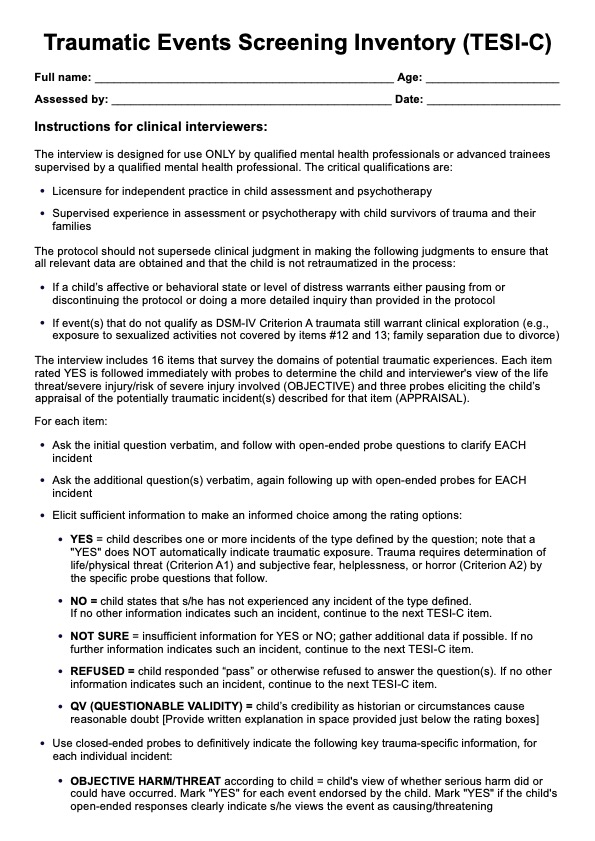
It is crucial that the TESI-C interview protocol is followed closely and responsibly to avoid damaging a child's recollection or causing further harm to their mental health. Here is how it works:
Step 1: Access the template
Open the free TESI-C protocol template by clicking "Use template," which opens it on the Carepatron app's template editor. From there, you can customize it, fill it out digitally, or print it. You can also get a ready-to-use and printable PDF by clicking "Download."
Step 2: Initial procedure
As a qualified psychologist, you should have licensure for independent practice in child assessment and psychotherapy, and supervised experience in assessment or psychotherapy with young survivors of trauma and their families. It is best if you have preexisting rapport with the child but no personal investment (to avoid skewing their reporting). If you are not familiar with the child, include a rapport building phase prior to the interview. Input key identification information for the child and about yourself, as well as the date.
Step 3: Begin the protocol
There are 16 items on the TESI-C, each of which pertains to a category of traumatic events. Ask the initial question for the first item verbatim, then follow up with open-ended probes to clarify each incident that fits within that category.
Step 4: Ask clarification questions
Next, ask the additional questions for that item verbatim, following up with open-ended probes where necessary for each of the incidents described. These questions are designed to clarify the nature of the incident and check whether the event meets A1 criteria in the DSM-V for traumatic stressors. These questions are only necessary if the child has not already provided the information in their initial explanation.
Step 5: Check DSM-V criteria
For each incident in that item, ask close-ended questions to determine if the incident qualifies as a traumatic stressor under trauma-specific A2 DSM-V criteria:
- Objective harm/threat - in the child's view, whether serious harm did or could have occurred
- Objective harm/threat - in your view as the interview, based on information provided by the child, whether the incident caused or threatened severe physical harm/death to anyone involved
- Subjective appraisal of extreme fear - whether the child felt extreme fear in or immediately following the incident
- Subjective appraisal of helplessness - whether the child felt helpless in or immediately following the incident
- Subjective appraisal of horror - whether the child felt sick, disgusted, or horrified in or immediately following the incident.
Each of these criteria should be marked yes or no separately for each incident.
Step 5: Rate the item
When you have sufficient information, rate the item as yes, no, not sure, refused, or questionable validity based on the guidelines in the template. If the incident meets both A1 and A2 criteria, ask the follow-up questions and record their answers.
Step 6: Repeat
Repeat steps 3-5 for all remaining items. If the information provided in subsequent questions indicates a need to clarify or revise the rating of any prior question, it is appropriate to do so. If at any point the child becomes distressed, pause or discontinue the assessment.
Step 7: Finish the interview
Review all the items to see if any missing information needs to be gathered or clarified. Create a clinical summary of your findings.