The Prone Instability Test is a physical examination procedure that aims to detect lumbar instability or abnormal movement patterns. It's a staple test conducted by physical therapists, orthopedists, and similar professionals, and it's a must for any clinical practice specializing in orthopedics.
This clinical test requires the patient to assume a certain position and maintain it for a few seconds. Depending on whether they can maintain this position or not, and if they feel pain and test positive, their lumbar spine may be compromised.
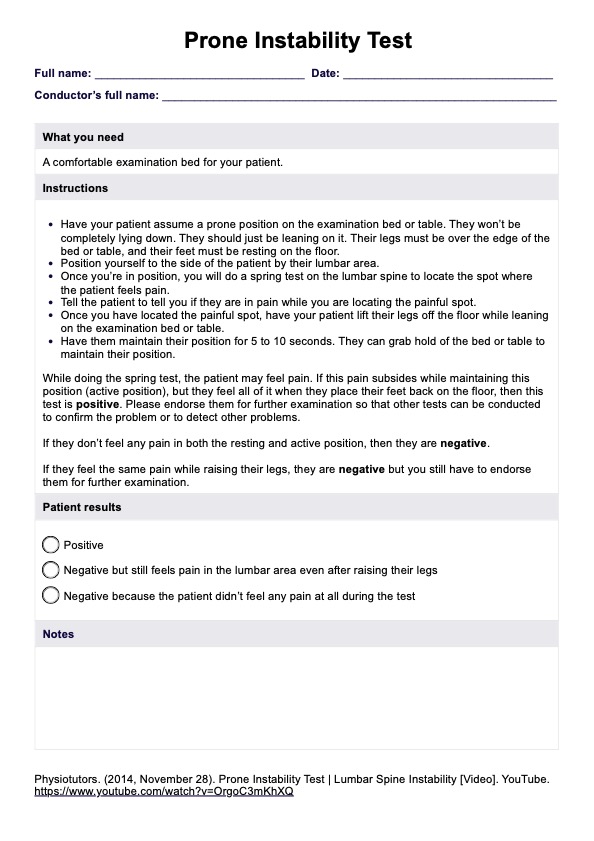
Before you do anything, the one thing that you have to prepare is a comfortable examination table or bed. This test requires the patient to assume a prone position. Once you have this ready, do the following (but demonstrate all of this first):
Step 1: Have your patient assume a prone position on the examination bed or table. They won't be completely lying down. They should just lean on it to place only their upper half on the bed or table. Their legs must be over the edge of the bed or table, and their feet must be resting on the floor.
Step 2: Next, you, the conductor, will position yourself to the patient's side by their lumbar area.
Step 3: Once you're in position, you will do a spring test on the lumbar spine. This means you will apply downward pressure on the lumbar area until you can locate the spot where the patient feels pain.
Step 4: Tell the patient to tell you if they are in pain while you are locating the painful spot.
Step 5: Once you have located the painful spot, have your patient lift their legs off the floor while leaning on the examination bed or table.
Step 6: Have them maintain their position for 5 to 10 seconds. They are allowed to grab hold of the bed or table to maintain their position.
And those are the steps on how to conduct the Prone Instability Test properly. All you need to do is to conduct the test and then tick any of the three results options on the template. The template also has a Notes section where you can discuss your findings and plans.
How to interpret the findings of the test
To determine the diagnostic accuracy of the results of the Prone Instability Test, you need to take note of the painful spot you located by performing the spring test on the lumbar spine area.
Positive test result
Once the patient raises their legs and maintains their position, ask them if they feel the same pain while keeping their legs raised. If their pain subsides while maintaining this position (active position), but they feel all of it when they place their feet back on the floor, then this test is positive.
Negative test result
They are negative if they don't feel pain in both the resting and active positions. They are still negative if they feel pain in both positions because the Prone Instability Test checks if the pain subsides when the patient assumes the active position. If that's the case, they may have other problems concerning spinal stiffness in their lower back.
If they provoke pain and are positive, the next step is to endorse them for further examination so that other tests can be conducted. Even with a positive designation, it doesn't mean that the problem is 100% lumbar spine instability. It might be a different problem, so other tests will help you confirm it. If they are negative but feel pain, endorsing them for further examination is still the best option.
When is it best to conduct the test?
If a patient shows up for an appointment and tells you about pains in their lower back or recurrent chronic lower back pain, that's the best time to tell them you will perform the Prone Instability Test.
The Prone Instability Test is included as part of a comprehensive examination. It should not be used as the sole assessment to determine the actual problem of a patient's lower back.
That's not to say that the test is unreliable. It is because it can determine if lumbar shear instability is the problem based on a certain factor, but that doesn't necessarily mean that it's just lumbar spine instability. There might be more to the patient's lower back. Other tests, especially imaging tests like magnetic resonance imaging, will help determine if lumbar spine instability is the actual problem and if the patient has other lower back problems like lumbar lordosis or lumbar spondylolisthesis contributing to their (chronic) low back pain.
Who can conduct the Prone Instability Test?
Since the Prone Instability Test is meant to assess patients with lower back problems and it is essentially a physical examination technique, the best healthcare professionals that can perform this test are those who have been highly trained to assess, diagnose, and treat musculoskeletal problems, especially in the lumbar area. These professionals would be:
Orthopedists
Physical therapists
Occupational therapists
Physiotherapists
Chiropractors
Rehabilitation specialists
These professionals specialize in treating such problems and are trained to properly execute physical examination techniques so their designations are, more or less, on the mark. They also have a grasp of other tests that should be conducted based on the Prone Instability findings, and they can properly analyze positive test results and determine the best treatment that the patient needs.
It is best to leave the execution of the Prone Instability Test to the experts, even if the instructions seem easy. This test should be restricted to them because they know how to conduct it safely.
Since this test involves pain, professionals will be able to perform the spring test easily and apply the necessary amount of pressure necessary to elicit the pain, and then they can provide support if needed during the part where the patient has to raise their legs. If performed incorrectly or if too much pressure is applied, the possible pre-existing condition that the patient has might get aggravated or worsen. So, it's best to leave it to the experts.
Commonly asked questions
The Prone Instability Test is a physical examination technique. The instructions are simple, and it can be accomplished in 1 to 5 minutes.
That depends. The technique itself isn't painful. However, patients might feel pain during the part where the professional does a spring test or when the patient has to lift their legs and feet. The pain will come from an already-existing condition, though.
Yes and no. Yes, because the test specifically looks for a certain factor in order to test positive, which is the subsiding of lumbar pain when patients lift their legs. No, because the pain might not necessarily be the fault of lumbar spine instability, other physical examination tests will have to be conducted to fully confirm what the problem is (like the passive lumbar extension test) or to reproduce results.