


Stanford-Binet TestsAI Template IconToolbar IconShare Icon

Stanford-Binet Tests

Download Carepatron's Stanford-Binet IQ Test Scoring Sheet free PDF here. Effectively gather results and findings with this sheet.

ウィノナ・ジュゲタ avatar

By ウィノナ・ジュゲタ on Aug 18, 2025.

Fact Checked by ゲールアラゴス.

Use Template

What is a Stanford-Binet intelligence test?

The Stanford-Binet intelligence test, specifically the Stanford-Binet Intelligence Scales, Fifth Edition (SB-5), is one of medical professionals' most used intelligence tests. It follows a standardized cognitive assessment system that is used to evaluate intelligence quotient (IQ) scores across different age groups (Roid & Pomplun, 2012). Developed from the original Binet-Simon Scale, it has evolved into the Stanford-Binet Intelligence Scale (SB5), measuring intelligence through structured mental testing. This test assesses multiple aspects of cognitive ability, including fluid reasoning, knowledge, quantitative reasoning, visual-spatial processing, and working memory.

The assessment consists of subtest scores derived from both verbal and nonverbal tasks, ensuring a comprehensive measure of intelligence. The test evaluates mental age by comparing individual performance to standardized norms. Fluid reasoning assesses problem-solving without prior knowledge, while quantitative reasoning measures numerical skills. Visual-spatial processing evaluates pattern recognition, and working memory examines short-term information retention.

The Stanford-Binet Intelligence Scale typically involves one-on-one administration by trained professionals and adapts based on the test-taker’s responses. Results provide insights into cognitive strengths and weaknesses, aiding in educational planning, developmental assessments, and clinical evaluations. The test remains a widely used tool in mental testing, offering a detailed analysis of intellectual functioning through reliable IQ scores and structured subtest scores.

Stanford-Binet Tests Template

Download PDF Template

What is a Stanford-Binet IQ Test Scoring Sheet?

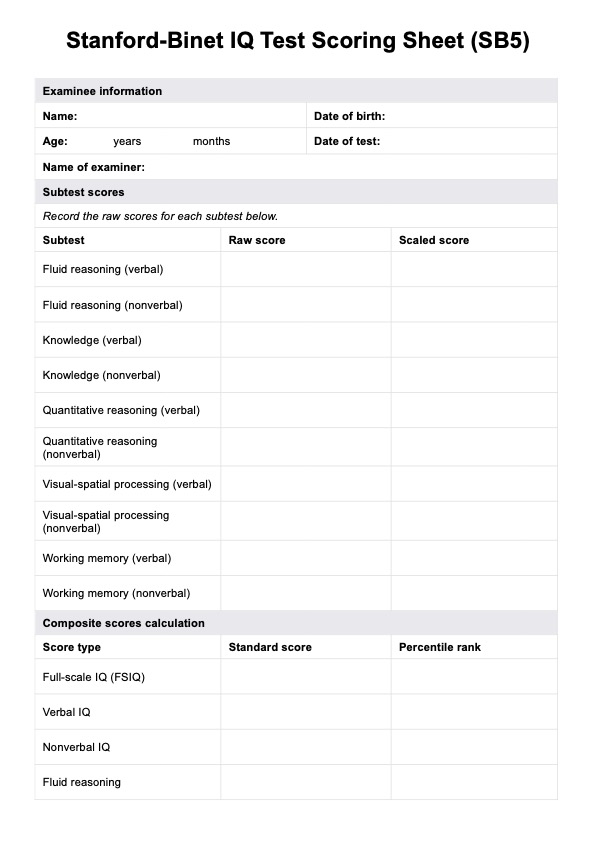
The Stanford-Binet IQ Test Scoring Sheet is a structured tool used in psychological assessment to record and analyze test results from the fifth test edition of the Stanford-Binet scale. It helps medical professionals document test performance across multiple cognitive areas. The sheet includes raw scores for subtests, which are converted into composite scores, including full-scale IQ (FSIQ), verbal IQ, and other domain-specific measures.

This scoring sheet facilitates the deviation IQ calculation, ensuring standardized chronological age comparisons. The test's primary scale measures adult intelligence and cognitive abilities across different age groups. By systematically organizing results, the scoring sheet allows professionals to interpret data effectively, aiding in measuring IQ for diagnostic, educational, and clinical purposes. It is essential for deriving accurate intelligence classifications and understanding cognitive strengths and weaknesses.

How does this work?

Medical professionals can efficiently administer and score the Stanford-Binet IQ test using Carepatron’s Stanford-Binet IQ Test Scoring Sheet. This structured template ensures accurate documentation of test results, facilitating clear analysis and interpretation. Follow these steps to access and utilize the template effectively.

Step 1: Access the template

Click “Use template” to open and customize the Stanford-Binet IQ Test Scoring Sheet in the Carepatron app. The template is easy to modify and features fillable tables and a structured format for efficient scoring. It streamlines psychological assessment for everyday use with built-in fields for raw scores, composite scores, and interpretations.

Step 2: Use the template when conducting the test

During the SB5 assessment, enter raw scores for each subtest directly into the template. The structured format ensures that all components, including composite scores, Full Scale IQ, Verbal IQ, and domain-specific indices, are accurately documented for later interpretation.

Step 3: Gather data and interpret scores

Once test administration is complete, analyze test performance by converting raw data into standardized deviation IQ and ratio IQ scores. Compare results against established norms to assess cognitive ability, chronological age, and adult intelligence, ensuring accurate psychological evaluation.

Step 4: Provide further patient education and next steps

Use the results to guide further action, whether for clinical diagnosis, educational recommendations, or cognitive development planning. Discuss findings with the patient’s care team, ensuring that appropriate interventions or follow-ups are implemented based on the test results.

Scoring and interpretation

The Stanford-Binet IQ test evaluates intelligence through subtest scores categorized into five cognitive factors: fluid reasoning, knowledge, quantitative reasoning, visual-spatial processing, and working memory. Each subtest yields a raw score, which is converted into a scaled score and combined to determine composite scores, including Full Scale IQ (FSIQ), Verbal IQ (VIQ), and Nonverbal IQ (NVIQ).

The test is standardized with a mean IQ score of 100 and a standard deviation of 15, ensuring a normal distribution. IQ classifications range from below 70 (low average) to 130+ (gifted intelligence). While the test provides a structured measure of intelligence, results should be interpreted cautiously, considering factors such as chronological age, test conditions, and external influences.

Medical professionals use Stanford-Binet Intelligence Scale scores to assess cognitive ability, support clinical diagnoses, and guide educational planning. However, intelligence extends beyond numerical scores, requiring comprehensive psychological assessment for accurate conclusions.

Who is this Stanford-Binet IQ Test PDF for?

The Stanford-Binet IQ Test PDF is a valuable resource for professionals and practitioners in assessing cognitive abilities and providing support services to individuals across different settings. Here are some of the key groups that can benefit from using this template:

1. Educators

Educators, including teachers, school psychologists, and school counselors, can use this to assess students' cognitive abilities, identify giftedness or learning disabilities, and inform educational planning. The test results can help tailor instruction, interventions, and support services to meet students' unique needs and optimize learning outcomes.

2. Clinical Psychologists

Clinical psychologists can utilize this to evaluate clients' cognitive abilities as part of a comprehensive psychological assessment. The test can aid in diagnosing learning disabilities, developmental concerns, or other cognitive disorders and guide treatment planning and therapeutic interventions.

3. Career Counselors

Career counselors may find this useful for assessing clients' cognitive strengths and weaknesses, which can inform career guidance and vocational planning. By understanding an individual's intellectual abilities, counselors can help clients make informed decisions about their career paths and identify areas where they might excel or need additional support.

4. Researchers

Researchers in psychology, education, and human development can use this tool to gather data on cognitive abilities across various populations. The test can be employed in studies investigating the nature of intelligence, factors influencing cognitive development, and the effectiveness of interventions designed to enhance cognitive functioning.

5. Special Education Professionals

Special education professionals, including special education teachers, diagnosticians, and resource specialists, can use the Stanford-Binet IQ Test PDF to assess students with special needs and inform individualized education plans (IEPs). The test results can provide valuable insights into students' cognitive abilities and help determine appropriate accommodations, modifications, and support services to facilitate their academic success.

Psychology Software Feedback

Commonly asked questions

The Stanford-Binet test is a standardized assessment designed to measure an individual's intelligence quotient (IQ) through a variety of cognitive abilities, making it one of the most widely used intelligence tests in educational and clinical settings.

The five factors assessed by the Stanford-Binet test include fluid reasoning, which evaluates problem-solving skills; knowledge, which measures accumulated information; quantitative reasoning, which assesses numerical abilities; visual-spatial processing, which involves understanding spatial relationships; and working memory, which examines short-term information retention.

The average score for the Stanford-Binet IQ test is 100, with a standard deviation of 15. This means that most individuals score within the range of 85 to 115, reflecting typical cognitive abilities.

EHR and practice management software

Get started for free

*No credit card required

Free

$0/usd

Unlimited clients

Telehealth

1GB of storage

Client portal text

Automated billing and online payments