



What is classical conditioning?
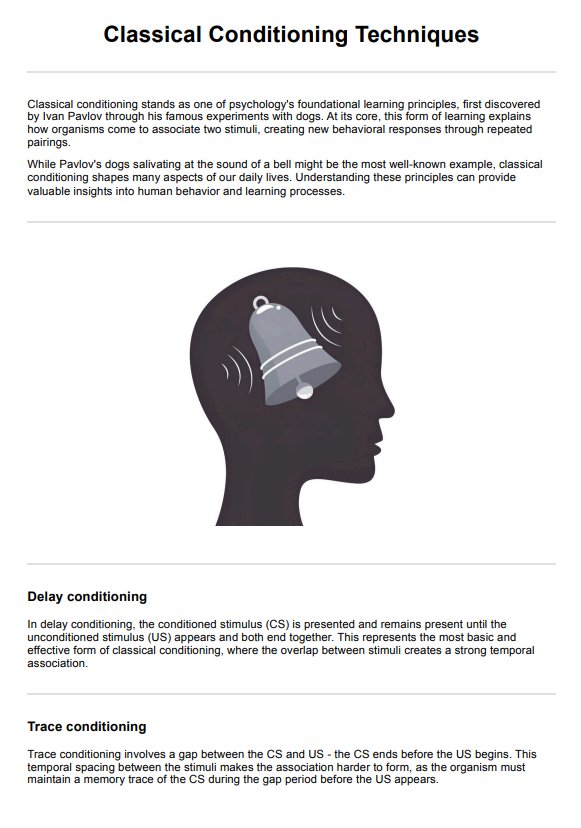
Classical conditioning, often referred to as Pavlovian conditioning, is a fundamental learning process in which a neutral stimulus (NS) is paired with an unconditioned stimulus (US) to elicit a conditioned response (CR). This technique was famously demonstrated in Pavlov's experiment, where he found that dogs could learn to associate the sound of a bell (the previously neutral stimulus) with the presentation of food (the unconditioned stimulus) (McLeod, 2022).
As a result, the dogs would salivate (the unconditioned response) in response to the bell alone after repeated pairings, illustrating how a neutral stimulus can become a conditioned stimulus (CS) that triggers the same response as the unconditioned stimulus. This example of the classical conditioning process highlights the principles of classical conditioning, which are essential for understanding various aspects of human behavior and emotional responses.
Classical conditioning involves several key components: the unconditioned stimulus (US), which naturally elicits an automatic response; the unconditioned response (UR), which is the innate reaction to the US; and the conditioned stimulus (CS), which is derived from the neutral stimulus after it has been paired with the US. Over time, through repeated associations, the previously neutral stimulus can evoke a conditioned response similar to the original unconditioned response.
This learning mechanism is crucial in behavioral therapy, where it can be used to modify maladaptive behaviors and emotional responses (Domjan, 2015).