


What are the Reasons for Living Inventory?
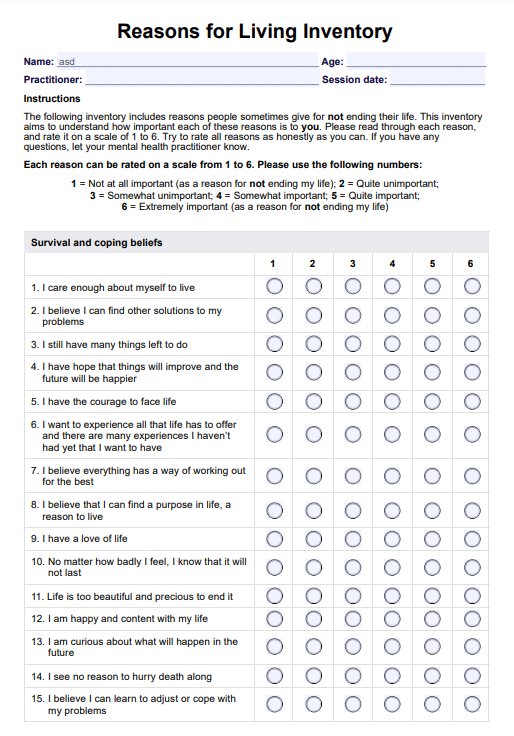
The Reasons for Living Inventory (RFL) is a 48-item self-report measure designed to evaluate a range of brief reasons individuals often give themselves for staying alive and not ending their lives. Designed by Linehan et al. (1983), this inventory encompasses six subscales:
- Survival and coping beliefs: This assessment assesses the client’s beliefs about their ability to cope with stress and adversity and their general outlook on survival.
- Responsibility to the family: This measure measures the client's sense of obligation or connection toward their family members.
- Child-related concerns: Clients often express concerns about the impact of their actions on their children’s lives, which can often serve as a powerful motivator for them to continue living.
- Fear of suicide: Assesses the client’s fear or aversion to the act of suicide itself, including the potential physical, emotional, and social consequences.
- Fear of social disapproval: Gauges the client's concern about how others, particularly their social circle or community, might view or react to their actions.
- Moral objections: Measures the client’s internal moral or ethical beliefs that prevent them from considering suicide; these are often rooted in religious or philosophical values, and they may identify suicide as morally wrong.
Individuals who undertake this inventory use a Likert scale from 1 (not at all important) to 6 (extremely important) to indicate how important each reason is to them.
It has often been subject to confirmatory factor analysis and has successfully displayed a robust factor structure, revealing the distinct dimensions of reasons for living (Pirani et al., 2020). These factor analyses examine how different psychological traits, such as coping skills and social support, clustered together and influenced overall mental well-being.
Practitioners within clinical psychology and clinical child psychology can use this inventory to gain a comprehensive understanding of the client's suicidal ideation or to assess the suicide risk factors surrounding previous suicide attempts. However, this resource can also be used to understand the client’s support systems better and provide an initial assessment of their current emotional state and other risk factors, such as suicide-related behaviors.