Everyone has a story to tell, and here we share and celebrate those who chose care as their life's work.
These are their words, their work and we're grateful to share them.
Elizabeth and Dennis handed their billing to Carepatron and grew My Therapeutic Concepts from five clients to seventy in two months, without losing their evenings.
Looking for a way to track your patient's trauma from when the trauma formed and how it has been affecting them to this day? Read our guide to learn about trauma timelines and use our Trauma Timeline Worksheet to help them look back on their trauma ever since they had it and how it has evolved or whittled down over time. This will help you gain a better understanding of what ultimately caused the trauma to begin with, learn how long it's been since they've been traumatized, and understand how they've grappled with it over time to determine what you can do to help them work through it.
## **What is a trauma timeline?**
A trauma timeline is a model used by mental health professionals who specialize in helping patients/clients work through their respective traumas through trauma therapy or similar work (psychiatrists, psychologists, counselors, therapists, social workers, etc.). While it can be used to pinpoint the origins of a person's trauma, the trauma timeline helps professionals and patients map not only painful memories and past events, but also to track their healing journey/trauma recovery process until it becomes past trauma (Understanding the Trauma Timeline: How Trauma Impacts Us, 2025).
It also records trauma symptoms and overwhelming emotions that have developed after the traumatic experience, whether immediately, days, months, or years after said experience. All of these will be used to determine what the patient is dealing with (e.g., post-traumatic stress disorder, complex trauma) and recognize patterns, painful emotions, physical reactions, as well as behaviors (coping mechanisms), that have developed over time (Dayton, 2015).
All this information will be used to determine plans to kickstart, maintain, and further the healing process of patients, and they will become part of their life story/life narrative when they decide to look back at the tumultuous periods of their lives.
## **What is a Trauma Timeline Worksheet?**
### **A record of traumatic memories and key events**
Traumatic events can have a devastating impact on individuals, leading to long-term physical, psychological, and emotional challenges. The experience of trauma can be any event or series of events that causes an individual to feel overwhelmed and powerless.
Trauma can involve one-time events, such as experiencing an earthquake or car accident, or experiencing ongoing or chronic events like exposure to domestic violence or childhood neglect.
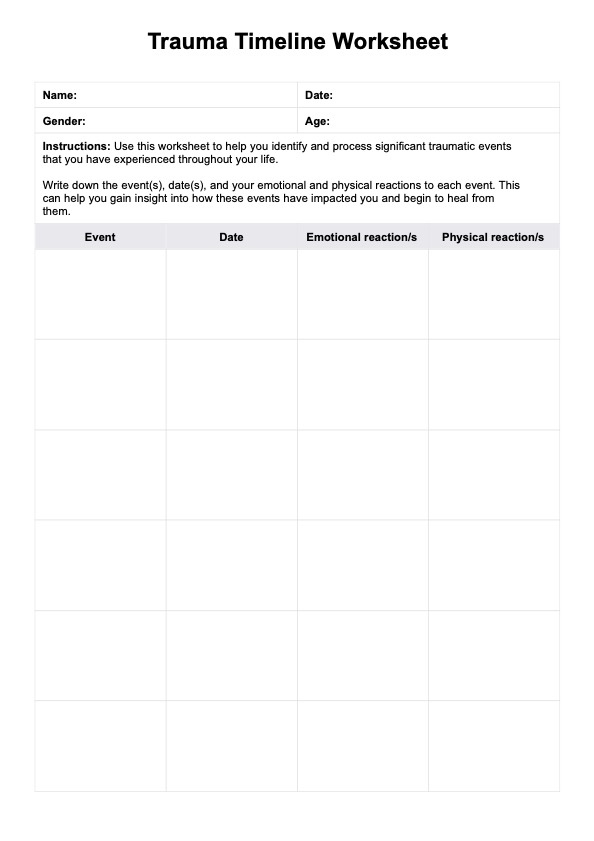
As a mental health professional, you can use this Trauma Timeline Worksheet to help patients better track and understand the timeline of their trauma. The worksheet is designed to act as a record of events that occur before, during, and after a traumatic event. Additionally, it can help individuals recall details they may not have remembered otherwise and work through the trauma safely and effectively.
These worksheets have spaces where patients/clients can write down and describe what specific key events took place that caused them to experience trauma/contributed to their trauma, when they happened (even if only vaguely), and what emotional and physical responses they had to these events.
### **Why should you use this kind of worksheet?**
The Trauma Timeline Worksheet can be used for various trauma-related cases. You may use this worksheet if and when you need to better track the timeline of a traumatic event. This can be useful for assessing the impact of an event and providing a frame of reference for your patient's treatment. It can be used to create a safe space for your patient to talk about their experiences.
This worksheet can also serve as a conversational framework for promoting dialogue about traumatic memories; it can help your patient discuss their traumatic experience in more depth. It can also help identify the root of their issues and work through them. Asking questions and discussing the timeline of events can help them work through their trauma.
In some cases, you may need to document the trauma for medical or legal purposes. The Trauma Timeline Worksheet can provide an accurate and detailed event record.
## **How does this Trauma Timeline Worksheet PDF work?**
Using the Trauma Timeline Worksheet, you can help individuals map the timeline of a traumatic experience. To get started, follow these simple steps:
### **Step 1: Download the worksheet**
Get a copy of the Trauma Timeline Worksheet using the download link provided on this page. You can also access it from the Carepatron app by clicking on ‘'Use template.''
### **Step 2: Give your patient a copy**
Hand your patient a copy of the Trauma Timeline Worksheet. Explain how it works and answer any questions they may have.
### **Step 3: Discuss the worksheet components**
Our Trauma Timeline Worksheet template is simple to use. It only has four components that your patient needs to engage with:
- **Event**: This is where they can briefly or descriptively describe traumatic events that they've had to undergo, or events that might have contributed to their trauma symptoms.
- **Date**: This is where they indicate the specific time and date when the traumatic event happened. If they are unable to recall the specific time and date, they can at least indicate when they think it happened, whether the season of a year, or just the month of a certain year.
- **Emotional reactions**: This is where they discuss the specific emotions they've felt before, during, and after the traumatic event.
- **Physical reactions**: This is where they discuss how they reacted physically to the event. It's also a section where they can discuss their behaviors that may have emerged due to the event.
Instruct your patient to begin filling out the worksheet by briefly describing traumatic events that may have happened to them. Give them enough time to complete the assessment.
### **Step 4: Review the worksheet**
Once your patient has completed the Trauma Timeline Worksheet, review it together and use it as an opportunity to discuss their trauma. Encourage your patient to talk about how they were feeling and what was going through their mind at different points leading up to and following the traumatic events they listed. Such discussions will help you chart a course for them where they can learn things like emotional regulation and develop strategies that not only help them work through trauma but also lead to their personal growth.
### **Step 5: Secure the form**
Because this Trauma Timeline Worksheet contains confidential information, make sure to securely store it in accordance with [HIPAA](https://www.carepatron.com/feature/hipaa-compliant-online-forms) and other applicable privacy regulations.
## **Other trauma-related tools you can use**
- [**Trauma and the Brain: List of Techniques to Cope**](https://www.carepatron.com/templates/trauma-and-the-brain-list-of-techniques-to-cope): After you and your patient establish their trauma timeline, you can take advantage of our handout showing the different coping techniques they can use to healthily cope instead of resorting to negative coping mechanisms. This handout can teach them like deep breath and the 5-4-3-2-1 technique.
- [**Trauma Arousal Worksheet**](https://www.carepatron.com/templates/trauma-arousal-ptsd-worksheet): Even if your patient has established their trauma timeline, that doesn't necessarily mean you've identified their trauma/PTSD triggers, despite having recognized some patterns. Use this worksheet to help them identify their triggers so you can develop methods for them to avoid or manage these triggers healthily.
- [**Self-Injury Trauma Scale**](https://www.carepatron.com/templates/self-injury-trauma-scale): If your patient is confirmed to engage in self-harming/self-injuring behaviors, you can use this scale to learn about the severity of these behaviors. This is important to know because this will help you determine the needed interventions to prevent them from engaging in self-harming behaviors and, instead, resort to healthy coping strategies.
## **References**
Dayton, T. (2015). The trauma time line. The Journal of Psychodrama, Sociometry, and Group Psychotherapy, 63(1), 83–86. https://doi.org/10.12926/0731-1273-63.1.83
Sabino Recovery. (2025, September 25). Understanding the trauma Timeline: How Trauma Impacts Us. https://www.sabinorecovery.com/trauma-timeline/
Commonly asked questions
Worksheets are tools that are important to mental health professionals. They might seem like assignments, but these are essential to mapping key events, symptoms, emotional states, and more that need to be identified to help kickstart one's healing journey.
If they're more comfortable that way, yes. However, this is trauma we're seeking to address. They might be so affected by whatever traumatized them that they might not know where to start. We recommend being there to ask guide questions because doing so will nudge them in a direction where they can look back at what happened to them.
You can use it as much as you want. The spaces the worksheet has are limited, so we recommend having multiple copies to better keep track of everything in the patient's trauma timeline. We also recommend using this every now and then throughout the patient's healing journey so you and your patient can see how far they have come.