



Raisin Meditation Mindful Eating ExerciseAI Template IconToolbar IconShare Icon

Raisin Meditation Mindful Eating Exercise

Practice mindfulness and mindful eating via the Raisin Meditation! Learn more about this type of mindful eating exercise through this guide.

Matt Olivares avatar

By Matt Olivares on Aug 2, 2025.

Fact Checked by Nate Lacson.

Use Template

What is mindful eating?

Mindful eating is a form of mindfulness meditation practice that applies all the principles of regular mindfulness, specifically to the act of eating. By emphasizing being fully present in the moment, mindful eating allows you to savor your food while staying in the present.

It's all about warding off all distractions, meaning you won't pay attention to anything you hear and see. It's also about what you're eating and savoring every bite you make.

Mindful eating practices emphasize the importance of refraining from labeling our thoughts as "good" or "bad." Instead, it encourages us to savor the experience of food by focusing on its taste, texture, and aroma. By eating slowly and mindfully, we can appreciate flavors and how we feel while eating. Reflecting on the effort put into preparing the food enhances the experience and instills gratitude for the hands that made it possible.

This approach cultivates an appreciation for food and moderation, fostering self-awareness and allowing us to recognize our hunger and fullness cues. Through mindful eating, we can develop a more balanced perspective and relationship with food, empowering us to avoid both undereating and overeating.

Raisin Meditation Mindful Eating Exercise Template

Download PDF Template

How to practice the Raisin Meditation Mindful Eating Exercise

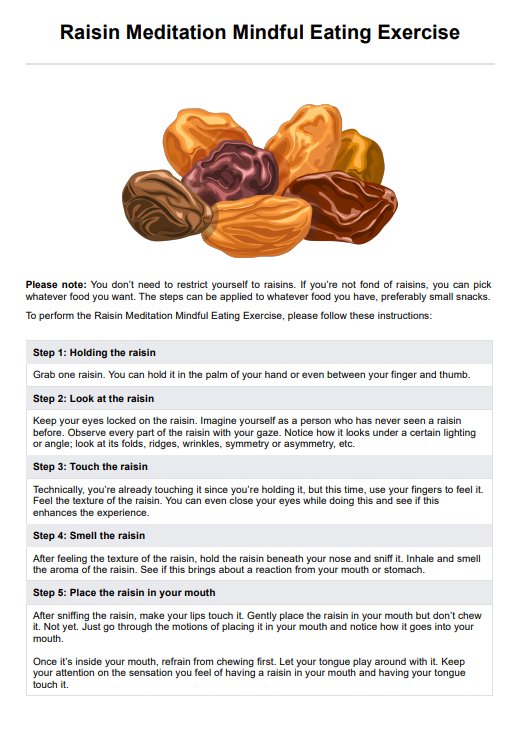
One mindful eating exercise that your clients should try is the Raisin Meditation (also known as the Mindful Raisin Exercise), which was made by the mindfulness teacher Jon Kabat-Zinn. This exercise only has eight steps, which means it's pretty easy to do.

Here are the steps to teach your clients when you introduce mindfulness meditation so they can practice this particular exercise:

  1. Holding the raisin: Grab one raisin. You can hold it in the palm of your hand or even between your finger and thumb.
  1. Look at the raisin: Keep your eyes locked on the raisin. Imagine yourself as a person who has never seen a raisin before. Observe every part of the raisin with your gaze. Notice how it looks under a certain lighting or angle; look at its folds, ridges, wrinkles, symmetry or asymmetry, etc.
  1. Touch the raisin: Technically, you're already touching it since you're holding it, but this time, use your fingers to feel it. Feel the texture of the raisin. You can even close your eyes while doing this and see if this enhances the experience.
  1. Smell the raisin: After feeling the raisin's texture, hold it beneath your nose and sniff it. Inhale and smell the aroma of the raisin. See if this brings about a reaction from your mouth or stomach.
  1. Place the raisin in your mouth: After sniffing the raisin, make your lips touch it. Gently place the raisin in your mouth but don't chew it. Not yet. Just go through the motions of placing it in your mouth and notice how it goes into your mouth. Once it's inside your mouth, refrain from chewing first. Let your tongue play around with it. Keep your attention to the sensation you feel of having a raisin in your mouth and having your tongue touch it.
  1. Tasting the raisin: Slowly chew the raisin. Raisins are small, so slowly chewing it will allow it to remain in your mouth longer. When you take a bit, try to direct your attention to what happens after each bite. Notice the taste and what happens to the texture, its shape, and how it feels right on your teeth. Pay attention to any changes in the raisin as you chew.
  1. Swallow the raisin: Once you feel the intent to swallow the raisin, indulge the intent. Focus your attention on the raisin falling down your throat and into your stomach. Notice the sensations you feel as you swallow.
  1. Reflect on the experience: Direct your attention to how your mouth feels after swallowing the raisin. How and what does your body feel? Do you want to take another bite of a raisin? Is there an aftertaste? Are you satisfied with what you ate? Reflect on the overall experience of eating a single piece of raisin.

Don't forget to tell them to take a few deep breaths now and then as they practice mindful eating! Also, make sure to take note of their eating habits because if they're the type to be quick with their food intake, it would be best to emphasize that they have to take slow, small bites so they can focus on the present moment and eat their food or the raisin mindfully.

When is it best to practice the Raisin Meditation Mindful Eating Exercise?

The best time to practice the Raisin Meditation Mindful Eating Exercise depends on the purpose.

For mindfulness coaches, such as yourself, incorporating this exercise into your classes, whether online or in person, is ideal. Although the Raisin Meditation Mindful Eating Exercise may seem solitary when reading a handout, practicing it in a group setting can enhance its benefits, especially for those focused on teaching mindful eating. Eating together fosters a sense of togetherness, and by savoring each bite, feeling the sensations, and appreciating the food and its preparation, practicing in a group can deepen the appreciation for shared meals.

For non-professionals who enjoy occasional mindfulness practice, the Raisin Meditation Mindful Eating exercise can be practiced at any time, especially when seeking a break from stress and work. Some people turn to eating as a means of relaxation and stress relief. Engaging in this mindful eating exercise can enhance the experience and promote a greater sense of relaxation.

Benefits of a mindfulness eating exercise

Here are some of its advantages:

It can be performed using any kind of food

If your clients are not fond of raisins, you can have them swap it out with another food they actually want to enjoy. The important part of the exercise isn't the raisin. The most important things are the experience and going through the exercise steps, so don't let the name of the exercise restrict them from ever doing this.

This exercise and mindful eating can have good benefits to eating attitudes

By embracing mindfulness principles, the practice of mindful eating can foster a healthier relationship with food. With its focus on attentively savoring the sensations of eating, this practice encourages individuals to embrace the idea that occasional indulgence is permissible and that eating should be a source of joy.

Mindful eating also promotes a heightened awareness of one's body, enabling individuals to gauge their hunger and fullness levels better, thereby helping to prevent overeating or undereating. Ultimately, it cultivates a deeper appreciation for the culinary arts and the process of food preparation.

It can be done anywhere, anytime! So long as there's food

Whether your client has a small bag of chips or any other food at hand, they can engage in mindful eating exercises effortlessly. When they find themself overwhelmed by stress, whether it's at home or work, they can grant themself a well-deserved break by dedicating a few minutes to the Raisin Meditation exercise, using whatever food they have available.

This practice can help them achieve a state of relaxation and tranquility, empowering them to confront any challenges that may have been troubling them. Sometimes, all they need is a brief respite.

Commonly asked questions

It can take at least 10 minutes. Maybe 30 minutes. It depends on the person and how long they want to practice this.

No. You can do this on your own. We recommend searching for online videos to help you practice mindfulness until you fully understand how mindfulness works and normally goes.

Yes. It’s up to you. The steps can be applied to any food.

EHR and practice management software

Get started for free

*No credit card required

Free

$0/usd

Unlimited clients

Telehealth

1GB of storage

Client portal text

Automated billing and online payments







