
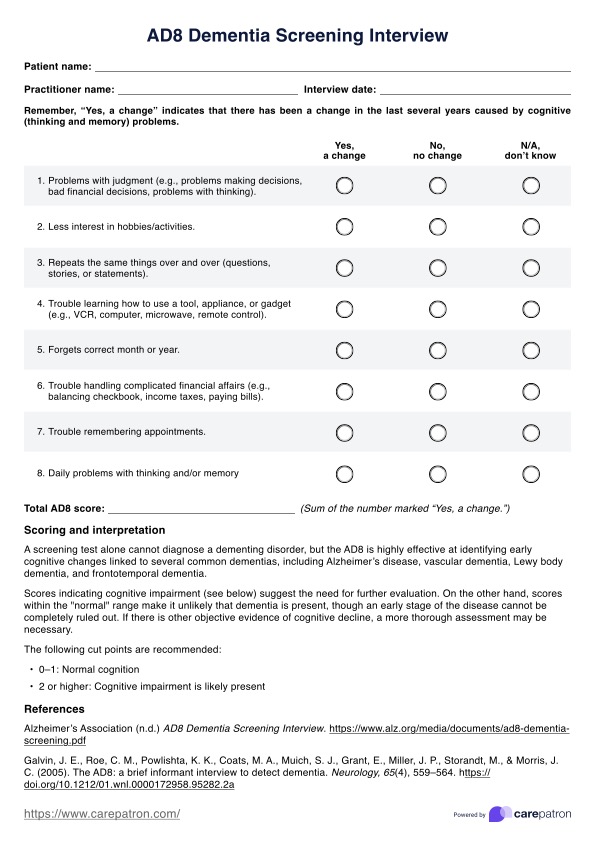




What is the AD8 Dementia Screening Interview?
The AD8 Dementia Screening Interview is a brief informant interview designed to detect cognitive impairment and cognitive ability to help differentiate between normal aging and cognitive decline, including mild cognitive impairment (MCI) and mild dementia. It is used primarily in primary care settings and geriatric emergency department patients, serving as a practical tool to screen for early signs of dementia, particularly Alzheimer's disease. The AD8 is widely utilized due to its ability to detect early cognitive change with high sensitivity and negative predictive value.
Developed by the Knight Alzheimer Disease Research Center of Washington University and evaluated on the Diagnostic and Statistical Manual of Mental Disorders (DSM), the AD8 is a brief informant interview that asks about specific changes in the patient's cognitive abilities, memory, and behavior. The questions cover common signs of dementia, such as problems with memory, attention, judgment, and mood changes, which are key cognitive domains typically affected in Alzheimer's disease and other forms of dementia.
Unlike comprehensive neuropsychological tests, the AD8 dementia screening is designed to be quick and easy, making it suitable for primary care settings and geriatric outpatient clinics. It is especially useful in a primary care setting or during a Medicare annual wellness visit, allowing healthcare providers to screen for dementia time-efficiently.
The AD8 consists of eight simple yes/no questions evaluating cognitive domains compared to baseline measures of function. A higher score indicates greater concern for cognitive decline, leading to a formal neuropsychological evaluation or a clinical assessment using tools like the Mini-Mental State Examination (MMSE) or the Clinical Dementia Rating Scale (CDR) for a more comprehensive diagnosis. This allows clinicians to assess cognitive function and differentiate between normal cognitive aging and more serious cognitive conditions like Alzheimer's disease.









