
The SLUMS test, or Saint Louis University Mental Status Examination, is a tool used to assess cognitive function and detect mild cognitive impairment and early dementia stages. It differs from the Mini-Mental State Examination (MMSE) in several ways. The SLUMS test includes more complex tasks, such as financial calculations and naming animals, making it more sensitive in detecting early cognitive changes. It is also considered more effective in distinguishing between normal cognitive function and mild neurocognitive disorder, especially in higher-education individuals.
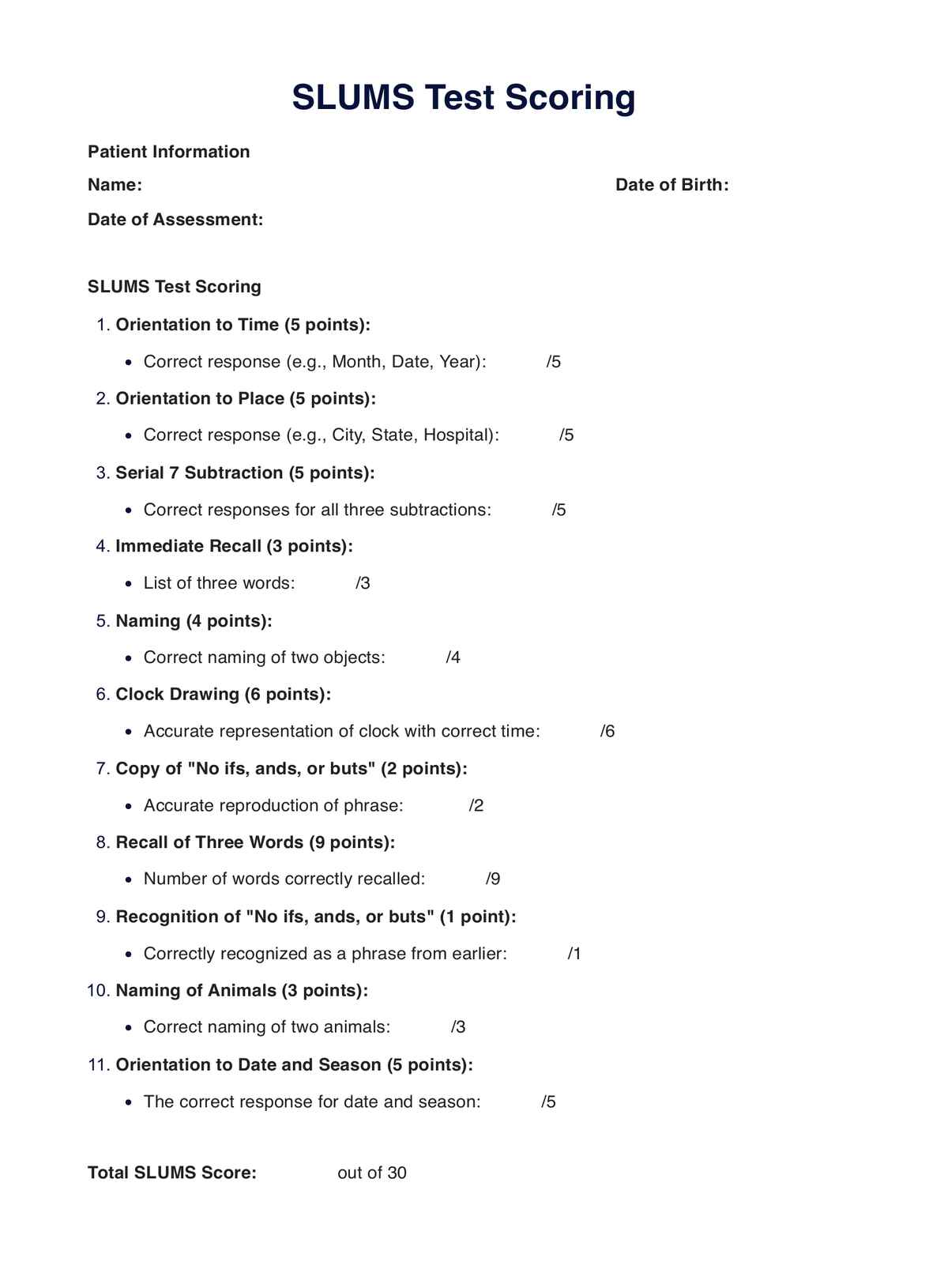



SLUMS Test Scoring
Discover the importance of precise SLUMS Test scoring for practical cognitive assessment and improve patient care today.

Use Template
SLUMS Test Scoring Template
Commonly asked questions
The SLUMS test scoring ranges from 0 to 30 points, with higher scores indicating better cognitive function. A score of 27-30 generally suggests normal cognition, 21-26 indicates mild cognitive impairment, and 20 or below suggests dementia. The test evaluates various cognitive domains,s including memory, attention, and executive function. However, a single score should not be the sole basis for a diagnosis; it indicates the need for further evaluation.
The SLUMS test is effective in detecting early signs of dementia and mild neurocognitive disorder (MCI). It assesses several cognitive domains, such as short-term memory, problem-solving skills, and spatial awareness, including tasks like drawing a clock face and recalling objects, tests of visual-spatial abilities, and memory recall, key areas affected in early dementia stages. However, for a definitive diagnosis, further testing and evaluation are necessary.










EHR and practice management software
Get started for free
*No credit card required
Free
$0/usd
Unlimited clients
Telehealth
1GB of storage
Client portal text
Automated billing and online payments