
The Hamilton Depression Rating Scale (HDRS or HAM-D) is a clinician-administered tool used to assess the severity of depressive symptoms in individuals already diagnosed with depression. It evaluates mood, guilt, insomnia, anxiety, and somatic symptoms. The total score helps guide treatment planning and monitor changes over time.
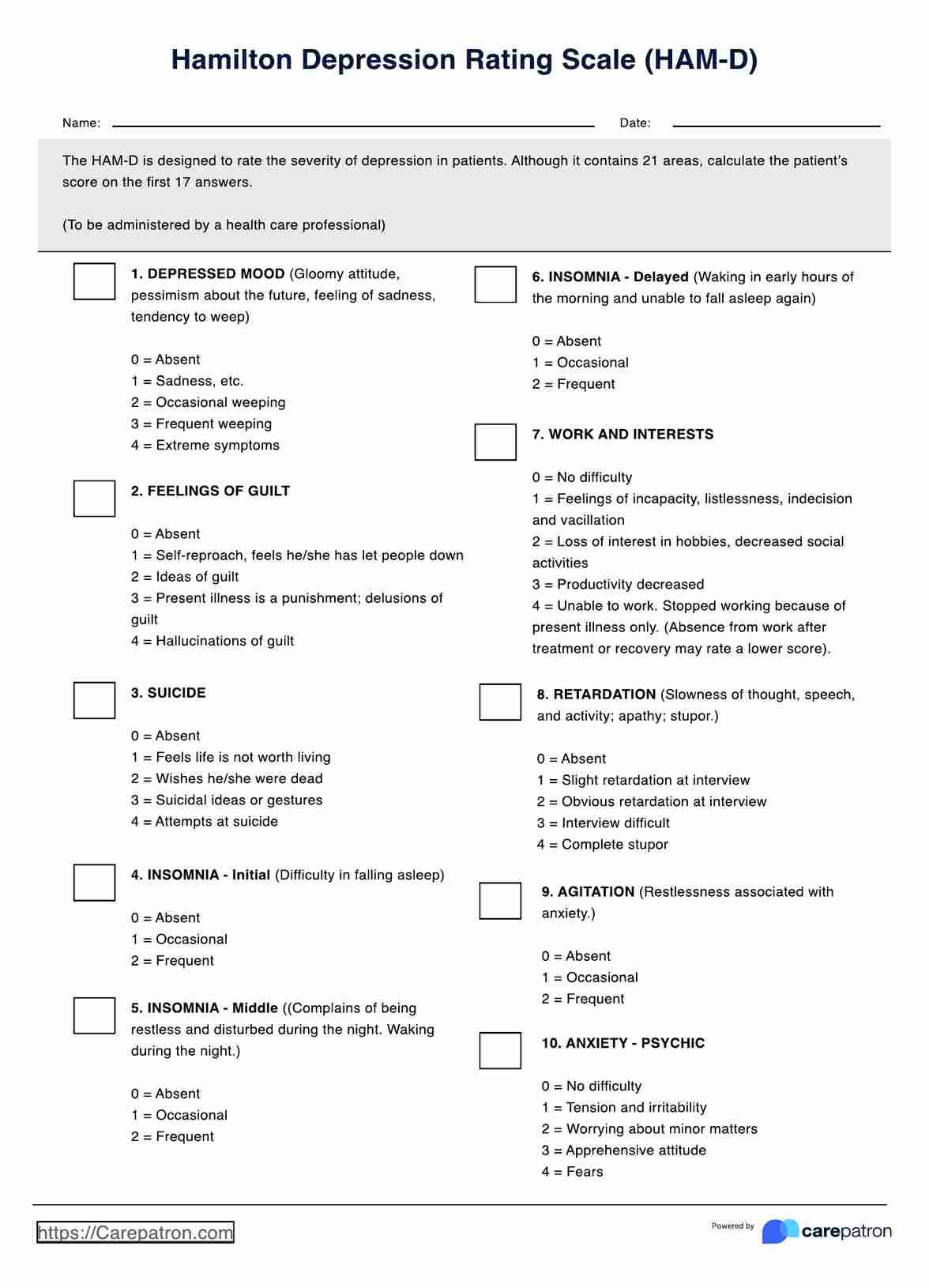



Hamilton Depression Scale
The Hamilton Depression Scale is a clinical tool that assesses the severity of depressive disorder. Download this PDF to better measure patients’ depression!

Use Template
Hamilton Depression Scale Template
Commonly asked questions
A trained clinician conducts a semi-structured interview using the 17-item or 21-item version of the scale. Each item is scored based on symptom severity, using either a 3- or 5-point scale depending on the question. The assessment usually takes 15–20 minutes and relies on both patient self-report and clinical observation.
The scale was developed by British psychiatrist Max Hamilton in 1960. He designed it to provide a standardized way for clinicians to measure depressive symptom severity and treatment response. Since then, it has become one of the most widely used depression rating tools in both research and clinical practice.
Interpretation of scores varies slightly by version, but generally a total score of 0–7 indicates no depression, 8–13 mild, 14–18 moderate, 19–22 severe, and 23 or higher very severe depression. Clinicians use these cut-offs to gauge symptom intensity and track improvement over time. The scale is not meant for diagnosing depression but for assessing its severity.










EHR and practice management software
Get started for free
*No credit card required
Free
$0/usd
Unlimited clients
Telehealth
1GB of storage
Client portal text
Automated billing and online payments