It is attributed to Anne Shumway-Cook and Marjorie Woollacott and is included in their 1995 book Motor Control Theory and Practical Applications.

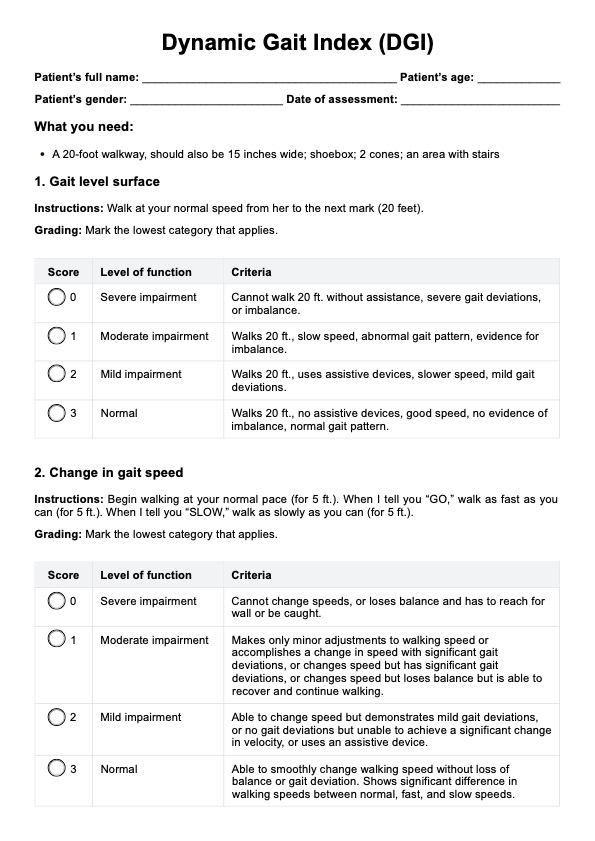



Use the Dynamic Gait Index (DGI) to determine the likelihood of falling in older adults. Check out our guide on how to use it and download our free template.

It is attributed to Anne Shumway-Cook and Marjorie Woollacott and is included in their 1995 book Motor Control Theory and Practical Applications.
On the Dynamic Gait Index template, you will see a corresponding function level per score. The level of function will tell you how capable or incapable the client is of achieving specific movements without assistance.
The interpretation of the total score is as simple as this: if the client obtains a score of 19 or less, they are at high risk of falling, and if they get a score greater than 22, it means they are ambulatory without risks.
The Dynamic Gait Index assesses the risk of falling in older adults through 8 types of gait tests involving tasks that require the client to do everyday movements such as walking, stopping, turning, etc. It also can measure a client’s stability and body control for movement.
EHR and practice management software
*No credit card required
Free
$0/usd
Unlimited clients
Telehealth
1GB of storage
Client portal text
Automated billing and online payments









