
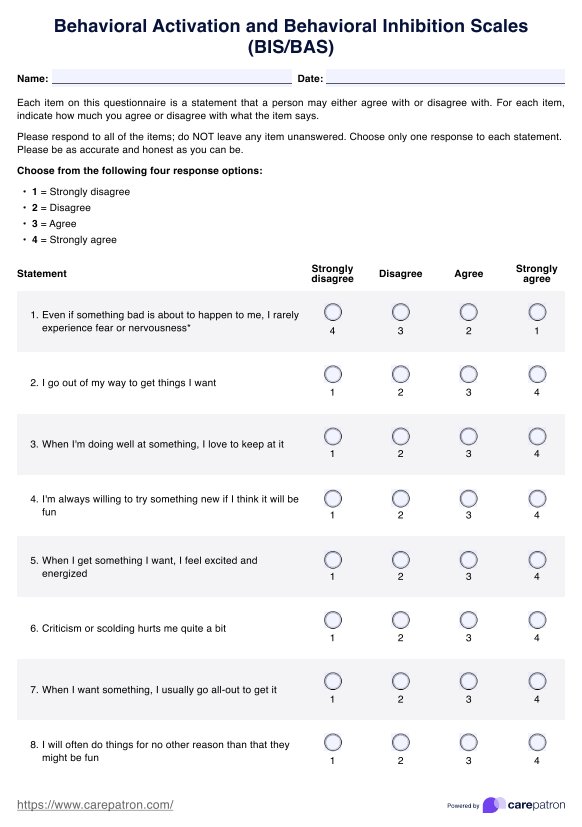
The behavioural inhibition system (BIS) and the behavioural activation system (BAS) are key components of Gray’s reinforcement sensitivity theory. The BIS regulates responses to signals of punishment, conflict, or uncertainty, encouraging avoidance behaviors to prevent adverse outcomes. In contrast, the BAS governs responses to rewards or incentives, driving goal-directed behavior and approach tendencies. These systems help explain individual differences in sensitivity to punishment and reward, shaping personality traits and emotional regulation.



BIS/BAS
Use our BIS/BAS assessment to understand reward sensitivity, affective responses, and personality traits. Download it now.

Use Template
BIS/BAS Template
Commonly asked questions
The BIS/BAS scales, developed by Carver and White (1994), are tools designed to measure behavioural inhibition and BAS sensitivity, as outlined in Gray’s theory. The BIS scale evaluates responses to the anticipation of punishment, reflecting behavioral inhibition and anxiety. The BAS scale includes three subscales: reward responsiveness, drive, and fun-seeking, which capture different aspects of reward sensitivity and approach-related behaviors. These scales are widely used to assess diverse populations' motivational tendencies and personality traits.
A high BAS scale score reflects heightened sensitivity to rewards and strong approach-oriented behaviors. People with high BAS sensitivity are more motivated to pursue goals, respond positively to potential rewards, and often act impulsively or spontaneously when seeking new opportunities. This can include a persistent drive to achieve, an intense emotional response to rewards, or a willingness to take risks in pursuit of positive outcomes.


EHR and practice management software
Get started for free
*No credit card required
Free
$0/usd
Unlimited clients
Telehealth
1GB of storage
Client portal text
Automated billing and online payments