In what states are mental health rates increasing the fastest?
Within their data collection, MHA has annually identified the prevalence of mental health rates according to state. Although a wide range of factors contribute to the development or onset of mental health disorders, it is interesting to note that geographical location can play a role.
Taking data from the MHA studies, six measures contribute to the Prevalence Ranking. These include:
- Adults with any Mental Illness
- Adults with Dependence or Abuse of Illicit Drugs or Alcohol
- Adults with Serious Thoughts of Suicide
- Youth with At Least One Past Year Major Depressive Episode
- Youth with Dependence or Abuse of Illicit Drugs or Alcohol
- Youth with Severe MDE
In an attempt to determine places in America that have experienced increasing mental health rates, we have selected the 2017 data and compared it to the data released in 2022 (which uses the same six measures). Some of the most notable findings include:
Connecticut
Connecticut moved from 1st place to 9th. Although Connecticut is still in the top 10 ranked states (meaning it has a lower prevalence of mental health disorders), it is nevertheless important to note that it has moved down 8 spots within 5 years.
Illinois
Illinois moved from 2nd place to 16th. Once again, considering there are 51 states, being 16th for the prevalence of mental health rates doesn’t seem too bad. Yet this is still a significant decrease over only 5 years.
North Dakota
North Dakota moved from 4th place to 33rd, indicating a fairly significant increase in the prevalence of mental health disorders within that state.
Iowa
Iowa moved from 12th place to 36th, which is also a notable increase in mental health prevalence.
If you are interested in diving more deeply into state-differentiated mental health rates, there is more information here.
Whilst the presented data doesn’t explicitly denote causation (meaning that the relevant state isn’t necessarily the cause of the increase in mental health disorders), geographical location is still a factor to be aware of.
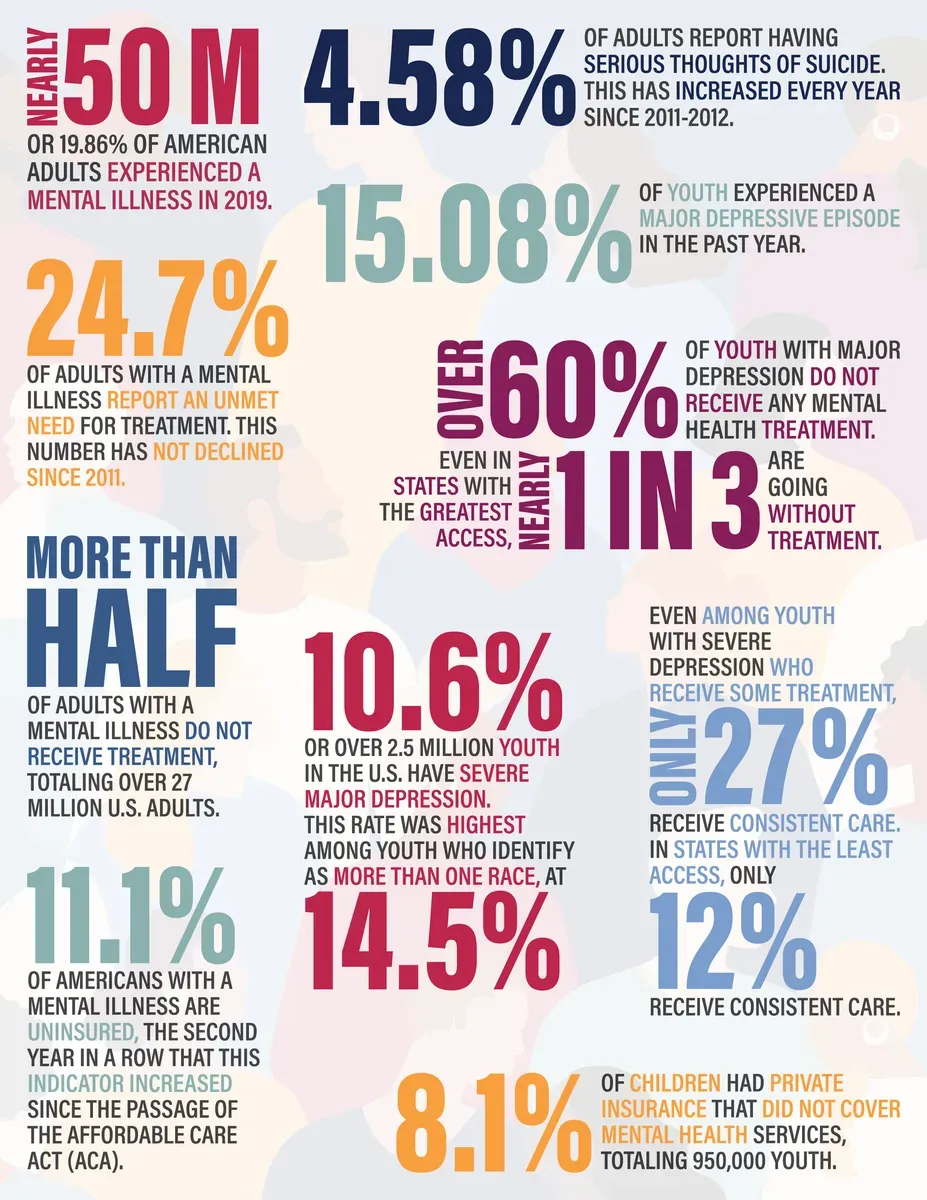
In the future, there is hope for implementing new qualitative studies that help explain why certain states are experiencing massive increases in mental health rates and whether or not the local healthcare industries are equipped to handle it. One of the best ways to determine whether or not a certain area (whether this is a state or something more local) can manage increased mental health rates is by identifying how accessible healthcare is. Whilst this article focuses on the relationality between geographical locality and prevalence, we thought it would be useful to highlight some of the relevant access-to-care data.