How To Use This Worksheet For Stroke Speech Therapy
If you’re thinking that Verb Network Strengthening sounds a little complicated, don’t worry, it is actually quite simple to start incorporating this activity into your client’s speech therapy. Just follow these simple steps below.
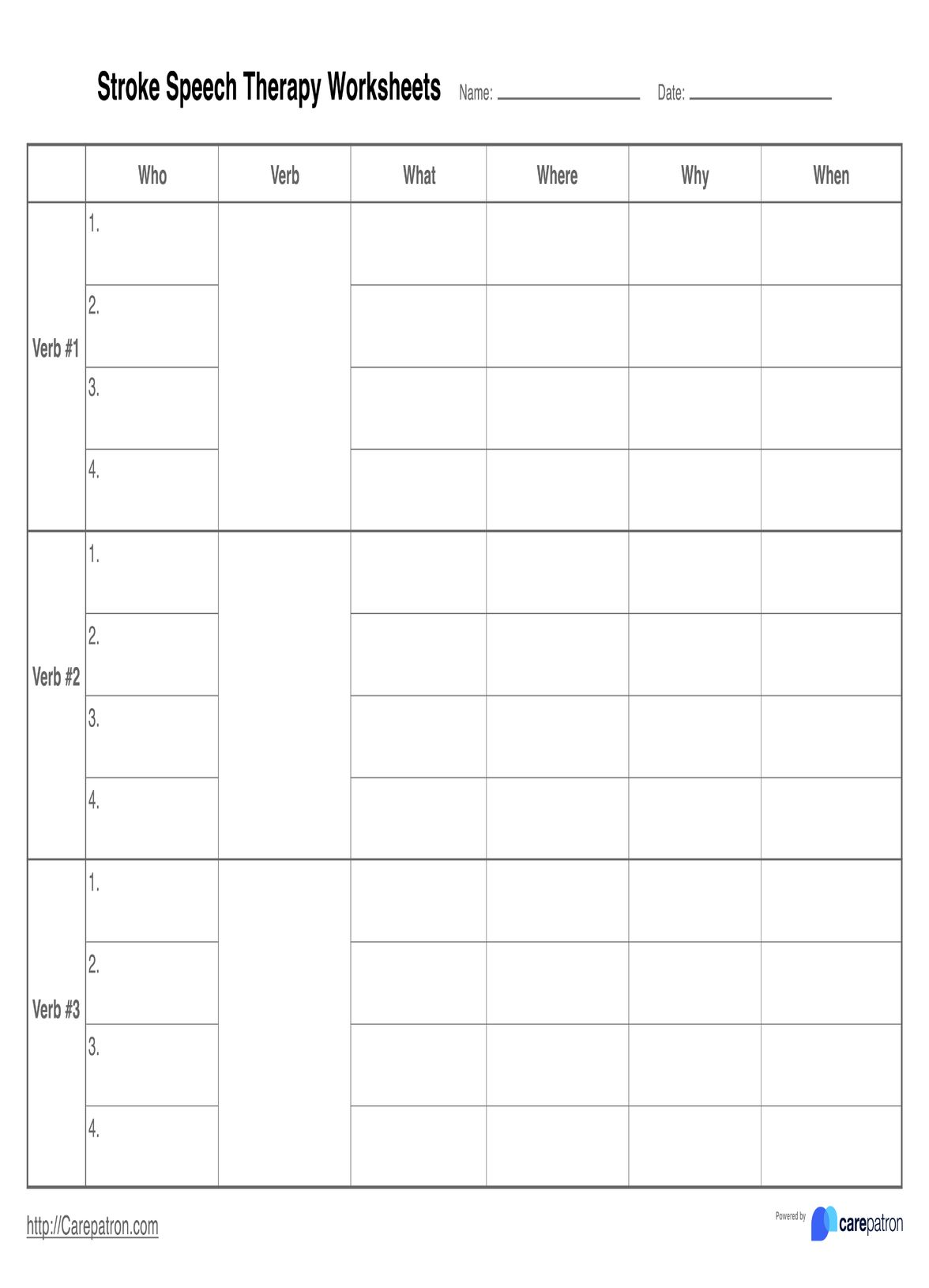
Before you start on the worksheet with your client, download the PDF Stroke Speech Therapy Worksheet template using the link on this page. You can then proceed to print it out for your client, or it can be completed digitally.
Choose a Verb
There are lots of options to choose from, but a good idea is to pick a verb that is relevant to your client’s daily life. The only specification here is that it should be a transitive verb, that is, a verb that can be used in the middle of a sentence. Examples of verbs that would not work are “arrive”, “run”, or “laugh”, as these cannot be used before an object word. Examples of transitive verbs that will work are “drive”, “eat”, or “like” as these can go in the middle of a sentence.
Write the Verb in the Main Box
Once you have chosen a verb for this worksheet, write it in the main box in the middle of the page.
Activity One: Make Three “Who and What” sentences using the verb
The first activity to work on with your client is making three sentences using the verb. To make these sentences, you and your client should find three people that might do the chosen activity, and three objects that this activity could be done to. For example, if you chose the verb “like”, a three-word triad might be “Puppy” “like” “treats”. It is not crucial to conjugate the verb at this stage, as the goal of this activity is to find words rather than create sentences with perfect grammar.
Activity Two: Make Three “When”, “Where”, and “Why” Sentences continuing on from each of the above “Who and What” sentences
The next stage of the worksheet is to move on to more complex sentences. For each three-word triad created in the first section, choose another three words to expand upon the triad, adding “When”, Where”, and “Why” information. From the example before, the more complex sentence might be: “Puppy” “like” “treats” “in his bowl” “every day” “to crunch”, again the grammar is not as important as the word-finding aspect of this activity!
Activity Three: Revise each of the Sentences
Depending on your client’s stage of recovery, you can proceed to go over each of the more complicated sentences, asking the Who, What, When, Where, and Why questions about each.
Remember, living with aphasia can be mentally exhausting and a gradual recovery process, so you should use your professional judgment on what parts of these activities your client is ready to attempt. Any of the activities can be modified to include drawings, flashcards, or other visual aids depending on your client’s needs.