
A positive Step Off Sign indicates the presence of spondylolisthesis, where there is palpable vertebral slippage along the spine. This sign is crucial for diagnosing the condition, particularly when a vertebra has moved enough to be felt through manual examination.
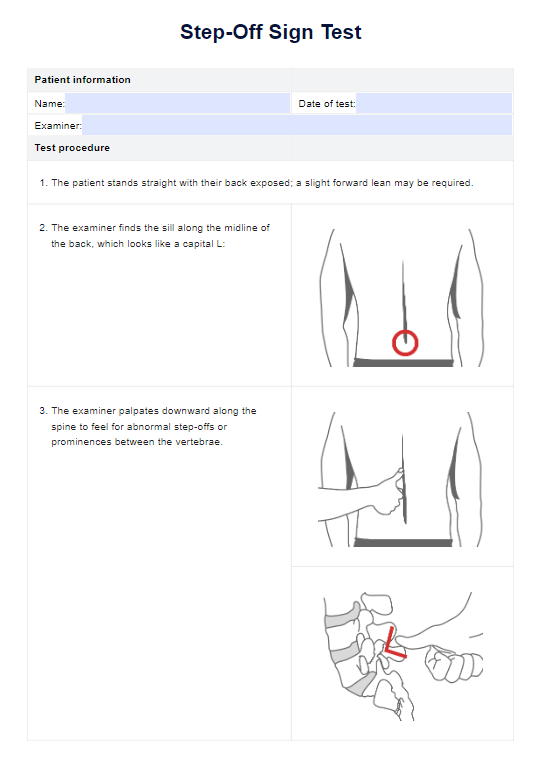



Step-Off Sign Test
Learn how the Step Off Sign Test is crucial for diagnosing lumbar spondylolisthesis. Access our free PDF to understand test procedures, interpretation, and more.

Use Template
Step-Off Sign Test Template
Commonly asked questions
The treating healthcare provider should determine the frequency of the Step Off Sign Test based on the patient’s symptoms and the stability of their condition. It might be conducted periodically to monitor any progression of the slippage or in response to changes in symptoms.
The Step Off Sign Test alone cannot differentiate between the types of spondylolisthesis, such as congenital, isthmic, or degenerative. It is primarily used to detect the presence of slippage. Further diagnostic tools and imaging studies are required to determine spondylolisthesis's specific type and cause and to accurately measure the grade of slippage.










EHR and practice management software
Get started for free
*No credit card required
Free
$0/usd
Unlimited clients
Telehealth
1GB of storage
Client portal text
Automated billing and online payments