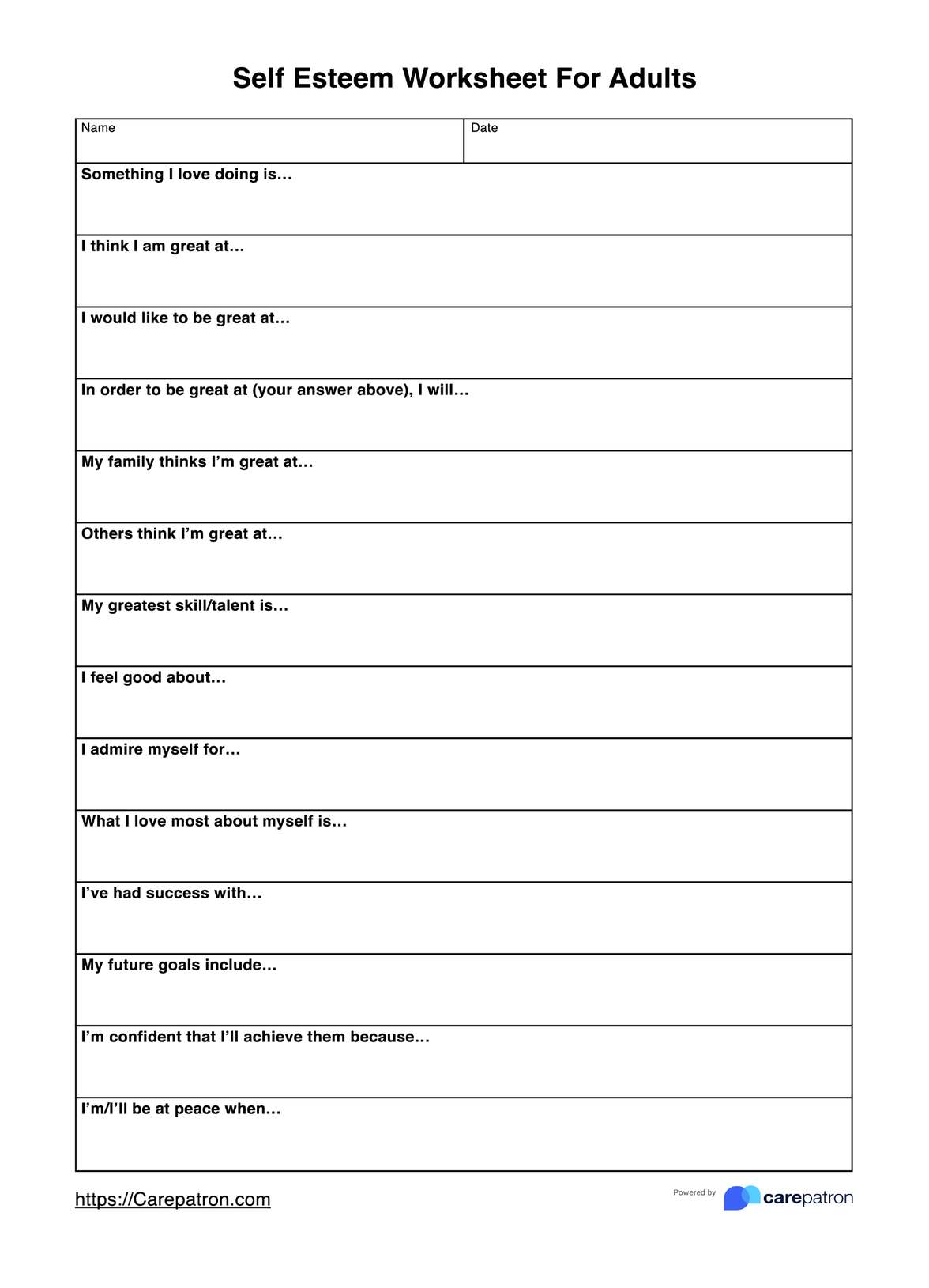
As a mental health professional, you know low self-esteem can hit adults hard. In this guide, learn how it affects daily life and help clients build confidence with Carepatron’s free Self-Esteem Worksheet for Adults.
## **The impact of low self-esteem in adults**
Low or absent self-esteem can profoundly affect adult functioning, influencing emotions, interpersonal relationships, and physical health. When self-esteem is low, negative thoughts and self-doubt often dominate, giving rise to biased expectations and harsh self-evaluations that reinforce feelings of unworthiness. Adults in this state may struggle to accept praise, interpret neutral or constructive feedback as criticism, or avoid challenges out of fear of failure or rejection.
Empirical research supports these dynamics. For instance, in experimental tasks, participants with low self-esteem consistently underestimated their own performance—even when objective measures showed no difference from those of high-self-esteem peers, highlighting a disconnect between actual ability and subjective evaluation (Rouault et al., 2022). In other words, negative self-evaluations persist even in the face of evidence to the contrary. Over time, this pattern of distorted beliefs undermines both personal and professional growth. Persistent self-criticism and uncertainty make boundary-setting and confident decision-making more difficult, often contributing to relationship strain, burnout, or codependent dynamics.
Physiologically and behaviorally, prolonged low self-esteem may exact a toll: chronic stress can lead to fatigue, disrupted sleep, diminished motivation for healthful habits, and neglect of self-care or medical needs. Moreover, longitudinal and meta-analytic evidence indicate that CBT-based clinical interventions yield significant improvements in self-report self-esteem scores among adults, including reductions in depressive and anxious symptoms, even months after the intervention (Kolubinski et al., 2018). Some clinical trials combining [cognitive behavioral therapy](https://www.carepatron.com/guides/cbt-techniques) (CBT) with other modalities (e.g., EMDR) also demonstrate sustained gains in self-esteem among the treatment population (Griffioen et al., 2017).
By guiding individuals to engage in structured self-reflection, identify distorted beliefs, and cultivate balanced core beliefs, approaches like CBT foster more accurate self-perceptions, adaptive coping, and emotional resilience. In doing so, they offer a pathway beyond uncertainty toward a more grounded and affirming self-concept.
## **What is a Self-Esteem Worksheet for Adults**
Self-esteem worksheets are used by psychologists, counselors, therapists, and life coaches to help clients understand and enhance their self-perception. In therapy, these worksheets provide a structured approach for exploring self-critical thoughts and identifying healthier perspectives, particularly in techniques such as cognitive behavioral therapy or acceptance and commitment therapy. Outside of clinical settings, educators, social workers, and wellness coaches also use them in workshops or coaching programs to promote self-awareness and confidence.
The guided prompts in Self-Esteem Worksheets for Adults mfacilitate reflection, helping users recognize negative thinking patterns, clarify their stengths, and notice progress over time. They offer an approachable entry point for adults who want to improve their confidence or emotional resilience without icommitting to therapy immediately
The benefits include improved [emotional regulation](https://www.carepatron.com/guides/emotional-regulation-skills/), enhanced self-awareness, and increased confidence in relationships and decision-making. Still, self-esteem worksheets have limits; they can encourage reflection, but don’t replace professional support, especially for people dealing with chronic low self-esteem, depression, or trauma. When paired with guidance or regular reflection, though, they can help adults build a more balanced and compassionate view of themselves.
## **How to use our free worksheet**
Carepatron’s free Self-Esteem Worksheet helps you encourage clients to reflect on their positive qualities, strengthen self-awareness, and gradually boost self-esteem through goal setting and self-affirmation. The worksheet is structured around simple yet meaningful prompts that invite reflection on strengths, abilities, and aspirations, helping clients understand how low self-esteem affects their thoughts and behaviors, and how they can start to rebuild confidence.
### **Step 1: Download the template**
Download the Self-Esteem Worksheet for Adults by clicking the "Use template" button. You can print it or fill it out digitally during or between sessions. Encourage clients to complete it at their own pace and with honesty.
### **Step 2: Complete the reflection prompts**
Guide your client through the worksheet’s prompts. These encourage self-discovery, recognition of personal strengths, and practice of positive affirmations. Discuss how these reflections reveal existing abilities, reinforce positive beliefs, and help clients overcome uncertainty. Conclude with goal-oriented prompts to connect insight with action and support long-term confidence-building.
### **Step 3: Reflect and discuss**
After completing the worksheet, review your client’s responses together. Identify patterns—such as recurring self-doubt or consistent strengths—and discuss how to build on these insights in therapy. Encourage clients to revisit the worksheet regularly to track their progress, strengthen balanced core beliefs, and maintain a confident and compassionate mindset.
## **Common strategies to help adults develop good self-esteem**
Supporting adults in developing healthy self-esteem requires a clinically informed approach that integrates psychological insight, behavioral reinforcement, and structured self-reflection.
### **Identify and restructure maladaptive cognitions**
Low self-esteem is often reinforced by automatic negative thoughts, biased expectations, and cognitive distortions that shape how individuals evaluate themselves. Encouraging clients to identify and verbalize these patterns through guided self-reflection can help expose underlying negative beliefs about competence, worth, or acceptance. Clinicians can then use cognitive restructuring techniques to help clients develop balanced core beliefs that promote a more realistic and compassionate self-concept.
### **Reinforce self-compassion and adaptive self-talk**
Practicing self-compassion is an empirically supported way to counteract the effects of chronic self-criticism and self-doubt (Bluth & Blanton, 2014). Interventions may include [journaling prompts](https://www.carepatron.com/templates/self-exploration-journal-prompts/), structured self-esteem exercises, or affirmations designed to replace punitive internal dialogue with more balanced, supportive self-talk. Consistent reinforcement of positive attributes and achievements helps stabilize mood and fosters a more enduring sense of self-worth.
### **Encourage mastery experiences and behavioral activation**
Behavioral strategies that emphasize goal-directed action can strengthen self-efficacy and self-confidence, encouraging clients to engage in mastery-oriented tasks such as developing new skills, practicing assertive communication, or participating in valued social roles. These experiences provide opportunities for corrective emotional growth.
Positive reinforcement through tangible success helps recalibrate self-perception and diminish the influence of negative thoughts and self-evaluations. Research has shown a significant correlation between consistent positive reinforcers, such as verbal praise, acknowledgment of effort, or achievement-based rewards, and higher levels of self-esteem (Encorporado et al., 2023; Niveau et al., 2021). These reinforcers activate motivational systems that strengthen adaptive self-beliefs, encouraging individuals to interpret their experiences more positively and with greater confidence.
### **Promote relational and environmental supports**
The social environment plays a critical role in shaping and maintaining self-esteem. Facilitating the development of healthy interpersonal boundaries and promoting engagement with positive people can help reduce exposure to invalidating or critical influences. In group therapy or psychoeducational contexts, clinicians can emphasize the importance of social feedback and mutual validation as mechanisms for strengthening self-worth.
### **Integrate self-care and affect regulation practices**
Encouraging clients to engage in structured self-care practices, such as regular exercise, mindfulness, adequate rest, and relaxation training, can improve emotional regulation and overall well-being. These behaviors not only enhance mood stability but also reinforce positive behaviors associated with high self-esteem and resilience.
## **References**
Bluth, K., & Blanton, P. W. (2014). The influence of self-compassion on emotional well-being among early and older adolescent males and females. The Journal of Positive Psychology, 10(3), 219–230. https://doi.org/10.1080/17439760.2014.936967
Encorporado, M. V., Razonable, S. Y., Ababon, J. B., Pasilang, B., Regulacion, M. P., & Sasan, R. A. A. (2023). Correlation Between Reinforcers and Level of Self-Esteem. Journal of Learning and Development Studies, 3(3), 34–51. https://doi.org/10.32996/jlds.2023.3.3.3
Griffioen, B. T., van der Vegt, A. A., de Groot, I. W., & de Jongh, A. (2017). The effect of EMDR and CBT on low self-esteem in a general psychiatric population: A randomized controlled trial. Frontiers in Psychology, 8. https://doi.org/10.3389/fpsyg.2017.01910
Kolubinski, D. C., Frings, D., Nikčević, A. V., Lawrence, J. A., & Spada, M. M. (2018). A systematic review and meta-analysis of CBT interventions based on the Fennell model of low self-esteem. Psychiatry Research, 267, 296–305. https://doi.org/10.1016/j.psychres.2018.06.025
Niveau, N., New, B., & Beaudoin, M. (2021). Self-esteem interventions in adults – A systematic review and meta-analysis. Journal of Research in Personality, 94(1). https://doi.org/10.1016/j.jrp.2021.104131
Rouault, M., Will, G.-J., Fleming, S. M., & Dolan, R. J. (2022). Low self-esteem and the formation of global self-performance estimates in emerging adulthood. Translational Psychiatry, 12(1). https://doi.org/10.1038/s41398-022-02031-8