




What is the Physical Function ICU Test (PFIT)?
The Physical Function ICU Test (PFIT) is a specialized assessment tool designed for critically ill patients in the surgical intensive care unit (ICU) (Nordon-Craft et al., 2014). It evaluates physical function outcomes in individuals unable to perform standard exercise assessments, such as the Six-Minute Walk Test (6MWT). The PFIT is particularly useful for patients with acute respiratory failure or ICU-acquired weakness, requiring a tailored approach to assess functional status and recovery potential.
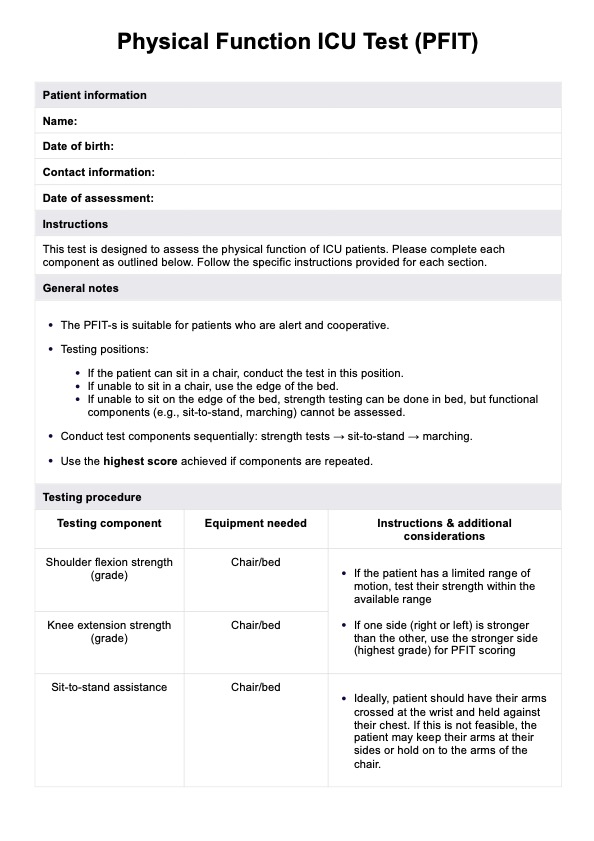
The PFIT consisted of five components: sit-to-stand assistance, shoulder flexion strength, knee extension strength, marching in place, and an upper extremity (UE) endurance task involving arm elevation. However, following a principal component analysis, the test was refined by removing the UE endurance task (Denehy et al., 2013). This modification led to the development of the PFIT-s, a scored version of the test comprising four items.
The PFIT-s provides an ordinal score ranging from 0 to 10, with scores based on the patient’s ability to complete specific tasks. Adjustments are made for patients unable to perform specific components due to illness severity, making it a practical and targeted tool for monitoring physical function in critically ill individuals.
The function ICU test-scored version includes strength assessments for shoulder flexion and knee extension, which provide critical insights into a patient’s muscle functionality. Another component is the evaluation of sit-to-stand assistance, which measures the level of support needed for the patient to transition to a standing position safely. Additionally, marching in place is assessed to objectively measure the patient’s endurance and cardiovascular response during activity.
This safe and inexpensive test has demonstrated utility in predicting hospital discharge outcomes, offering valuable data for clinicians to plan interventions (Denehy et al., 2013). Factors such as chronic health evaluation, ICU length of stay, and comorbidities like sepsis or mechanical ventilation (MV) influence its application, helping to stratify patients into distinct recovery trajectories.









