
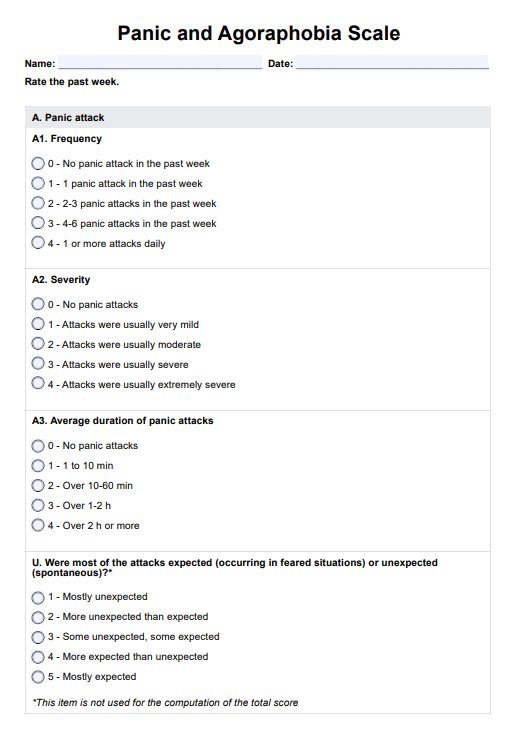




What is the Panic and Agoraphobia Scale?
The Panic and Agoraphobia Scale (P&A) is an essential tool for assessing panic disorder and agoraphobia (PDA). It measures the severity of these disorders following a diagnosis based on the Diagnostic and Statistical Manual of Mental Disorders (DSM) or the ICD-10.
Developed specifically for use in clinical trials in 1995 by Borwin Bandelow, this scale features 13 items assessed on a 5-point scale ranging from 0 to 4.
The scale has five subscales:
- A: Panic attacks
- B: Phobia avoidance
- C: Anticipatory anxiety
- D: Disability
- E: Worries about health
An additional item (U) is included to assess whether the attacks were anticipated or unforeseen. However, this item is not utilized in calculating the total score.
The inter-rater reliability, which serves as a measure of objectivity, was found to be 0.78 (p<0.005). Additionally, it has a Cronbach's alpha coefficient of 0.88 for self-rating (Bandelow, 1995).









