




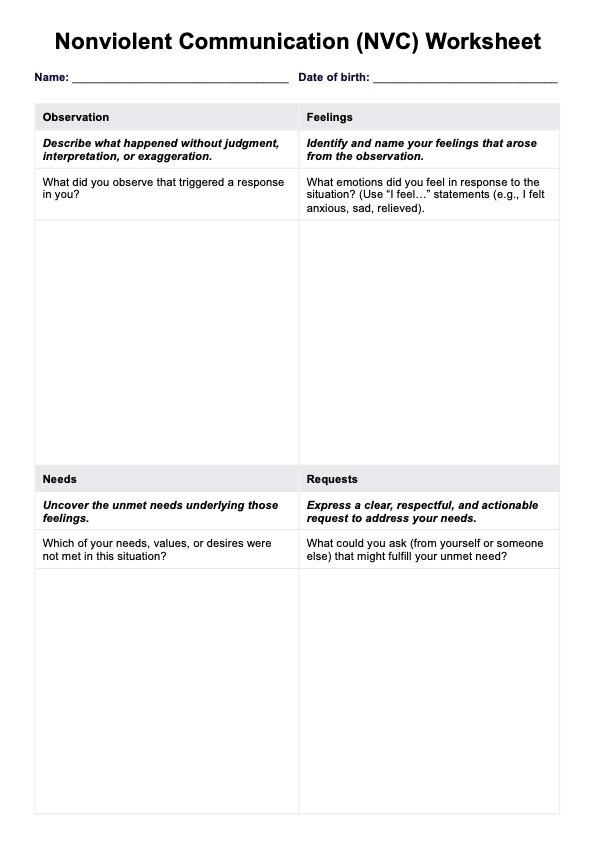




The importance of nonviolent communication
Nonviolent communication (NVC) is an evidence-based framework designed to enhance clarity, empathy, and effectiveness in interactions between human beings (Adriani et. al., 2024). For healthcare professionals, it offers practical exercises to build stronger relationships through understanding and active listening. Breaking down communication into four components—observation, feelings, needs, and requests—helps professionals recognize the other person’s feelings in such a way that fosters trust and collaboration.
This approach is extremely helpful in real-life situations, especially where tension or miscommunication is present. It emphasizes taking responsibility for one’s own emotions while receiving empathically, which supports conflict resolution and improves patient-provider dynamics. Role play and reflection are often used in training to reinforce these principles.
Nonviolent communication promotes a sense of respect and helps manage challenging interactions without blame or escalation. In clinical practice, it not only encourages personal growth among practitioners but also ensures that the person’s feelings are acknowledged and validated appropriately.









