Everyone has a story to tell, and here we share and celebrate those who chose care as their life's work.
These are their words, their work and we're grateful to share them.
Elizabeth and Dennis handed their billing to Carepatron and grew My Therapeutic Concepts from five clients to seventy in two months, without losing their evenings.
## **What is neuro cognitive testing?**
Neuro cognitive testing, also known as neuropsychological testing, is a comprehensive evaluation that assesses various aspects of cognitive function, making it a valuable tool for understanding brain health and functioning (Yale Medicine, n.d.). These tests, such as the Montreal Cognitive Assessment (MoCA), the Mini Mental State Exam (MMSE), and other cognitive assessments, are designed to measure cognitive functioning, including memory, attention, language, and problem-solving abilities (Wang et. al., 2022). Neuro cognitive testing plays a crucial role in the early detection and identification of cognitive impairments, including mild cognitive impairment, and can contribute to the diagnosis and follow-up of conditions such as Alzheimer's disease.
The tests involve small tasks, such as copying shapes, memory recall, and simple tests that evaluate cognitive abilities. For older adults, these assessments help identify potential cognitive decline and determine the need for further testing or medical evaluation. Neuro cognitive testing is not limited to specific age groups and can be used across the lifespan to assess cognitive function and risks associated with cognitive problems, including those stemming from traumatic brain injury or concussion. Clinicians and doctors use these assessments to measure cognitive abilities, identify symptoms, and make informed decisions about treatment and intervention strategies.
One of the important aspects of neuro cognitive testing is its ability to evaluate cognitive function at different time points, allowing for tracking changes over time and making it a valuable tool for ongoing research in the field. Additionally, neuro cognitive testing is crucial in concussion and traumatic brain injury management, helping doctors and clinicians assess cognitive function and guide treatment decisions.
These tests are essential for understanding cognitive function, determining cognitive risks, and providing valuable information for medical and research purposes, such as neuropsychological evaluation and baseline neurocognitive assessment.
## **Reasons for cognitive testing**
Neuro cognitive testing is a pivotal tool in evaluating various aspects of cognitive function, making it essential for many reasons. One of its primary roles is in the early detection and identification of cognitive impairments, including mild cognitive impairment, by assessing critical domains such as memory, attention, language, and problem-solving abilities. This comprehensive evaluation involves tasks such as copying shapes and memory recall, providing insights into cognitive skills crucial for understanding cognitive decline and making informed decisions about diagnosis and treatment.
Neuro cognitive testing is vital for individuals of all ages in determining cognitive functioning and potential risks associated with cognitive problems. Clinicians and doctors utilize these assessments to measure cognitive function, identify symptoms, and make informed decisions regarding patient care. The tests also help track changes over time, allowing for continuous monitoring and contributing valuable data for ongoing research in the field, such as tracking changes in short-term memory, mental functioning, or reaction time.
In addition to its diagnostic applications, neuro cognitive testing is instrumental in concussion and traumatic brain injury management, providing a means for doctors and clinicians to assess cognitive function and guide treatment decisions. Furthermore, these tests are adaptable across different populations, helping clinicians evaluate cognitive function in older adults and individuals at risk of cognitive decline, whether due to normal changes in aging or specific neurological concerns.
## **How to use this Neuro Cognitive Test template**
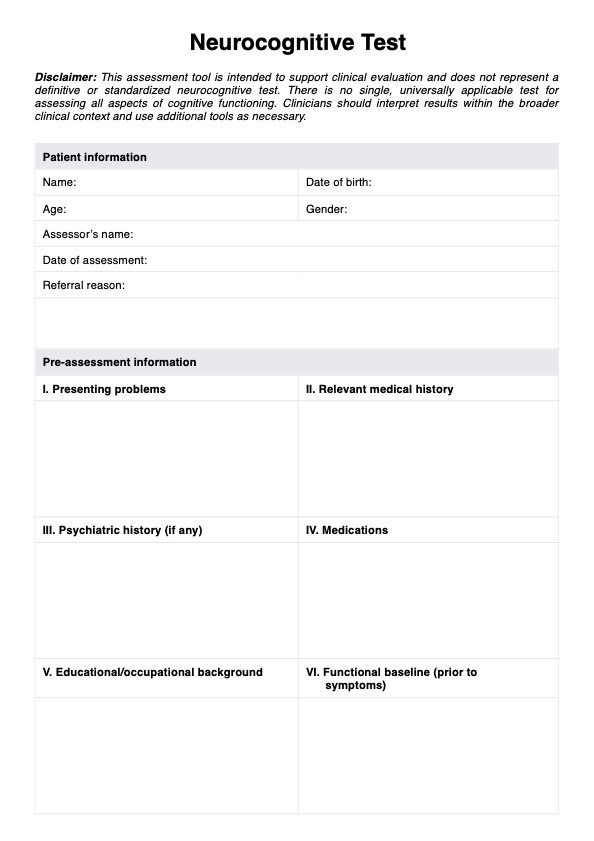
Carepatron’s Neuro Cognitive Test template simplifies cognitive assessment by guiding clinicians through a structured, domain-based process. From initial access to interpretation and next steps, each stage ensures accurate, efficient evaluations that support better clinical outcomes. Here’s how to integrate it seamlessly into your workflow.
### **Step 1: Access the template**
Click the “Use template” button on this page to launch Carepatron’s Neuro Cognitive Test within the app. You’ll be prompted to download Carepatron if it’s not yet installed. This streamlined access ensures you can begin your patient assessments without delay.
### **Step 2: Use the template during patient assessment**
Open the template during your consultation to document key history, cognitive domains, and behavioral observations in real time. The intuitive layout helps ensure you don’t miss any critical areas while aligning with clinical best practices and documentation standards, including tracking cognitive functions like processing speed, problem-solving, and motor skills.
### **Step 3: Conduct the assessment**
Use the template to administer and score standardized neurocognitive tasks across attention, memory, executive function, and other domains. The structure helps maintain consistency in how tests are delivered, reducing variability and supporting more reliable interpretations of mental functioning.
### **Step 4: Gather and interpret findings**
Review observations, score summaries, and patient responses to identify strengths, weaknesses, and possible cognitive impairments. The template includes interpretation prompts and space for clinical impressions, making it easier to align your findings with evidence-based diagnostic criteria.
### **Step 5: Provide patient support and next steps**
Based on your assessment, use the recommendations section to outline referrals, follow-up plans, or therapeutic interventions as needed. Whether suggesting neurology consults or educational accommodations, the template helps ensure each patient receives informed, actionable next steps tailored to their needs, including support for memory loss, poor attention, or making decisions.
## **Neuro Cognitive Test scoring**
Interpreting neurocognitive test scores involves more than simply labeling them as “good” or “bad.” Scores must be evaluated in context—factors like age, education, cultural background, and test version significantly influence interpretation. Rather than relying solely on total scores, clinicians should examine individual domain scores (e.g., memory, language, attention) to identify specific cognitive strengths and weaknesses.
Cutoff scores can suggest potential impairment but are not definitive; false positives and negatives are possible, and diagnosis requires comprehensive evaluation. A “good” score typically aligns with normative expectations for a person’s background and reflects consistency over time, indicating stable function.
However, even scores below expected thresholds are not inherently negative—they serve as markers for further assessment. Low scores should prompt an investigation into possible medical, psychological, or environmental causes. Ultimately, neurocognitive test scoring is a tool for guiding care, not a fixed judgment. Effective interpretation leads to tailored support strategies and improved cognitive outcomes.
## **Interpreting the results of this assessment**
Interpreting the results of the Neuro Cognitive Test is a crucial step in understanding an individual's cognitive functioning comprehensively. The assessment covers various cognitive domains, including memory, attention, language, and executive function. Each section provides valuable insights into different aspects of cognitive health.
- **Memory**: This section assesses an individual's ability to recall immediate and delayed information. A higher score or observation of normal expectations indicates adequate memory retention.
- **Attention**: Measuring the ability to focus and maintain concentration, this section evaluates the individual's attentional capacity. A higher score suggests better attentional control.
- **Language**: The language domain evaluates language comprehension and expression. It includes tasks such as naming objects, following instructions, and repeating sentences.
- **Executive function**: This crucial domain assesses higher-order cognitive abilities involved in planning, problem-solving, and decision-making. A higher score indicates stronger executive functioning.
## **References**
Wang, G., Estrella, A., Hakim, O., Milazzo, P., Patel, S., Pintagro, C., Li, D., Zhao, R., Vance, D. E., & Li, W. (2022). Mini-Mental State Examination and Montreal Cognitive Assessment as tools for following cognitive changes in Alzheimer’s Disease Neuroimaging Initiative participants. Journal of Alzheimer’s Disease, 90(1), 263–270. https://doi.org/10.3233/jad-220397
Yale Medicine. (n.d.). Neurocognitive testing. https://www.yalemedicine.org/clinical-keywords/neurocognitive-testing
Commonly asked questions
Cognitive tests often include memory recall exercises, word fluency challenges, visuospatial puzzles, attention checks, and language-based tasks. These are designed to assess various brain functions such as reasoning, processing speed, and executive control.
No, cognitive tests alone do not diagnose dementia. They serve as screening tools to identify possible cognitive impairment that may require comprehensive evaluation.
Cognitive screening can be integrated into routine checkups to flag early signs of cognitive decline. This enables healthcare providers to recommend timely interventions and further assessments when necessary.